The short version
- Manager Michael Carrick rejects suggestions that Manchester United have an advantageous start, emphasizing the difficulty of facing two newly promoted teams.
- The club is still negotiating for a midfielder while addressing concerns about squad depth at left-back, continuing a recent pattern of late-window activity.
- Historical data shows United rarely wins their first two games against promoted sides, suggesting early results may not reflect long-term season trajectory.
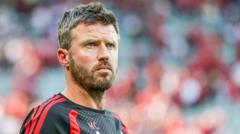
Michael Carrick has moved to recalibrate expectations for Manchester United’s opening phase of the campaign, directly challenging narratives that suggest the club has been handed a gentle introduction to the Premier League season. The manager characterized the notion of a favorable start as ridiculous, pointing instead to the inherent difficulties of competing against Hull City and Ipswich Town, both of whom earned promotion through rigorous playoff campaigns. Carrick emphasized that his focus remains strictly on the immediate challenge, refusing to look beyond the upcoming fixtures despite the perception among some observers that these opponents pose less resistance than established top-tier rivals.
The managerial stance comes as fanbase agitation grows regarding the pace of recruitment. Since the completion of Youri Tielemans’ transfer from Aston Villa in mid-July, no further permanent additions have been finalized. Negotiations are reportedly ongoing with Brighton concerning Cameroon international Carlos Baleba, but a definitive agreement has not yet been reached. Carrick acknowledged the desire to strengthen the roster, confirming that work is actively underway to address squad needs. This transparency aims to temper frustration among supporters who had hoped for earlier consolidation of the playing group.
A specific point of concern involves the defensive lineup, particularly at left-back. The club’s reliance on Luke Shaw as the sole orthodox option in that position raises significant fitness risks. Given Shaw’s injury history and the physical demands of a full season, depending on him to maintain availability throughout the campaign is viewed by many analysts as a substantial gamble. The lack of a secure backup or alternative solution remains a focal point for those monitoring the team’s structural vulnerabilities ahead of the competitive schedule.
Historical context suggests that United supporters might benefit from adjusting their expectations regarding early-season performance. In the Premier League era, Manchester United has faced newly promoted sides in their opening two fixtures on only two previous occasions. On neither of those instances did the club secure back-to-back victories. In August 2001, the team came from behind to defeat Fulham but settled for a draw against Blackburn Rovers. Similarly, in 2009, despite having reached the Champions League final just months prior, United managed only a single goal against Birmingham City before suffering a defeat to Burnley.
More recent history reinforces the unpredictability of early campaigns. The last time United began with consecutive wins was during the 2017-18 season under Jose Mourinho, with dominant performances against West Ham and Swansea. In contrast, the previous campaign under Ruben Amorim saw a home loss to Arsenal and a draw at Fulham. The 2022-23 season marked a low point, with heavy defeats to Brighton and Brentford triggering a frantic transfer scramble that resulted in significant spending on Casemiro and Antony.
The timing of these transfers highlights a persistent operational pattern at the club. For the past six seasons, Manchester United has consistently brought in senior first-team players as the transfer window nears closure. Last year, the decision to appoint Senne Lammens as the new number one goalkeeper was finalized on deadline day, replacing earlier interest in Emi Martinez. In 2024, Manuel Ugarte arrived from Paris Saint-Germain at the eleventh hour, while 2023 saw the loan acquisitions of Sergio Reguilon and Sofyan Amrabat.
Earlier deadline-day moves have yielded mixed results, further complicating the narrative around late recruitment. The return of Cristiano Ronaldo in 2021 was intended to propel the club back to the summit but ultimately failed to deliver sustained success. Edinson Cavani’s arrival in 2020, delayed by pandemic-related schedule changes, also occurred at the window’s close. While these examples do not necessarily indicate that late signings are inherently flawed, they underscore a recurring theme of last-minute activity that contrasts with fan preferences for early stability.
With the transfer window set to close on September 1, judgment on the season’s trajectory should remain reserved until after the initial fixtures and final recruitment moves. Aspirations for the campaign vary widely among stakeholders. Some view a repeat of last season’s third-place finish as a significant achievement, particularly given the expanded fixture list that could increase total games by fifty percent compared to the previous year. Others argue that consistent Champions League qualification is the minimum acceptable standard for a club of this stature.
Despite thirteen seasons without a title challenge, expectations remain high for meaningful progress. The gap between current performance levels and historical benchmarks continues to drive debate about the club’s direction. Whether the focus is on securing European football or rebuilding toward contention, the coming weeks will provide critical data points. Carrick’s insistence on treating each match as a distinct challenge reflects a pragmatic approach to navigating both immediate sporting pressures and the lingering uncertainties of the transfer market.
As the season approaches, the interplay between squad composition and early results will define the narrative. The historical tendency toward late-window activity suggests that final roster decisions may still be pending. Until those pieces fall into place and the team establishes a rhythm against promoted opposition, any assessment of Manchester United’s prospects remains provisional. The club’s ability to manage these transitional pressures will likely determine whether this season represents a step forward or another cycle of adjustment.
Sources behind this briefing
Go to the original reporting
- BBC Sport↗Why first 10 days of new season could tell us a lot about Man Utd
