The short version
- President Emmanuel Macron has promised legal consequences for those involved in looting and violence during nationwide demonstrations against rising living costs.
- At least 1,800 arrests have been made following days of unrest that included fires at public buildings and clashes with police in major cities.
- Political opponents from both the far-right and far-left are criticizing the government’s handling of the crisis as the country approaches presidential elections.
French President Emmanuel Macron addressed the nation on Sunday, expressing deep anger and shame over the widespread rioting and looting that erupted during protests against rising living costs and deteriorating school conditions. In a televised speech, he vowed to hold accountable those who attempted to undermine the Republic, stating clearly that individuals responsible for looting would be required to compensate for damages. Macron attributed the unrest to unrestrained violence driven by insurrectionist elements from radical far-left groups, alongside numerous criminals seeking to exploit the situation.
The scale of the disruption was significant, with authorities reporting approximately 550,000 participants across France, while protest organizers claimed the number reached 800,000. The demonstrations were coordinated by labor unions, student organizations, and activists aiming to revive the momentum of the yellow vest movement that began in 2018. While the right to protest remains a fundamental principle, Interior Minister Laurent Nuñez emphasized on social media that deliberately sowing disorder through violence is not protected, citing the destruction of hundreds of businesses in cities including Paris, Marseille, Lyon, and Bordeaux.
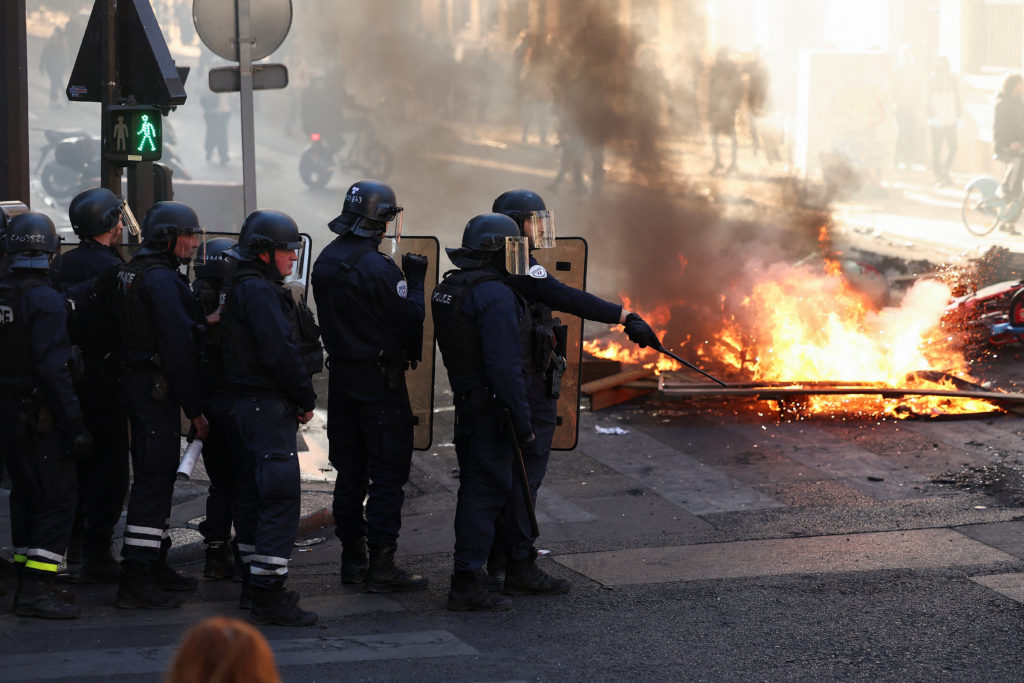
Violence marked several key locations during the unrest. In Limoges, central France, flames engulfed the historic 19th-century City Hall, causing its roof to collapse and nearly destroying the structure. In Paris, heavy police presence surrounded the Place de la République, where officers deployed tear gas as tensions flared. Small groups attempted to set fire to bicycles and trash bins, leaving behind dislodged cobblestones, shattered storefronts, and broken glass. The central monument in the square, a statue of Marianne symbolizing France, was partially dismantled by protesters.
Law enforcement agencies responded with mass arrests, detaining at least 1,800 people nationwide. In the Paris region alone, police reported 855 arrests, with 557 individuals remaining in custody as investigations continued. The arrest figures approach the nearly 2,000 recorded during a single day of yellow vest protests in December 2018, highlighting the severity of the current unrest. One death was confirmed in Paris, where police stated a person died of a heart attack, though details remain limited and the prosecutor’s office is investigating the circumstances.
Macron instructed prefects to collaborate with mayors to protect public buildings and businesses in the coming weeks, including the potential banning of protests when necessary. This directive follows an emergency meeting with senior government officials held after masked groups attacked public buildings and set fires in several cities. The administration’s focus is now on restoring order and preventing further escalation, while balancing the need to maintain public safety and respect for democratic processes.
Reactions from citizens varied widely, reflecting the complex emotions surrounding the protests. Some residents expressed shock at the level of destruction, with government employee Marie Peyreigne describing herself as stunned by the violence. Others, like Jean Foissy, a lifelong Parisian, reported feeling scared and distressed by the scenes of riot police and fires, noting that the chaos hurt him deeply. Meanwhile, Margaux Eude, who supported the protest movement, lamented that troublemakers had delegitimized the cause through their actions.
Political leaders across the spectrum are leveraging the fallout to gain advantage ahead of next spring’s presidential election. Far-right leader Marine Le Pen criticized Macron’s centrist government as exhausted and disoriented, suggesting it is incapable of effective action beyond commenting on its own powerlessness. Conversely, far-left leader Jean-Luc Mélenchon accused Prime Minister Sébastien Lecornu of playing with fire by banking on social degradation, which he claimed has united youths and workers’ unions against the government.
Mélenchon, who joined the march in Paris, clarified that those sharing his political fight have no business engaging in looting or destruction. Despite this distinction, the violence has overshadowed the original grievances regarding education policies and economic hardship. The unrest underscores deep societal fractures and challenges for the French government as it seeks to address both immediate security concerns and underlying social issues without alienating large segments of the population.
International attention has also focused on the situation, with U.S. President Donald Trump posting comments linking the unrest to immigration issues. However, domestic political dynamics remain the primary driver of the narrative in France. As investigations continue and legal proceedings loom for those arrested, the coming weeks will likely see heightened security measures and ongoing debates about the balance between protest rights and public order.
The events highlight the fragility of social cohesion in France amid economic pressures and political polarization. While the immediate violence has subsided somewhat, the underlying tensions persist. The government’s response will be closely watched for its effectiveness in restoring stability while addressing the legitimate concerns that sparked the initial demonstrations. The outcome may significantly influence the political landscape leading up to the presidential election.
Sources behind this briefing
Go to the original reporting
- PBS NewsHour↗France's Macron vows to hold accountable those who 'sought to bring down the Republic'