The short version
- Arnaud Carayon, a descendant of Jules-Eugène Lenepveu, has initiated legal proceedings to demand the removal of Marc Chagall’s ceiling canvases at the Palais Garnier.
- The dispute centers on whether the original 19th-century fresco, classified as a historic monument, should be restored and potentially alternated with Chagall’s modern work during upcoming renovations.
- While Chagall’s installation is celebrated as a personal homage to Paris, critics argue it obscures the architectural integrity of Charles Garnier’s Second Empire masterpiece.
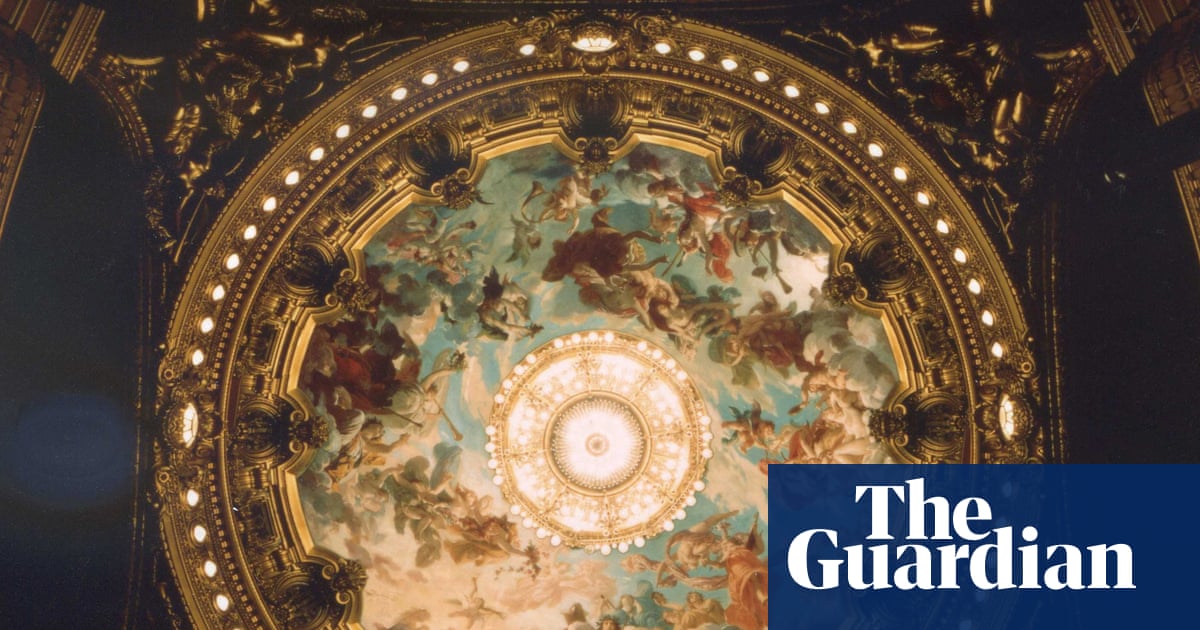
A long-simmering controversy regarding the artistic identity of Paris’s Palais Garnier has moved from public debate into the French legal system. Arnaud Carayon, a descendant of Jules-Eugène Lenepveu, the artist responsible for the opera house’s original dome fresco, has instructed lawyers to pursue court action. His goal is to have the 24 colorful canvases installed by Marc Chagall in the 1960s removed, thereby revealing and restoring the underlying 19th-century work that has been concealed for more than sixty years.
The conflict traces its origins to a decision made by André Malraux, who served as France’s culture minister at the time. According to accounts, Malraux grew bored during a ballet performance in 1962 and looked up at the classical ceiling designed by Jules-Eugène Lenepveu. Finding the original decor lacking, he commissioned his friend Marc Chagall to create a new visual experience for the dome. Chagall accepted the commission without payment, working in secret over two years to produce wedge-shaped canvases that were subsequently installed over Lenepveu’s work.
Lenepveu’s original contribution, titled The Muses and the Hours of Day and Night, was painted directly onto copper plates using oil. It was selected by Charles Garnier, the architect who designed the Palais Garnier in its entirety, including minute details like door knobs. Garnier viewed Lenepveu as a key artistic collaborator, and the resulting allegorical piece fit seamlessly with the ornate Second Empire style of the building. The work received historic monument classification in 1923, recognizing its cultural significance long before it was covered.
Chagall’s intervention transformed the dome into a vibrant mosaic of red, blue, green, yellow, and white sections. Spanning approximately 220 square meters around the central chandelier, the installation features dancers, angels, musicians, and names of composers. Curators describe the work as Chagall’s autobiography and a cinematic homage to Paris, highlighting monuments like the Eiffel Tower and artists he admired. It is viewed by many as a gift from an artist grateful for the country that welcomed him.
However, the installation was not without opposition even before it was completed. Traditionalists argued that covering Lenepveu’s work violated the architectural harmony intended by Garnier. The Royal Institute of British Architects wrote to Malraux urging him to abandon the plan, stating that the edifice’s unique character relied on the unity of its architecture, paintings, sculptures, and mosaics. Despite these pleas, the culture minister proceeded with the installation, effectively silencing the original design for generations.
Carayon, who leads the Friends of Lenepveu Society, argues that the current situation leaves the historic monument in an unknown state of preservation. He notes that while Lenepveu was a celebrated figure in his time, leading the French Academy in Rome and creating frescoes in the Panthéon, he has largely been forgotten by the public. Carayon contends that Malraux’s whim overruled Garnier’s deliberate artistic choices, resulting in the erasure of a significant piece of French heritage.
The Palais Garnier is scheduled to close for extensive renovations between 2027 and 2032. Carayon has proposed a compromise: alternating the display of the Lenepveu and Chagall ceilings after the opera house reopens, with each artist’s work visible for a decade at a time. He claims the Chagall installation was designed to be removable without damage. While the Élysée Palace acknowledged receipt of his letters to President Emmanuel Macron, stating the president is attentive to the matter, no concrete steps toward alternation have been announced.
Alexander Neef, director of the Paris Opera, acknowledges the legitimacy of Lenepveu’s descendants in defending their ancestor’s memory. He notes that the debate over the ceiling has persisted for over six decades and recognizes the heritage value of the listed Lenepveu fresco. As legal proceedings begin, the outcome may determine whether the Palais Garnier returns to its original 19th-century aesthetic or maintains the modernist vision imposed by Malraux and Chagall in the mid-20th century.
Sources behind this briefing
Go to the original reporting
- The Guardian World↗Chagall or Lenepveu or both? Row over Paris opera house dome enters legal arena