The short version
- Karoline Leavitt will leave her post as White House press secretary at the end of August to prioritize time with her young children.
- President Trump announced she will continue serving as a top outside advisor and influential voice within the Republican Party ahead of midterm elections.
- Leavitt’s tenure was marked by frequent clashes with journalists, efforts to reshape media access protocols, and staunch defense of administration policies.
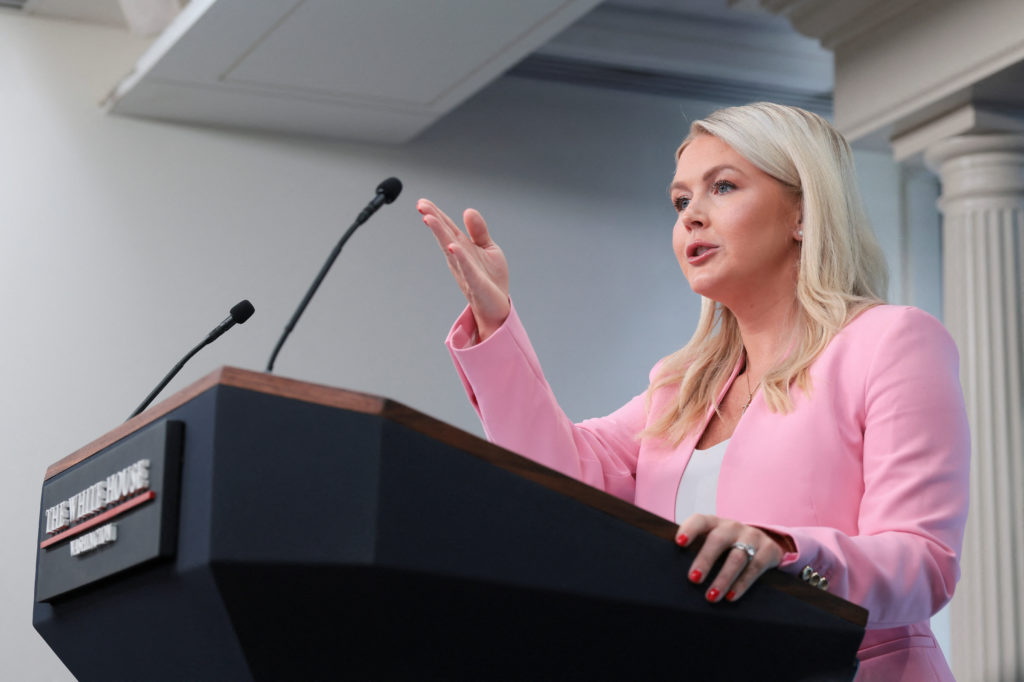
White House press secretary Karoline Leavitt will step down from her position at the end of August, marking the conclusion of a tenure defined by both historic milestones and persistent friction with the news media. President Donald Trump announced the departure on Wednesday, stating that he fully understands and respects her decision to leave the high-profile role. Leavitt, 28, confirmed the move in a social media post shortly after the president’s announcement, describing it as a bittersweet choice driven by her desire to be more present for her two young children.
Leavitt recently returned to the White House podium following maternity leave taken for the birth of her second child, a daughter named Viviana, in May. She also has a two-year-old son. In her statement, Leavitt wrote that since returning from leave, she felt unable to provide the constant time and energy required by the press secretary role while being the best mother her children deserve. She characterized her time in the position as an honor and adventure, noting the challenge of balancing one of the world’s most demanding jobs with new motherhood.
Despite leaving the daily briefing room, Leavitt will remain closely tied to the administration. Trump indicated that she would transition into a role as one of his top outside advisors and serve as an influential voice within the Republican Party. The president emphasized her importance in helping to win upcoming midterm elections. White House Deputy Chief of Staff Stephen Miller echoed this sentiment, calling Leavitt a close friend and role model whose story is just beginning, suggesting she will continue working with the administration on a daily basis.
Leavitt’s departure leaves a vacancy in a position that has seen significant turnover during Trump’s two terms. She became the youngest person ever to serve as White House press secretary when she took office last year. Her tenure lasted approximately 20 months, making her the second-longest-serving press secretary in either of Trump’s administrations, trailing only Sarah Huckabee Sanders. It remains unclear who will replace her or when a successor will be selected. During Leavitt’s recent maternity leave, several senior officials, including Vice President JD Vance and Secretary of State Marco Rubio, temporarily took over briefing duties.
Throughout her time in the role, Leavitt maintained a combative relationship with many journalists, frequently accusing reporters of bias and left-wing agendas. She faced criticism for amplifying misinformation and restricting press freedom, including an incident where her office blocked the Associated Press from the White House press pool after the outlet refused to adopt the term Gulf of America. Her team also attempted to seize control of the press pool from the White House Correspondents’ Association and introduced a new media seat often occupied by conservative commentators friendly to the administration.
Leavitt was known for her unflinching defense of Trump’s policies, earning praise from supporters and the president himself. She faced intense scrutiny during periods of controversy, including questions about Trump’s past relationship with Jeffrey Epstein and federal law enforcement actions in Minneapolis. In one notable exchange, she sharply rebuked a reporter who suggested an ICE agent acted recklessly in a fatal shooting, labeling the journalist a biased hack. However, she did distance herself from some administration rhetoric, refusing to endorse claims that Alex Pretti, another victim of federal gunfire, was a would-be assassin.
Before her appointment as press secretary, Leavitt had a long history within Trump’s orbit. She served as an assistant press secretary and speechwriter during his first term and later became communications director for New York Representative Elise Stefanik. In 2022, she ran for Congress in New Hampshire, winning a crowded Republican primary but losing the general election to Democrat Chris Pappas. She subsequently worked as a spokesperson for MAGA Inc., a pro-Trump super PAC, before joining his 2024 campaign as national press secretary.
Leavitt’s departure underscores the challenges of balancing high-stakes political roles with personal life, particularly for young parents in the public eye. As she prepares to leave the White House, the administration faces the task of finding a new chief spokesperson who can navigate the complex media landscape while maintaining the president’s preferred messaging strategy. The transition will likely draw attention as the midterm elections approach and the administration seeks to consolidate its political base.
Sources behind this briefing
Go to the original reporting
- PBS NewsHour↗Karoline Leavitt is leaving her role as Trump's White House press secretary
- The Guardian World↗Trump’s press secretary Karoline Leavitt leaving role, president says – US politics live
- BBC World↗Trump says White House press secretary Karoline Leavitt to leave post
- The Guardian US Politics↗Karoline Leavitt: six key takeaways from 20 months as Trump’s press secretary

