The short version
- Japan has launched the world’s first mission designed to return physical samples from Phobos, one of Mars’ two small moons.
- The spacecraft carries international hardware, including a French-German rover and NASA sampling tools, to gather data on the moon’s composition.
- Scientists hope the retrieved material will clarify whether the moons are captured asteroids or debris from an ancient impact event.
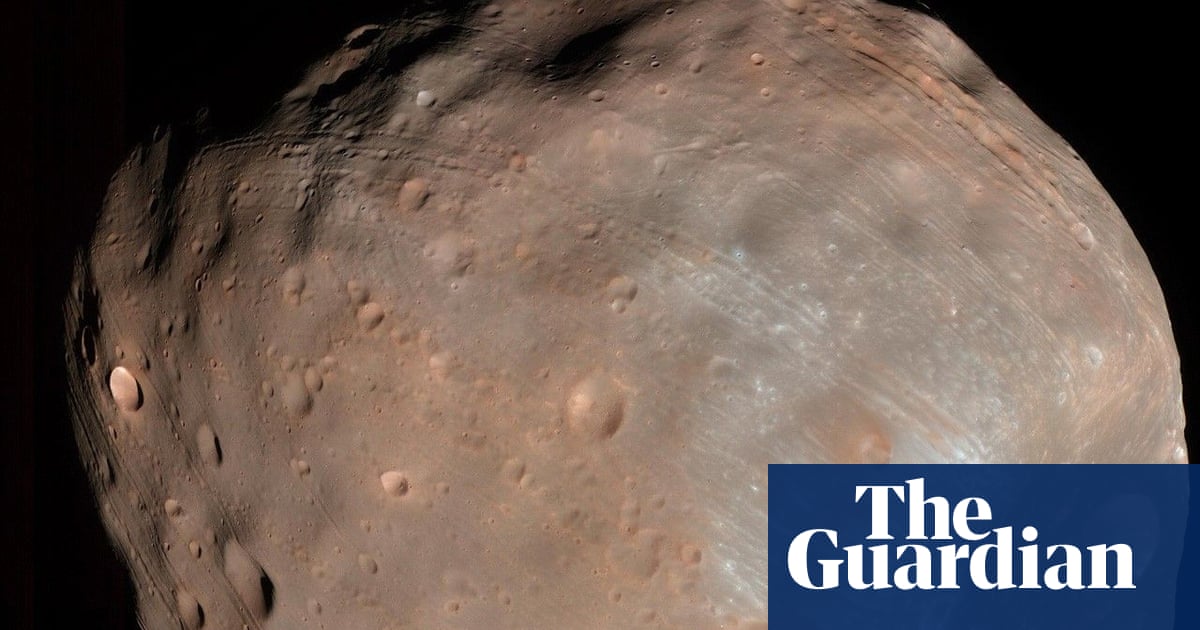
Japan has initiated the first mission in history aimed at collecting and returning samples from Phobos, one of the two irregularly shaped moons orbiting Mars. The Japan Aerospace Exploration Agency launched the spacecraft on Tuesday using a new H3 rocket, marking the start of an ambitious five-year campaign. This effort represents a significant shift in planetary science, moving beyond orbital observation to direct physical analysis of bodies that have remained largely unexplored since the early space age.
The primary scientific objective is to determine the origin of Phobos and its smaller companion, Deimos. Current theories are divided on whether these cratered bodies are remnants of debris ejected after a massive celestial object struck Mars or if they are asteroids captured by the planet’s gravity from elsewhere in the solar system. Researchers believe that analyzing soil samples will provide definitive evidence to distinguish between these competing hypotheses. Understanding their formation could also offer broader insights into the geological history of the Martian system and potentially shed light on conditions relevant to the origins of life.
The mission, known as the Martian Moons eXploration project, is a collaborative international effort. While Japan leads the operation, it incorporates critical technology from other space agencies. The spacecraft carries thirteen instruments, including a sampling device provided by NASA and a deep-space communication system from the European Space Agency. A French-German rover named Idefix will also play a central role in the exploration phase. This multinational cooperation underscores the complexity of the endeavor and the shared interest in unlocking the secrets of Mars’ satellites.
The journey to Mars is extensive, with the spacecraft traveling between 500 million and 600 million kilometers before arriving at the Martian region around August 2027. Once there, the probe will spend approximately three years orbiting and flying near Phobos to gather data and collect samples. The mission architecture consists of three distinct modules: propulsion, exploration, and return. Only the return module is designed to survive the trip back to Earth, carrying the collected material in a heat-protected capsule built to withstand atmospheric reentry.
Sampling operations present significant engineering challenges due to Phobos’ extremely low gravity, which is just two-thousandths of Earth’s. To address this, the exploration module features four-legged landing gear with shock absorption to minimize bouncing upon touchdown. The mission plans two separate sampling attempts using different methods. NASA’s device will use pressurized gas to lift surface dust into a container, while Japan’s coring tool will extract material from about two centeters below the surface. Collecting samples from multiple depths and locations increases the likelihood of capturing diverse geological data.
The French-German rover Idefix is scheduled to land on Phobos first, around 2029, for a hundred-day mission. Its primary task is to explore the surface and identify smooth, level sites suitable for the main spacecraft’s landing. The rover is equipped with wheels designed to gain traction in low gravity and can right itself if it tips over. Data from Idefix will guide the selection of sampling locations, ensuring that the subsequent Japanese operations target areas most likely to yield scientifically valuable material.
Beyond basic geology, the mission aims to assess the feasibility of using Martian moons as staging grounds for future human exploration. Project managers note that Phobos could serve as a base for astronauts traveling to Mars, given its proximity to the planet. The spacecraft includes a Japanese radiation monitor designed to collect data on space weather conditions, which will inform safety protocols for manned missions. With the United States, China, and other nations planning crewed trips to Mars, understanding the environment of its moons is becoming increasingly strategic.
Previous attempts to explore Phobos have been fraught with difficulty. Multiple Russian missions, including one launched in 2011, failed to land successfully. The moon’s pockmarked surface and weak gravitational pull make precise landing operations particularly hazardous. Despite these historical setbacks, Japanese officials express confidence that the new technology and international collaboration will overcome these obstacles. The samples are expected to return to Earth in 2031, providing scientists with tangible evidence to resolve decades-old questions about the Martian system.
The choice to focus on Phobos rather than Deimos was driven by its closer proximity to Mars, which suggests it may contain more information about the planet itself. Officials estimate that material originating from Mars will constitute approximately 0.1 percent of the collected samples. This small fraction could be crucial for understanding the exchange of material between the planet and its moons. The mission also includes plans to fly by Deimos to collect observational data, allowing scientists to compare the two bodies and further refine theories about their shared history.
As the spacecraft begins its long transit toward Mars, the scientific community awaits the arrival with cautious optimism. The success of this mission would mark a milestone in space exploration, demonstrating the ability to navigate, land on, and retrieve material from a distant celestial body with minimal gravity. The data returned will not only answer fundamental questions about solar system formation but also provide practical insights for the next era of human spaceflight. The coming years will test the durability of the hardware and the precision of the international coordination required to bring Martian moon soil back to Earth.
Sources behind this briefing
Go to the original reporting
- The Guardian US↗Japan to launch world-first mission to collect samples from Martian moon


