The short version
- Japan successfully launched the MMX spacecraft on an H3 rocket, beginning a five-year journey to Mars’ largest moon.
- The mission relies on international contributions from NASA and European agencies, building on Japan’s prior success with asteroid sample returns.
- Scientists hope to determine if Phobos is a captured asteroid by analyzing surface samples collected via drilling and pneumatic sampling techniques.
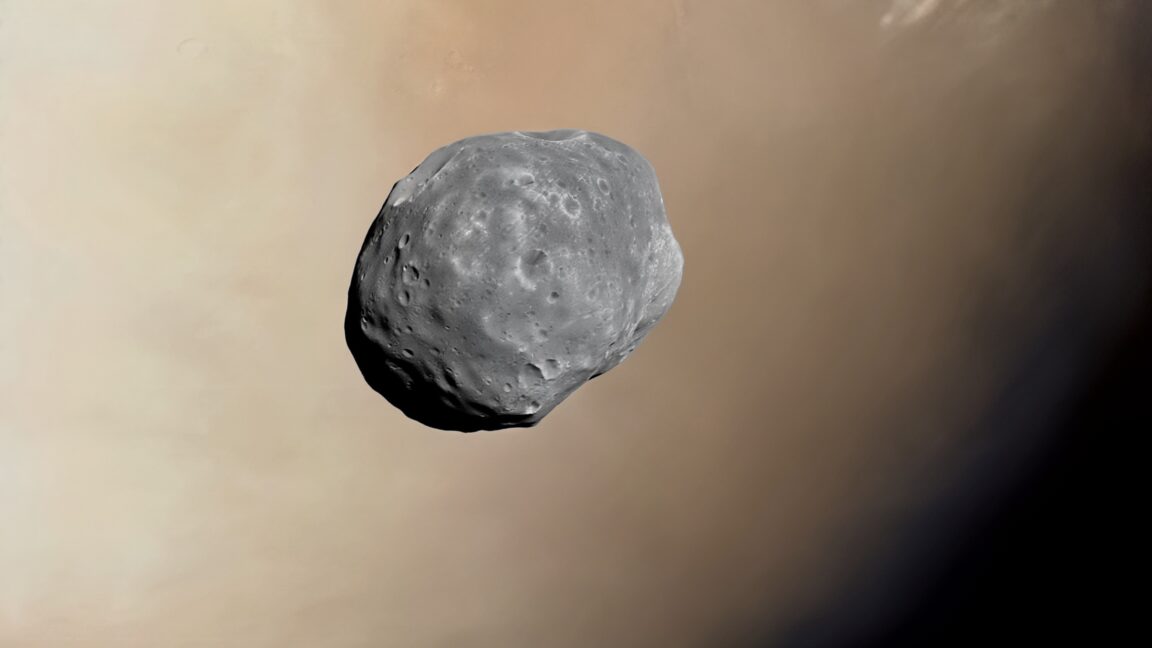
Japan has initiated a complex interplanetary expedition designed to retrieve physical material from Phobos, the larger of Mars’ two moons. The Martian Moons eXploration mission, commonly referred to as MMX, lifted off from the Tanegashima Space Center in southern Japan on Monday afternoon. This $578 million endeavor marks a significant escalation in the nation’s space capabilities, aiming to return pristine specimens to Earth after a five-year voyage that includes a ten-month transit to the red planet.
The spacecraft ascended aboard an H3 rocket, Japan’s primary launch vehicle, which was configured specifically for this heavy payload. The rocket featured four solid rocket boosters and an extended shroud to accommodate the mission’s demands. After accelerating the nearly 9,900-pound probe to speeds exceeding 24,000 miles per hour, the upper stage separated from the spacecraft approximately 71 minutes after liftoff. Mission officials confirmed that the probe successfully unfurled its solar panels and established stable communication with ground controllers shortly after separation.
Hiroshi Yamakawa, president of the Japan Aerospace Exploration Agency, characterized the launch as a successful start to a long journey. The mission represents a continuation of Japan’s strategic focus on sample return operations, following the historic achievements of the Hayabusa and Hayabusa 2 missions, which brought back asteroid specimens. Yasuhiro Kawakatsu, the project manager at JAXA, noted that these prior successes have established a reputation for reliability in deep space retrieval, attracting international partners who view collaboration with Japan as a lower-risk path to achieving similar scientific goals.
International cooperation is a central component of the MMX architecture. NASA and European space agencies have contributed critical hardware and expertise to the project. This collaborative approach underscores the growing trend of shared risk and resource pooling in major space endeavors. The involvement of these partners reflects confidence in Japan’s technical track record, with officials suggesting that joining a Japanese-led mission offers higher certainty of success compared to independent efforts by other nations.
The scientific objectives center on resolving longstanding questions about the origin of Phobos. Current theories suggest the moon may be an asteroid captured by Mars’ gravity billions of years ago. By analyzing samples from its surface, researchers hope to verify or refute this hypothesis, providing new insights into the formation and evolution of the Solar System. The mission will also conduct reconnaissance of Deimos, the smaller Martian moon, during its three-year operational period in Martian orbit.
Upon arrival at Mars next August, the spacecraft will discard its propulsion module to reduce mass before approaching Phobos. Due to the weak gravity of the moon and the strong gravitational influence of Mars, MMX cannot maintain a stable orbit around Phobos. Instead, it will operate in a quasi-satellite trajectory, allowing it to maneuver close to the surface while remaining bound to the planet. This complex orbital mechanics challenge requires precise navigation to ensure the spacecraft can approach the target safely.
The mission’s climax is scheduled for late 2028 or early 2029, when the main spacecraft will attempt up to two landings on Phobos. Prior to this, a small rover named Idefix, provided by French and German agencies, will be deployed to explore the surface. The shoebox-sized robot is designed to operate for up to 100 days, navigating the rough terrain and extremely low gravity, which is less than one-thousandth of Earth’s. The main probe will then use a robotic arm with a coring drill and a NASA-provided pneumatic sampler to collect material from the surface.
The sampling process involves two independent mechanisms to maximize the chances of success. One system will extract a cigar-shaped core sample, while the other will use high-pressure nitrogen gas to sweep loose debris into a collection canister. The landing gear is engineered to absorb impact energy, addressing concerns about tipping or bouncing away due to Phobos’ uneven gravity field. If successful, the mission will return these samples to Earth, offering scientists direct access to material from a body that has never been physically visited by human technology.
Sources behind this briefing
Go to the original reporting
- Ars Technica↗Japan launches mission to bring home a piece of the Martian moon Phobos
