The short version
- Israeli Defense Minister Israel Katz announced a zero-tolerance policy regarding kites and balloons launched from Gaza, equating them with drones regardless of whether they carry explosives.
- Hamas rejected responsibility for the recent kite sightings, describing them as children's toys from displacement camps and accusing Israel of fabricating pretexts to continue military operations.
- Recent Israeli airstrikes in central Gaza have resulted in additional casualties, including a four-year-old boy, while the Israeli military claims to have targeted Hamas commanders involved in weapons manufacturing and the October 2023 attacks.
Israel has issued a stern warning to Hamas regarding the recent appearance of kites and balloons near the Gaza border, signaling a potential escalation in military activity. Defense Minister Israel Katz stated on Monday that forceful actions would be taken to end this phenomenon, emphasizing that the Israeli government maintains a zero-tolerance stance. According to Katz, any balloon or kite is treated with the same severity as a drone, irrespective of whether it carries explosive materials. This hardline position reflects deep-seated security concerns among Israeli officials and border communities.
The immediate trigger for these warnings was the discovery of several kites in an Israeli community near the Gaza border over the weekend. Local media reports indicate that four kites were found in Kibbutz Nahal Oz, located approximately 800 meters from the border, on Friday and Saturday. Additional sightings occurred in other parts of southern Israel in the days following. While military sources confirmed that no suspicious materials were attached to these specific kites and that they did not pose an immediate threat, the mere presence of such objects has reignited fears among residents.
Residents of Kibbutz Nahal Oz expressed their anxiety through a public statement, noting their fear that old tactics might be returning. They explicitly rejected any policy of containment when it comes to their security, demanding robust protection measures. This sentiment is rooted in the pre-war period, when Hamas and other groups launched kites and balloons carrying incendiary devices into Israel. Those earlier launches caused significant damage, burning forests and farmland, and left a lasting psychological impact on communities living near the border.
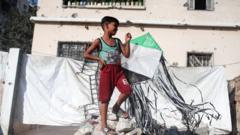
In contrast, Hamas has firmly denied any involvement in the recent kite launches. The group characterized the objects as innocent children's toys originating from displacement camps, arguing that they represent children searching for remnants of childhood amidst the rubble of war. A Hamas spokesperson accused Israel of using these incidents as fabricated pretexts to justify continued aggression and violations against the Palestinian people. They warned of the dangers posed by such allegations and threats, suggesting that Israel is attempting to undermine the ceasefire agreement reached in October.
Despite the diplomatic rhetoric surrounding the ceasefire, violence has persisted on the ground. On Sunday, Palestinian health officials reported that two people were killed and seven others injured in Israeli strikes targeting Nuseirat refugee camp and the town of al-Zuwayda in central Gaza. Among the deceased was a four-year-old boy named Mohammed Taha, who died when a building in al-Zawayda, just north of Maghazi refugee camp, was bombed. These incidents highlight the ongoing risk to civilians even as negotiations and ceasefires are discussed.
The Israeli military stated that its strikes were targeted operations aimed at specific Hamas figures. In the Maghazi area, Israel claimed to have killed Ismail Abu Ful, identified as the commander of a Hamas weapons manufacturing site. The military asserted that residents had been warned to evacuate the area beforehand. Similarly, on Monday, Palestinian media reported the death of Mohammed Abu Asad in an overnight strike on a tent in Deir al-Balah. Israeli forces identified Abu Asad as a member of the elite Nukhba forces of Hamas's military wing, alleging his participation in the October 7, 2023, cross-border assault.
The broader context of these events remains fraught with tension and loss. The current conflict began in response to the October 2023 attack by Hamas, which resulted in approximately 1,200 deaths in Israel and the taking of 251 hostages. Since then, Israeli military operations in Gaza have led to significant casualties on both sides. According to the Hamas-run health ministry in Gaza, more than 74,420 people have been killed in Israeli attacks since the war began. This figure includes 1,288 deaths that occurred after the ceasefire took effect last October, underscoring the fragility of the truce.
Local residents continue to express a desire for peace and stability amidst the chaos. Abu Ahmed, a displaced man sheltering near the strike zones, told Reuters news agency that there is effectively no ceasefire in practice. He emphasized the community's longing for solutions and a return to peaceful living conditions. As Israel prepares for potential forceful responses to future kite sightings and Hamas continues to deny responsibility, the situation remains volatile. The interplay between security concerns, civilian safety, and political maneuvering ensures that the region remains on edge, with little immediate prospect of de-escalation.
Sources behind this briefing
Go to the original reporting
- BBC News↗Israel warns of 'forceful' response to kites flown from Gaza

