The short version
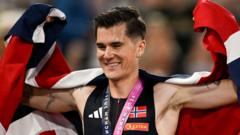
- Jakob Ingebrigtsen won the 5,000-meter race at the European Championships, marking his return to competition after an eleven-month injury layoff.
- The Norwegian athlete expressed strong disappointment that British rival Josh Kerr is not participating, stating that such decisions damage the sport.
- Ingebrigtsen achieved a record seventh gold medal in Birmingham, tying him as the most successful male competitor in the history of the event.
Jakob Ingebrigtsen returned to elite competition on Monday with a decisive victory in the 5,000-meter race at the European Championships in Birmingham. The win marks a significant milestone for the twenty-five-year-old Norwegian, who had been sidelined for eleven months following surgery on his Achilles tendon. By securing this title, Ingebrigtsen has now amassed seven gold medals at the European level, establishing himself as the joint-most successful male athlete in the history of the competition.
Despite the personal triumph, Ingebrigtsen used the platform to voice sharp criticism regarding the absence of his primary rival, Britain’s Josh Kerr. The Scottish runner recently shattered the long-standing mile world record and claimed Commonwealth gold in Glasgow but opted not to compete in Birmingham. Ingebrigtsen described himself as very disappointed by Kerr’s decision, arguing that athletes who bypass major championships in favor of time trials are actively harming the integrity of track and field.
The Norwegian champion emphasized that while chasing records is a valid pursuit, it should not come at the expense of championship participation. He stated that he could never prioritize a personal best over a title, suggesting that both goals can be pursued simultaneously without conflict. Ingebrigtsen argued that championships exist specifically to showcase the best athletes competing against one another, and that skipping these events undermines the fundamental purpose of the sport.
This public disagreement highlights the ongoing tension between two distinct philosophies in modern distance running. Kerr’s team has made it clear that the European Championships were never part of his strategic plan for this season, focusing instead on breaking barriers in specific distances. Ingebrigtsen acknowledged Kerr’s recent performances as extremely strong and complimentary of the record-breaking effort in London. However, he maintained that professional runners have the capacity to work hard every day and should not view championship participation as an optional burden.
The rivalry between Ingebrigtsen and Kerr has defined much of the recent narrative in middle-distance running. Their competition intensified significantly after Kerr defeated Ingebrigtsen at the 2023 World Championships in Budapest, setting the stage for a highly anticipated clash at the Paris Olympics. That Olympic final ultimately saw American Cole Hocker take gold, with both European rivals finishing behind him. The lead-up to those Games was marked by intense verbal exchanges, with Ingebrigtsen claiming he could defeat Kerr blindfolded and Kerr criticizing his rival’s demeanor and support team.
Since the Paris Olympics, the dynamic between the two runners has shifted somewhat due to Ingebrigtsen’s prolonged injury struggles. The Norwegian had been absent from competition for nearly a year, raising questions about his ability to maintain his dominance on the world stage. His return in Birmingham serves as a clear signal that he remains a formidable force. By winning his twentieth major international track title since 2018, Ingebrigtsen has demonstrated that his competitive edge remains intact despite the physical setbacks.
Ingebrigtsen’s comments reflect a broader concern within athletics about the scheduling and prioritization of events by top-tier athletes. He suggested that many fans and stakeholders should share his disappointment when star competitors choose not to participate in continental championships. The argument centers on the idea that these events are designed to crown champions through direct competition, rather than serving as mere stepping stones for record attempts. This perspective challenges the growing trend of athletes tailoring their seasons exclusively around world records or specific high-profile meets.
Looking ahead, the implications of this disagreement may influence how future competitions are structured and perceived. If top athletes continue to skip major championships in favor of isolated time trials, the prestige of events like the European Championships could diminish. Ingebrigtsen’s stance underscores a traditional view that titles hold greater weight than times, a belief that resonates with many long-time fans of the sport. As the season progresses, the contrast between Kerr’s record-focused approach and Ingebrigtsen’s championship-centric strategy will likely remain a central theme in discussions about the future of distance running.
The victory in Birmingham also sets the stage for renewed competition as both athletes prepare for upcoming international events. While Kerr continues to break barriers in the mile, Ingebrigtsen has reasserted his dominance over longer distances at major championships. The next time they meet on the track will be closely watched, not only for the athletic performance but also for how their differing philosophies play out in a direct contest. For now, Ingebrigtsen’s return serves as a powerful reminder of his enduring legacy and his commitment to the traditional values of championship racing.
As the European Championships continue, attention will shift to other key events and emerging talents. However, the narrative surrounding Ingebrigtsen’s win and his subsequent comments is likely to dominate headlines for days. The debate over whether records or titles matter more in track and field is far from new, but it has gained renewed urgency with the rise of athletes who can excel in both areas. Ingebrigtsen’s insistence that championships are paramount offers a counterpoint to the modern emphasis on statistical milestones, ensuring that the conversation about the sport’s direction remains vibrant and contested.
Sources behind this briefing
Go to the original reporting
- BBC Sport↗Kerr's Europeans absence ruining the sport - Ingebrigtsen
