The short version
- The inaugural IndyCar race on Washington streets is part of a broader series of events marking America's 250th birthday.
- Organizers are managing significant logistical challenges, including securing manhole covers and constructing temporary barriers along the circuit.
- While the president hopes for recurring races, organizers describe the event as a one-time occurrence with no firm plans for repetition.
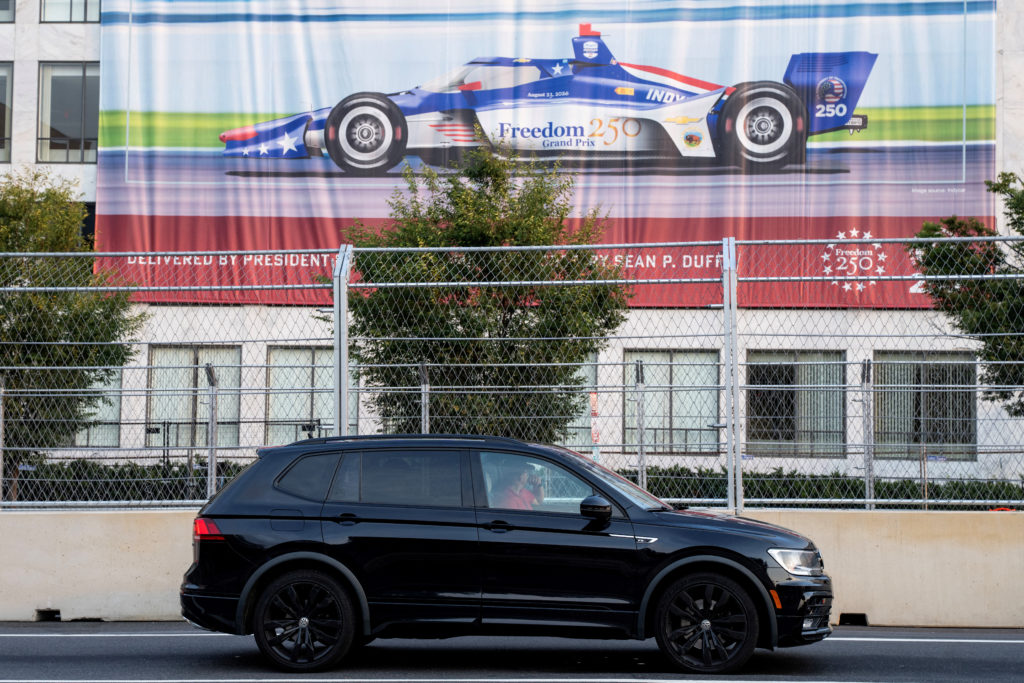
Construction crews are currently erecting grandstands and installing fencing along a newly designated circuit in Washington, D.C., preparing for the debut of the Freedom 250 Grand Prix. This open-wheel motorsport event marks the first time IndyCar has raced on the streets of the nation's capital. The race is scheduled to take place over two days in late August, featuring vehicles capable of reaching speeds approaching 200 mph on street courses. The event serves as a centerpiece for the ongoing semiquincentennial celebrations marking the 250th anniversary of the Declaration of Independence.
The track layout utilizes Pennsylvania Avenue, a thoroughfare typically governed by a 25 mph speed limit, as its longest straightaway. Temporary pedestrian bridges have been constructed over sections of the circuit to allow foot traffic to continue during the event. The route extends from 3rd Street to 9th Street NW before doubling back and looping south toward Independence Avenue alongside the National Mall. Key landmarks such as the U.S. Capitol, the Washington Monument, and the Smithsonian's National Air & Space Museum provide backdrops for various turns and pit lanes.
Logistical preparations have required extensive modifications to the urban infrastructure. Organizers report that more than 220 manhole covers along the circuit had to be welded in place to prevent high-speed cars from dislodging them due to aerodynamic lift. Approximately 50 of these covers, which were set too deep into the road surface, required additional silicone fitting to eliminate bumps that could destabilize vehicles. Additionally, crews are installing 1,800 concrete barriers, each weighing 10,000 pounds, to ring the track and ensure spectator safety.
Financial responsibility for the event falls primarily on Penske Corporation, led by series owner Roger Penske. Bud Denker, president of Penske Corporation and chair of the race, stated that the company is covering the vast majority of expenses, including road construction and improvements. The District of Columbia is handling only limited repaving duties. Denker estimated that road improvement costs for the one-third of the track requiring work would remain under $3 million, a figure significantly lower than the up to $9 million spent on similar preparations for an upcoming race in Markham, Ontario.
The event has drawn attention for its integration into President Donald Trump's broader celebration of America's 250th birthday. The president has hosted multiple high-profile events in recent months, including a UFC fight on the White House South Lawn and rallies on the National Mall. Roger Penske, who received the Presidential Medal of Freedom from Trump in 2019, played a key role in bringing the race to Washington. He presented the president with a racing helmet, suggesting it be worn during the traditional pre-race kickoff involving the presidential limousine.
Security and permitting have required coordination with federal agencies rather than local funding sources. Penske Corporation is working with the Departments of Interior and Transportation to facilitate permits for vendor activities on the National Mall, including merchandise sales and beer service, which are not typically allowed in that area. Metal detectors manned by Secret Service agents will be deployed at entry points to manage crowd control and security protocols.
Public interest in the event appears strong, with organizers reporting that 288,000 free tickets were requested through a lottery system. This demand exceeds the capacity of 130,000 spectators planned for each of the two race days. The race is scheduled to proceed in rainy conditions unless lightning strikes or significant puddling creates hazardous track conditions. Attendees are expected to experience high-speed racing against the backdrop of iconic government buildings and national monuments.
The long-term future of street racing in Washington remains uncertain. While President Trump has expressed interest in hosting additional races in future years, event organizers have not committed to a recurring schedule. D.C. Mayor Muriel Bowser suggested the event could be the first of several, but Denker characterized it as a unique occurrence. He noted that while the race is historic, there are no definitive plans to repeat the event, leaving its legacy as either a singular milestone or the beginning of a new tradition in the capital.
Sources behind this briefing
Go to the original reporting
- PBS NewsHour↗WATCH: IndyCar hosts Freedom 250 Grand Prix news conference ahead of Washington race

