The short version
- Activist Sonam Wangchuk states that recent youth-led protests have severely damaged the standing of Prime Minister Narendra Modi and his administration.
- The unrest, sparked by leaked examination papers and a judicial remark comparing unemployed youth to pests, led to the resignation of the education minister.
- While the government has introduced fast-track courts and appointed a tech billionaire to reform exams, critics argue these measures fail to address deep-seated structural unemployment.
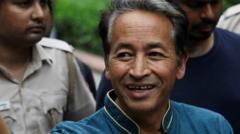
Prominent Indian activist Sonam Wangchuk asserts that recent youth-led demonstrations have substantially weakened Prime Minister Narendra Modi’s political position. The engineer and education specialist, who recently concluded a grueling hunger strike in the capital, told reporters that the atmosphere within the country has shifted dramatically. He argues that mass dissent has emboldened young citizens, fostering a belief that they can effect change rather than passively accepting government policies. This sentiment marks a significant departure from previous periods of relative quiescence regarding public dissatisfaction with the ruling Bharatiya Janata Party.
The protests gained momentum following the leak of examination papers, an incident that ignited widespread anger among students and their families. The movement, which adopted the moniker 'Cockroach' in reference to a controversial remark by India’s chief justice comparing unemployed youth to pests, escalated into some of the largest anti-government displays seen in years. Wangchuk’s own fast, lasting 26 days in extreme heat during June and July, served as a catalyst for this broader mobilization. He consumed only salt and water during the ordeal, losing significant weight before being forcibly hospitalized for the final six days.
The immediate political consequence of the unrest was the resignation of Education Minister Dharmendra Pradhan on July 25, the day after Wangchuk ended his fast. In response to the crisis, the government announced the establishment of fast-track courts to prosecute those accused of leaking exam materials. Additionally, a technology billionaire was appointed to lead efforts aimed at reforming the examination system. The administration also pledged compensation to families of students who died by suicide following the leaks, attempting to mitigate the human toll of the scandal.
Despite these measures, Wangchuk contends that the government’s response fails to address the root causes of public anger. He points to chronic graduate unemployment, which has hovered between 35 and 40 percent for the past quarter-century, as a deeper structural issue. The current examination system, he argues, relies heavily on multiple-choice questions designed for efficiency rather than assessing genuine skills or understanding. This approach shapes teaching methods in ways that disconnect education from job market realities, leaving graduates ill-prepared for available employment opportunities.
Wangchuk advocates for fundamental reforms that prioritize hands-on experience and aptitude over rote memorization. He suggests that schools should adapt their curricula to reflect the needs of future sectors, ensuring that students are not left unemployed while critical industries face labor shortages. Such planning, he argues, is essential for aligning educational outcomes with the economic landscape expected in 15 years. Without these changes, the cycle of unemployment and underemployment will persist, undermining long-term national development.
The government has defended its record, arguing that claims of an unemployment crisis are exaggerated and that macroeconomic policies remain robust. However, Wangchuk points to recent electoral setbacks as evidence of declining public confidence. The ruling party lost two of three by-elections held recently, including a seat in Bihar it had held for more than three decades. He interprets these losses as a direct reflection of the damage inflicted on the party’s reputation by its delayed response to the education crisis.
Protesters continue to face repercussions despite Supreme Court directives against coercive action against those without prior criminal records. Many participants in the 'Cockroach Janta Party' movement report facing court cases, police harassment, and social media abuse. Wangchuk notes that while progress has been made, the government’s failure to fully listen to public demands could lead to broader protests extending beyond education issues. He maintains a belief in the power of non-violent resistance, drawing inspiration from Mahatma Gandhi’s philosophy.
Wangchuk, who has previously campaigned for greater self-rule in Ladakh and against environmental destruction, remains in his hometown after regaining some weight. He views the recent events as a turning point, suggesting that the government has been forced to reconsider its approach due to the sustained pressure from youth activists. While he offers leaders a chance to amend their ways, he warns that continued neglect of public grievances could result in further erosion of political stability.
Sources behind this briefing
Go to the original reporting
- BBC News↗Youth protests have weakened Modi, Indian activist who went on hunger strike tells BBC

