The short version
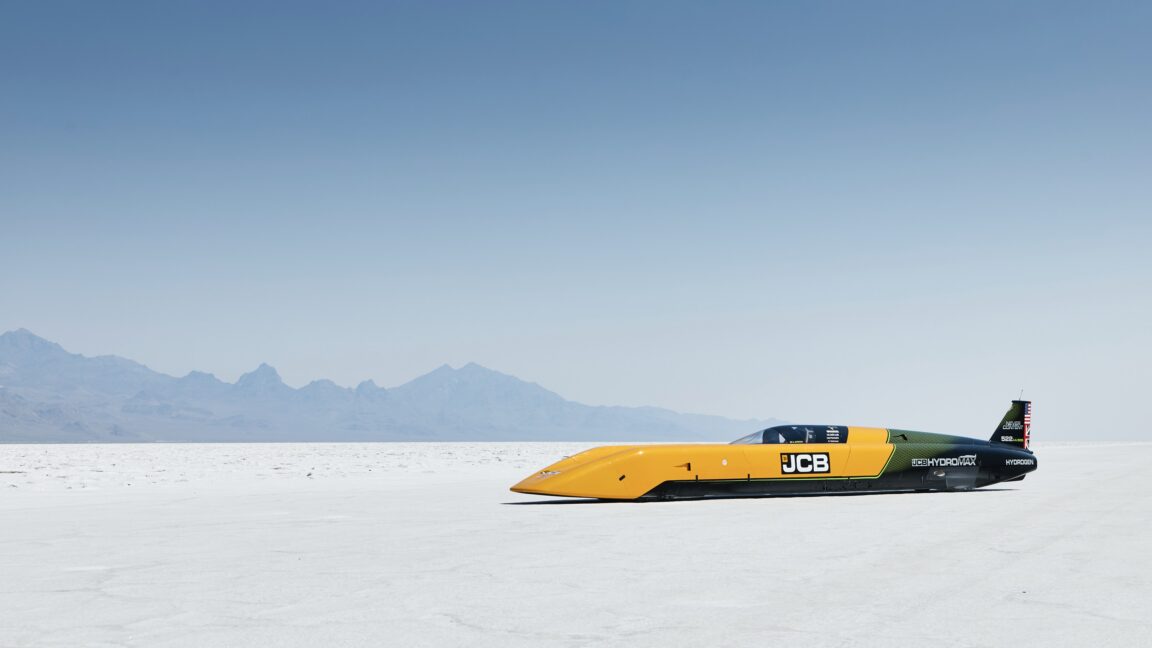
- The JCB Hydromax achieved a two-way average speed of 406.32 mph at Utah's Bonneville Salt Flats, setting a new record for hydrogen-powered vehicles.
- The vehicle utilizes two heavily modified internal combustion engines that burn hydrogen rather than using fuel cells, marking a shift in the company's strategy after finding fuel cell technology too fragile and expensive for industrial use.
- RAF Wing Commander Andy Green, who previously broke the sound barrier on land, piloted the car, which produced 1,600 horsepower through significant engineering modifications including turbocharging and advanced cooling systems.
A new benchmark for hydrogen-powered transportation was established at the Bonneville Salt Flats in Utah, where a specialized vehicle achieved a two-way average speed of 406.32 miles per hour. The JCB Hydromax, driven by retired Royal Air Force Wing Commander Andy Green, surpassed previous records for both hydrogen combustion and fuel cell vehicles. This achievement highlights a distinct path in the development of clean energy propulsion, favoring modified internal combustion over electric or fuel cell systems for this specific high-speed application.
JCB, a British manufacturer known for heavy industrial machinery such as diggers and loaders, has been exploring alternatives to diesel engines to meet strict carbon emissions targets. While battery power is suitable for some equipment, the company found hydrogen fuel cells to be prohibitively expensive and mechanically fragile for harsh construction environments. Consequently, JCB pivoted in 2020 toward developing its own hydrogen combustion engine, leveraging its extensive experience with diesel technology.
The engineering challenge lay in adapting an engine designed for low-revving industrial work to handle extreme speeds. Standard hydrogen combustion has historically struggled with efficiency; earlier attempts, such as a modified BMW V12, resulted in significant power loss and high fuel consumption. To overcome this, JCB engineers doubled the engine speed to 3,800 rpm, replaced pushrod valves with double overhead camshafts for precise timing control, and implemented direct fuel injection at higher pressures.
Each of the two engines in the Hydromax was boosted from a standard 74 horsepower to 800 horsepower. The combined output reached 1,600 horsepower and 2,600 pound-feet of torque, delivered through an all-wheel-drive system. Critical to this performance was the management of heat; the vehicle employs two ice tanks to cool air exiting the turbochargers, reducing temperatures from nearly 400 degrees Fahrenheit to below 50 degrees Fahrenheit. This cooling system ensures the engine components remain stable under intense stress.
Andy Green, a veteran of land speed record attempts, piloted the vehicle during the record-setting runs. Green previously drove the jet-powered Thrust SSC to break the sound barrier on land in 1997 and set a diesel-powered record with JCB in 2006. His experience was crucial for managing the vehicle's stability at such high velocities. The Hydromax completed one run at 400.623 mph and the return run at 412.135 mph, averaging out to the final recorded speed.
This new record significantly outpaces previous hydrogen-powered achievements. It more than doubles the 185.5 mph record set by a BMW H2R in 2004 using a hydrogen combustion engine. It also exceeds the fastest speed achieved by a hydrogen fuel cell vehicle, which stands at 303 mph, and beats the electric vehicle land speed record of 341 mph set in 2016. However, it does not surpass the overall wheeled land speed record held by nitromethane-fueled vehicles.
The success of the Hydromax serves as a proof of concept for hydrogen combustion engines in high-performance contexts. While the primary goal for JCB is to decarbonize its industrial fleet, the extreme modifications required for the speed record demonstrate the potential power density and reliability of hydrogen when burned directly in an internal combustion engine. The project underscores the complexity of transitioning heavy machinery away from fossil fuels without relying solely on electrification.
Looking ahead, the data gathered from these runs will inform future developments in JCB's hydrogen engine technology. The ability to maintain stability and power at such speeds suggests that hydrogen combustion could be a viable alternative for applications where battery weight or fuel cell fragility are limiting factors. As regulatory pressures mount on industrial emissions, this record may encourage further investment in combustion-based hydrogen solutions.
The event took place against the backdrop of stalled attempts to break the absolute land speed record, such as the Bloodhound project, which ran out of funding. With Thrust SSC's 763 mph record remaining unchallenged for nearly three decades, niche records like this one fill the void in high-speed engineering milestones. The Hydromax achievement marks a significant step in the evolution of alternative fuel technologies.
Green described the vehicle as stable and strong, noting the privilege of setting a record with hydrogen power two decades after his previous diesel-powered attempt. The success reflects the collaborative effort of a specialized team and advanced engineering practices. As the industry seeks diverse pathways to net-zero emissions, this demonstration provides tangible evidence that hydrogen combustion can compete in performance metrics traditionally dominated by fossil fuels.
Sources behind this briefing
Go to the original reporting
- Ars Technica↗Two hydrogen-burning engines powered this car to a new land speed record
- BBC Science & Environment↗Watch: Hydrogen car breaks land speed record at 406 mph
