The short version
- András Baka was elected president by a wide margin despite a walkout by opposition lawmakers protesting the removal of their preferred candidate.
- The new administration has rapidly dismantled emergency decrees and established agencies to investigate alleged corruption from the previous government era.
- Baka’s tenure is likely temporary, serving as a transitional figure until a new constitution replaces the 2011 framework established by Viktor Orbán.
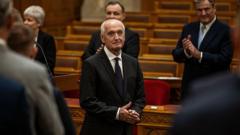
Hungary’s parliament has elected András Baka, a seventy-three-year-old former head of the Supreme Court, as the country’s new president. The vote passed with one hundred forty votes in favor and six against, marking a significant shift in the nation’s leadership structure. This appointment comes amid a broader political realignment following the recent electoral victory of Prime Minister Péter Magyar’s government, which has moved swiftly to dismantle the institutional framework built by former Prime Minister Viktor Orbán.
The election was not without controversy. All fifty-one members of parliament from Fidesz, Orbán’s party, walked out of the chamber before the vote concluded. Their protest centered on the previous month’s removal of Tamás Sulyok from the presidential post, a candidate favored by their faction. Despite the boycott, Baka secured his position, reflecting the current majority’s determination to install a figure aligned with their vision for democratic restoration rather than continuity with the prior administration.
Baka brings a distinct legal pedigree to the role, having served for seventeen years as Hungary’s judge at the European Court of Human Rights in Strasbourg. His appointment is viewed by many as a symbolic break from the past, given that Fidesz removed him from his position as Supreme Court president in 2011. At that time, he was ousted for attempting to prevent measures that critics argued undermined the rule of law. Now, he returns to a central role in the state’s governance, albeit one that is largely ceremonial under the current constitutional arrangement.
In his address to parliament following the election, Baka emphasized reconciliation over retribution. He stated that building a new Hungary should not rely on revenge, acknowledging that while many citizens feel a sense of liberation and hope, others experience disappointment and uncertainty. He framed these divergent feelings as natural within a democratic society rather than anomalies requiring suppression. His remarks suggested an intent to navigate the transition with caution, aiming to stabilize the political environment while implementing significant structural changes.
The new government has already enacted substantial legislative changes since taking office in early May. Twenty-seven laws have been passed, alongside two constitutional amendments that fundamentally alter the balance of power. Notably, the states of emergency declared by Orbán regarding migration, the pandemic, and the war in Ukraine have all been rescinded. These decrees had previously allowed the government to rule by decree, bypassing standard legislative processes. Their removal signals a return to normal parliamentary procedures and a reduction in executive overreach.
Further institutional shifts include the abolition of the Sovereignty Protection Office, an agency used by the previous government to target critical journalists and non-governmental organizations. In its place, a National Asset Recovery and Protection Office has been established. This new body possesses sweeping powers to investigate and prosecute individuals accused of misappropriating state funds during the Fidesz era. These moves have drawn sharp criticism from Fidesz, which accuses the current administration of establishing a tyranny, despite their own history of consolidating power.
Constitutional Amendments 16 and 17 introduce strict term limits for elected officials, restricting prime ministers to two terms and members of parliament to three. Additionally, the ability of the Constitutional Court to oversee acts of parliament, which had been stripped away by Fidesz, has been restored. These changes aim to prevent the concentration of power in a single executive or party. However, Baka himself has expressed reservations about limiting MPs’ terms, viewing it as an intrusion on voters’ rights to freely choose their representatives, indicating potential friction between the president and the legislative majority.
Baka’s presidency is expected to be transitional. Under the constitutional amendment that enabled his election, he will likely serve only until a new constitution comes into force, with a maximum term of five years. His primary task will involve overseeing the drafting of this new document to replace Orbán’s 2011 constitution. Public service radio and television have been off-air since July 9 as news programs are revamped to restore independence from their previous role as government propaganda organs. This media overhaul is part of a broader effort to rebuild trust in public institutions.
The path forward remains uncertain. While Baka has promised the broadest possible debate on the new constitution, his legal background and stated opposition to certain term limits suggest he may not be a passive figurehead. His intention to push back against Hungary’s tendency to trust powerful leaders indicates a commitment to institutional checks and balances. As the country navigates this transition, the interplay between the executive, legislative, and judicial branches will determine the durability of these democratic reforms.
The immediate focus is on stabilizing governance while preparing for constitutional change. The restoration of judicial oversight and the dismantling of emergency powers represent significant steps toward normalcy. However, the political divide remains deep, with Fidesz continuing to resist the new order. Baka’s role as a transitional leader will be critical in managing these tensions, ensuring that the shift away from Orbán’s legacy does not devolve into further polarization but instead fosters a sustainable democratic framework.
Sources behind this briefing
Go to the original reporting
- BBC World↗Former judge removed by Orbán elected Hungarian president

