The short version
- Hubble images of distorted background galaxies are being used to calibrate computer models for analyzing dark matter distribution.
- The upcoming Roman telescope will survey wide areas of the sky, detecting many more gravitational lenses than Hubble can observe individually.
- Researchers aim to combine Hubble’s sharp detail with Roman’s broad coverage to better understand the invisible mass shaping the universe.
NASA is utilizing data from the Hubble Space Telescope to prepare for scientific operations with the Nancy Grace Roman Space Telescope, focusing specifically on the phenomenon of gravitational lensing. This collaborative approach aims to deepen the understanding of dark matter, an invisible substance that constitutes most of the mass in the universe but remains undetectable through direct observation. By analyzing how foreground galaxies warp spacetime and distort light from more distant objects, astronomers can infer the presence and quantity of this elusive material.
Gravitational lensing occurs when a massive object, such as a galaxy, sits between Earth and a more distant background source. The gravity of the foreground object bends the path of light traveling from the background source, acting like a cosmic magnifying glass. This effect causes the background galaxy to appear distorted, stretched into arcs, or even multiplied into multiple images. These distortions are not merely optical illusions but precise indicators of the mass distribution within the foreground galaxy, including its dark matter content.
Recent Hubble observations have captured specific examples of this phenomenon, such as an image featuring a foreground elliptical galaxy located approximately 4.5 billion light-years away. The light from this galaxy began its journey toward Earth when our solar system was still in its formative stages. Behind it lies a background galaxy roughly eight billion light-years distant, appearing as a pair of arcs due to the gravitational influence of the closer object. One arc is large and prominent, while the other is smaller and inverted, creating what astronomers term an arc-counterarc pair.
The degree of distortion observed in these background galaxies allows researchers to calculate the total mass of the foreground galaxy. Since visible matter alone cannot account for the level of bending seen in the light, the discrepancy reveals the amount of dark matter present. This method provides a critical tool for mapping the invisible scaffolding of the cosmos, helping scientists determine how much dark matter exists and how it is distributed within galactic structures.
While Hubble has been instrumental in capturing these high-resolution details since its launch in 1990, it has limitations in terms of coverage. The telescope can only examine one gravitational lens at a time, making comprehensive surveys inefficient. In contrast, the Roman Space Telescope is designed with a much wider field of view, enabling it to capture panoramic images that include numerous lenses simultaneously. This capability will allow for a significantly larger sample size, enhancing statistical analyses of dark matter distribution.
To maximize the potential of Roman’s wide-field data, astronomers are using Hubble’s sharp images to develop sophisticated computer models. These models are designed to analyze the subtle distortions caused by dark matter in large datasets. By training these algorithms on high-quality Hubble observations, researchers hope to accurately interpret the broader but less detailed images that Roman will produce. This synergy ensures that the new telescope’s data can be processed with precision.
The two telescopes also complement each other in their spectral capabilities. Hubble primarily observes in visible and ultraviolet light, with some infrared coverage, while Roman focuses mainly on infrared wavelengths with some visible light detection. This difference allows for a more comprehensive view of cosmic objects, as different wavelengths reveal different physical properties and evolutionary stages of galaxies. The combination of these perspectives enriches the overall picture of the universe.
In addition to building models, Hubble will continue to play an active role by following up on interesting lenses detected by Roman. When the new telescope identifies promising candidates for further study, Hubble can provide detailed, high-resolution views of those specific objects. This iterative process ensures that both instruments contribute their unique strengths to the ongoing exploration of dark matter and the large-scale structure of the universe.
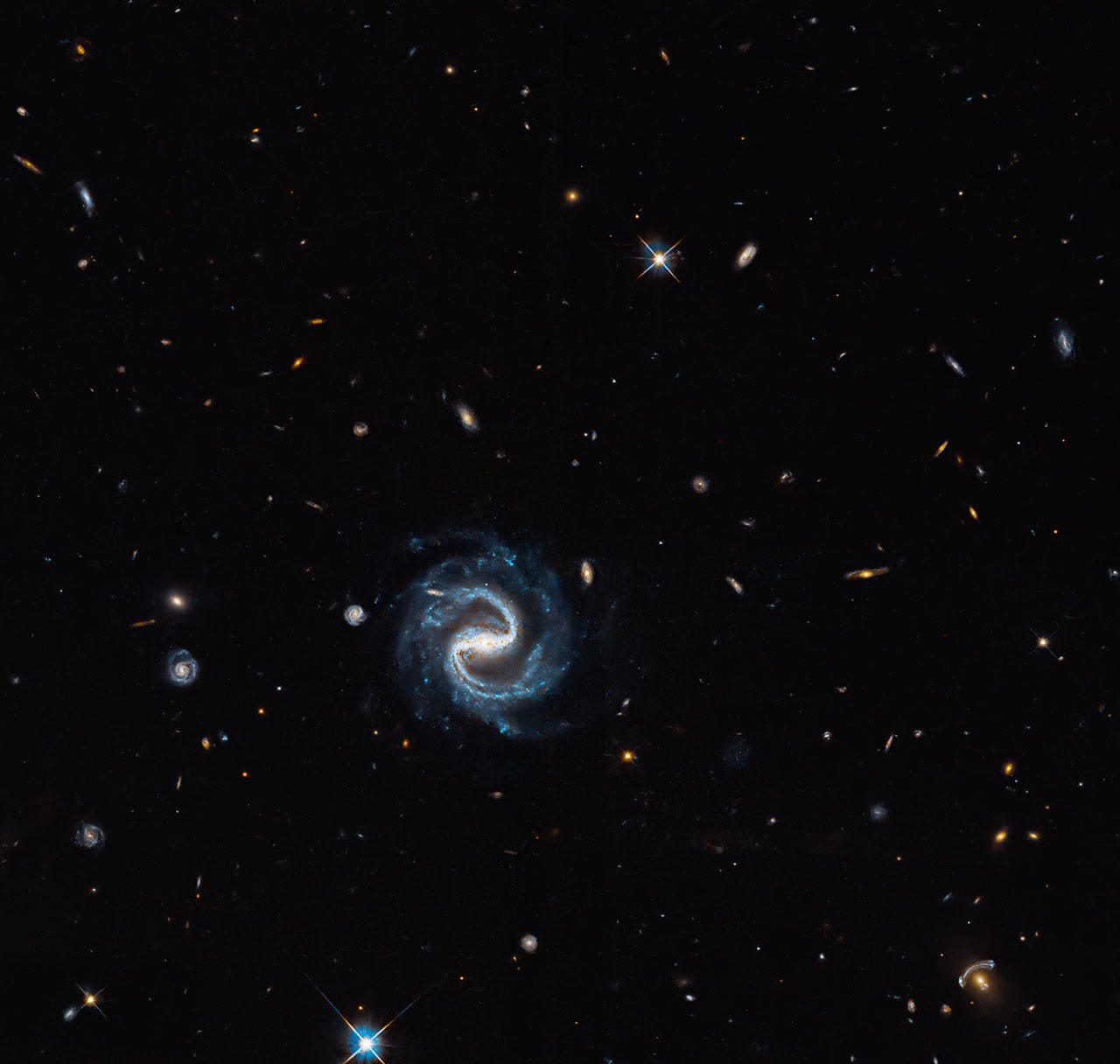
The broader context of these observations includes a sweeping barred spiral galaxy visible in recent imagery, similar in size to the Milky Way. Such galaxies are common in the universe, and understanding their mass and composition helps astronomers refine models of galactic evolution. The presence of smaller satellite galaxies, akin to the Magellanic Clouds orbiting our own galaxy, further adds complexity to these systems, offering additional opportunities for study.
As NASA prepares for the deployment of the Roman Space Telescope, these preparatory steps highlight a strategic shift toward large-scale cosmological surveys. By leveraging existing data from Hubble, scientists are laying the groundwork for discoveries that could redefine our understanding of dark matter. The collaboration between these two powerful instruments represents a significant advancement in observational astronomy, promising to unlock new insights into the fundamental nature of the cosmos.
Sources behind this briefing
Go to the original reporting
- NASA↗NASA’s Hubble Charts Path for Roman with Gravitational Lenses

