The short version
- Houthi rebels killed six people by firing missiles at a commercial vessel in the Bab el-Mandeb strait, marking the first known deaths from such attacks in this phase of conflict.
- U.S. forces disabled a Panamanian-flagged ship that ignored warnings to stop while attempting to evade the American blockade on Iranian ports in the Gulf of Oman.
- Pakistan’s interior minister visited Tehran for his sixth diplomatic trip aimed at reviving negotiations between Iran and the United States under an interim peace framework.
Violence has escalated significantly in the Middle East, with Houthi rebels killing six individuals in a missile attack on a commercial vessel within the Bab el-Mandeb strait. Yemeni authorities confirmed that the victims included four crew members and two personnel from the government-allied National Resistance Forces. The Transportation Ministry of the internationally recognized Yemeni government reported that three ballistic missiles were fired at the ship, marking the first recorded fatalities resulting from Houthi strikes on maritime traffic in this current surge of hostilities.
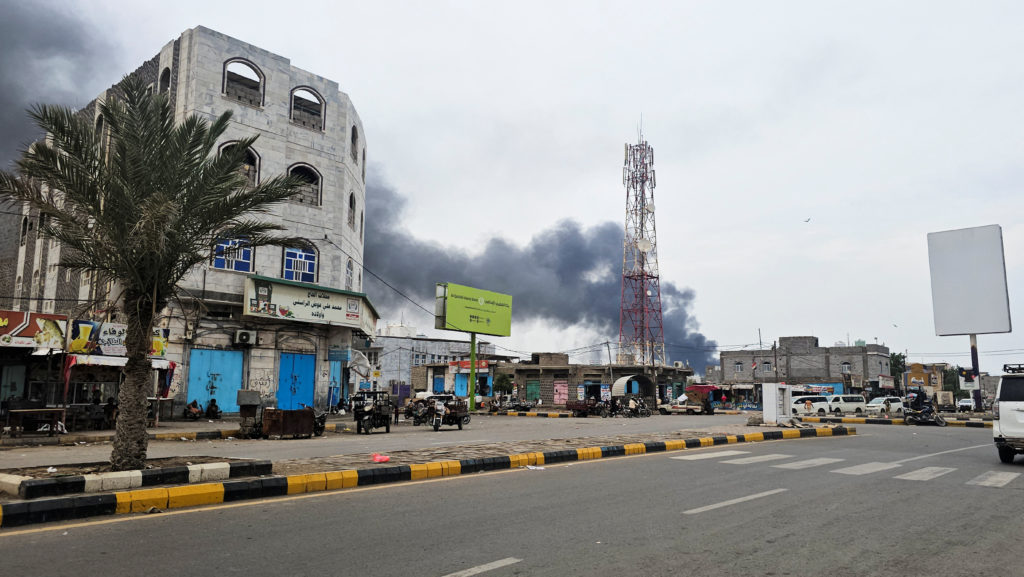
The attack occurred against a backdrop of intensified military activity across Yemen and neighboring regions. Houthi forces have simultaneously targeted the government-held port city of Mokha on the Red Sea coast, along with other areas under state control. According to the Yemeni military, dozens of troops and civilians have perished in these assaults since the previous week. This pattern of aggression represents a broader escalation by the Houthis against both domestic government forces and Saudi Arabian interests, including oil infrastructure and shipping lanes.
Strategic implications are mounting as the Strait of Hormuz remains effectively closed due to Iranian actions. Consequently, attention has shifted toward the Red Sea and the Bab el-Mandeb strait at Yemen’s southern tip, which serves as a critical alternative route for Saudi Arabia to export its oil. Analysts warn that these Houthi strikes could reignite the country’s civil war, which had been paused by a 2022 truce, while simultaneously opening a new front in the wider regional conflict involving Iran and its adversaries.
Mohammed Abdul-Salam, the chief negotiator and spokesperson for the Houthis, accused Saudi Arabia of exploiting the ceasefire to tighten an air and sea blockade originally imposed in 2015. In a social media statement, he indicated that while the group remains open to negotiations, any potential settlement must include the lifting of these restrictions. This stance highlights the deepening rift between the rebel group and the coalition supporting the Yemeni government, complicating prospects for a diplomatic resolution.
In parallel developments, United States military forces engaged in enforcement actions against maritime traffic attempting to bypass sanctions on Iran. The U.S. military reported firing on a Panamanian-flagged vessel, identified as the M/V Vela Nova, in the Gulf of Oman after it ignored warnings to stop. A helicopter launched missiles into the ship’s engine room, disabling it without reporting any casualties among the crew. This action is part of President Donald Trump’s strategy to maintain economic pressure on the Islamic Republic.
U.S. Central Command stated that it has redirected 55 commercial vessels attempting to run the blockade, disabled three non-compliant ships, and boarded two others. The American naval presence in the Arabian Sea currently includes more than 15 warships, featuring two aircraft carriers and an amphibious assault ship. These operations underscore the intensity of the U.S. commitment to enforcing the blockade despite ongoing Iranian resistance.
Iran has continued its campaign against ships in the Strait of Hormuz, largely shutting down this vital waterway that previously handled roughly one-fifth of global traded oil supplies. Tehran has refused to withdraw its demands for the U.S. to end the port blockade, lift sanctions, and meet other conditions before reopening the strait. The uncertainty surrounding the waterway’s future has kept energy prices at the center of U.S. political discourse ahead of November’s midterm elections.
Amidst the military confrontation, diplomatic efforts are underway through third-party mediation. Pakistani Interior Minister Mohsin Naqvi traveled to Tehran for meetings with Iranian Foreign Minister Abbas Araghchi and other officials. This marks Naqvi’s sixth trip to Iran as part of Pakistan’s ongoing diplomatic initiative to ease tensions between Tehran and Washington. The goal is to encourage Iran to resume negotiations under an interim peace deal brokered by Pakistan in June, although the success of these talks remains uncertain given the current escalation.
Sources behind this briefing
Go to the original reporting
- PBS NewsHour↗Iranian-backed Houthis kill 6 in attack on vessel, and other developments in the Mideast

