The short version
- High school interns developed computational models to predict when acoustic propellant gauging can yield reliable data during the IM-3 lunar mission.
- The team reconstructed spacecraft trajectories using public flight records from previous missions to estimate engine burns and velocity changes.
- Mentors noted the students' work rivaled that of graduate researchers, offering insights into fuel management critical for sustained lunar exploration.
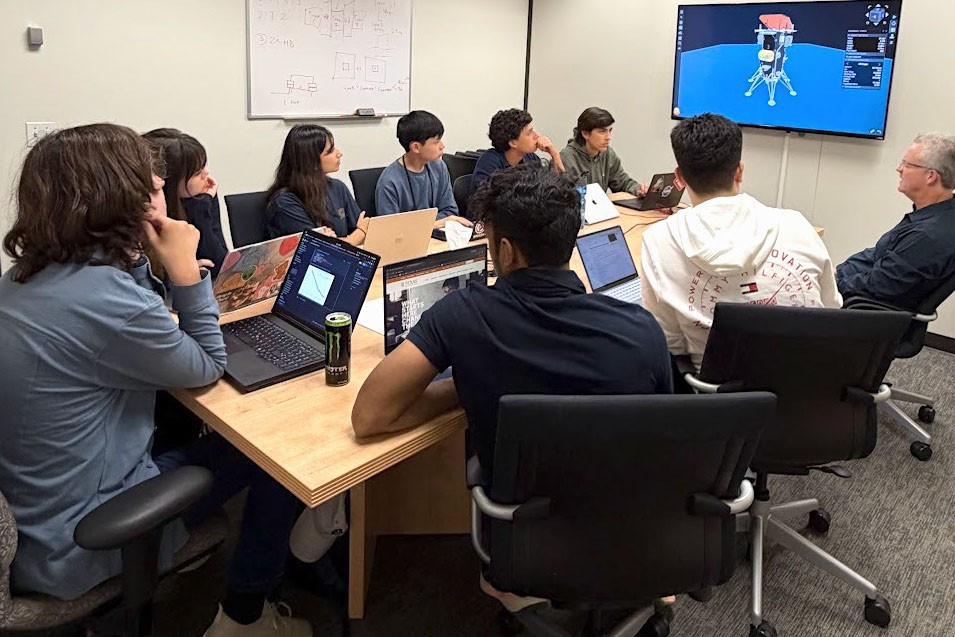
A group of high school students participating in a NASA-supported internship program has completed an analysis of propellant measurement techniques for an upcoming commercial lunar landing. The interns, part of the STEM Enhancement in Earth Science initiative at the University of Texas Center for Space Research, focused on the challenges of measuring fuel mass in microgravity environments. This work addresses a technical hurdle central to NASA’s broader Artemis exploration strategy, where liquid fuel tends to cling to tank walls rather than settling predictably.
The student team, known as the Mission Architecture Tool for Research, Integration, and eXploration group, applied a specific method called Modal Propellant Gauging. This approach relies on the acoustic response of propellant tanks to estimate the mass of fuel contained within them. The technique has already seen successful use in various spaceflight experiments and is scheduled for demonstration on the Intuitive Machines IM-3 mission. That lander, named Trinity, is planned to touch down in the Reiner Gamma region of the Moon in 2027.
To conduct their analysis, the students relied exclusively on publicly available information. They utilized trajectory records provided by the NASA Jet Propulsion Laboratory for previous Intuitive Machines missions, specifically IM-1 and IM-2. By comparing the reconstructed flight path of the IM-2 spacecraft with a theoretical model of its motion absent engine thrust, the team was able to identify specific engine burns. This allowed them to estimate the change in velocity associated with each maneuver, providing a baseline for understanding fuel consumption patterns.
Because a complete trajectory for the upcoming IM-3 mission is not yet public, the interns wrote a reconstruction algorithm based on the historical data from earlier flights. They also ran computational fluid dynamics simulations to estimate how fuel sloshes within tanks during movement. Additionally, they conducted Monte Carlo simulations to predict the range of possible propellant states under various conditions. These methods allowed them to model fluid behavior in ways that mirror professional aerospace engineering practices.
The analysis indicated that the acoustic gauging method can produce reliable readings during two primary engine burns: Lunar Orbit Insertion and Powered Descent. In some scenarios, reliable data could also be obtained during Descent Orbit Insertion. The team found that the spacecraft’s starting mass had the most significant impact on the duration of these gauging windows. They also identified potential launch opportunities for 2027 and produced a landing analysis showing the distribution of possible landing sites near the target area in Reiner Gamma.
The students presented their findings to engineers at Intuitive Machines, walking them through the methods and results used to build a rigorous analysis from public data. The research was also presented at the SEES Annual Symposium and the Wisconsin Space Grant Consortium Annual Conference. The team is scheduled to present again at the American Geophysical Union Annual Meeting in San Francisco later this year. These presentations highlight the practical application of their models to active mission planning.
Dr. Kevin Crosby, a mentor from Carthage College who helped develop the gauging approach, praised the depth of understanding achieved by the students in less than a month. He noted that their facility with advanced methods rivals that of graduate students in the field. The work product was described as exceptional, with the presentation to industry engineers impressing attendees with its sophistication and creativity.
This internship program provides eleventh and twelfth-grade students with direct experience using data, tools, and analytical methods common in the aerospace industry. By applying NASA and commercial mission data to an active lunar mission, the team contributed analysis relevant to propellant management. This capability is essential for future goals such as in-space refueling, fuel depots, and sustained exploration of the Moon and beyond.
The project underscores the potential for educational programs to contribute meaningfully to real-world spaceflight challenges. The interns’ ability to reconstruct mission parameters and predict sensor reliability from open-source data demonstrates a growing intersection between academic training and operational aerospace needs. As commercial lunar missions increase in frequency, such analytical frameworks may become increasingly valuable for mission assurance and planning.
The SEES program has operated for over a decade, supported by a NASA cooperative agreement. It places high school students on small, mission-focused research teams mentored by experts from NASA, academia, and industry. The success of this recent project highlights the program’s ongoing role in preparing the next generation of aerospace professionals while contributing tangible insights to current exploration efforts.
Sources behind this briefing
Go to the original reporting
- NASA↗NASA SEES Interns Tackle Real-World Challenges in Lunar Exploration

