The short version
- Researchers utilized the Daniel K. Inouye Solar Telescope to capture images of the sun's surface at a resolution never before achieved.
- The data reveals feathery, rippling patterns caused by magnetized plasma moving at different speeds, a phenomenon previously unobserved at this level on the solar surface.
- Understanding these fluid dynamics may improve predictions of coronal mass ejections and their potential impact on Earth's technology and communications infrastructure.
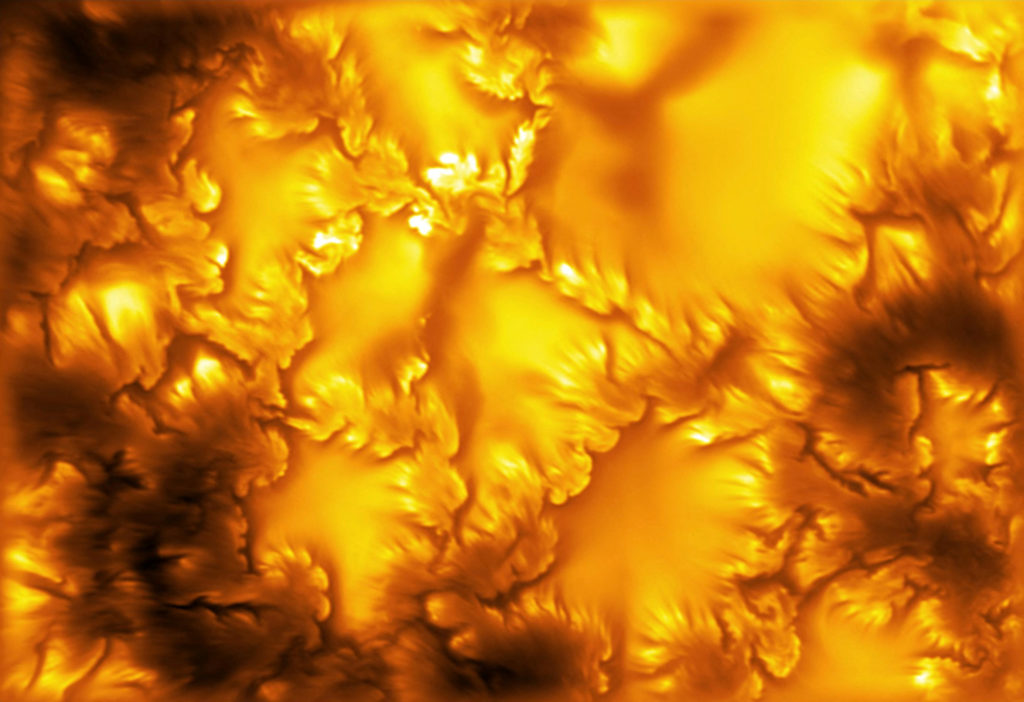
Scientists have released a new set of images depicting the sun’s surface with unprecedented clarity, revealing complex and dynamic structures that were previously invisible. The photographs, taken using the National Science Foundation’s Daniel K. Inouye Solar Telescope on the island of Maui, Hawaii, represent the highest resolution ever achieved for the star’s bright outer shell. While the initial goal of the observation was to test the technical limits and fine-tune the instrument, the resulting data provided a startlingly detailed view of solar activity.
The images highlight strange, feathery patterns rippling across the photosphere. These visual features resemble swirling skies in famous impressionist paintings, drawing comparisons to Vincent van Gogh’s work among independent observers. The patterns are not merely aesthetic; they represent physical instabilities on the sun’s surface. Specifically, they show bits of magnetized plasma moving past one another at varying speeds, creating turbulence similar to waves stirred by wind over water.
This type of fluid dynamic behavior is well understood in terrestrial physics and has been observed on other planets, such as Jupiter and Saturn. However, seeing it at this specific level of detail on the solar surface is a first. Friedrich Wöger, a co-author of the study published in the journal Nature, noted that while the phenomenon itself is known, its observation at this resolution on the sun had never been accomplished before. The clarity allows researchers to see how these magnetic forces interact in real-time.
The significance of these findings extends beyond pure astrophysics into practical space weather forecasting. Scientists are deeply interested in the sun’s internal mechanics because they drive massive bursts of energy known as coronal mass ejections. These eruptions can hurl charged particles toward Earth, potentially disrupting GPS signals, scrambling communications systems, and triggering solar storms. By better understanding the surface turbulence that precedes or accompanies these events, researchers hope to improve their ability to predict when such dangerous bursts might occur.
The Daniel K. Inouye Solar Telescope plays a critical role in this advancement due to its location and design. Situated on Maui, it benefits from stable atmospheric conditions that allow for sharper imaging than many other ground-based observatories. The telescope’s ability to resolve these fine details marks a significant step forward in solar observation technology. It demonstrates that current instruments can now peer into the sun’s scorching surface with enough precision to capture subtle magnetic interactions that were previously blurred or invisible.
Ruizhu Chen, a solar physicist at Stanford University who was not involved in the new research, commented on the visual impact of the data. He described the rippling patterns as reminiscent of artistic depictions of turbulent skies, highlighting how scientific data can sometimes mirror aesthetic beauty while conveying rigorous physical truths. This intersection of art and science underscores the profound nature of the discovery, bridging the gap between abstract physics and tangible visual evidence.
The publication of these findings in Nature signals a shift in how solar physicists approach surface dynamics. Previous models may have lacked the granular data needed to fully account for these small-scale instabilities. With this new dataset, researchers can refine their simulations of solar behavior. This refinement is crucial for long-term space weather monitoring, which protects satellite infrastructure and power grids on Earth from the effects of solar activity.
Looking ahead, the scientific community will likely analyze these images further to correlate surface turbulence with deeper solar processes. The data provides a new benchmark for future observations and may guide the development of next-generation telescopes. As understanding of the sun’s magnetic field improves, so too does the potential to mitigate risks associated with space weather events. This breakthrough offers a clearer window into our star, helping to demystify the forces that shape the solar system.
While the images are striking, they also serve as a reminder of the sun’s volatile nature. The same magnetic instabilities captured in these photos contribute to the energy releases that can affect life on Earth. Continued monitoring and analysis will be essential to translate these high-resolution visuals into actionable forecasts. For now, the release marks a milestone in solar astronomy, providing both scientists and the public with a more detailed understanding of the celestial body that sustains life on our planet.
Sources behind this briefing
Go to the original reporting
- PBS NewsHour↗WATCH: Scientists release most detailed sun images ever

