The short version
- Lewis Hamilton expressed frustration over Ferrari's race management during the Dutch Grand Prix, claiming a delayed pit instruction for Charles Leclerc cost him valuable track position.
- Hamilton contrasted Ferrari's hesitation with Mercedes' decisive strategy, which allowed Kimi Antonelli to secure second place by having George Russell yield position late in the race.
- Despite finishing fourth, Hamilton remains focused on closing the 59-point gap to championship leader Antonelli and urged his team to accelerate engine development efforts.
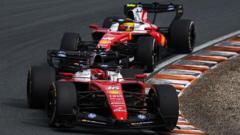
Lewis Hamilton has voiced significant dissatisfaction with Ferrari’s strategic handling of the Dutch Grand Prix, suggesting that a delay in managing teammate Charles Leclerc’s pit stop may have cost him a second-place finish. The Mercedes driver finished fourth at Zandvoort, trailing championship leader Kimi Antonelli by 59 points and sitting 28 points ahead of Leclerc, who placed fifth. Hamilton argued that the team’s hesitation in executing a planned maneuver left him stuck behind slower traffic during a critical phase of the race, ultimately hindering his ability to challenge for a higher position.
The controversy centered on a mid-race sequence where Hamilton, running on fresher tires, requested to pass Leclerc to optimize his battle against the Mercedes drivers ahead. Although team radio communications indicated an initial plan for Leclerc to pit, the Monegasque driver resisted the instruction and remained on track for an additional lap before finally coming in. Hamilton criticized the delay over the team radio, remarking on the wasted time. He later stated that losing several seconds behind his teammate was a decisive factor that prevented him from closing the gap to the leaders.
Hamilton drew a sharp contrast between Ferrari’s approach and the strategy employed by Mercedes during the same event. In a move designed to consolidate championship standing, Mercedes ordered George Russell to let team-mate Kimi Antonelli pass late in the race. This decisive action allowed Antonelli to secure second place without losing time to internal competition. Hamilton praised his current team for executing their plan effectively, noting that such clarity and speed are essential when fighting for a title. He emphasized that while Ferrari has shown promise, the lack of similar decisiveness needs to be addressed.
Ferrari team principal Frederic Vasseur offered a different perspective on the incident, attributing the confusion to a deliberate attempt to keep strategic information hidden from competitors. Vasseur explained that the team did not want to disclose their long-term plans to Hamilton early in the race, fearing that rivals might adjust their strategies accordingly. He maintained that keeping Hamilton on track until the end was intended to block Antonelli, and he believed this approach would have been the correct call if executed without error. Vasser acknowledged the miscommunication regarding Leclerc’s pit stop but expressed confidence that the team would clarify these issues in post-race briefings.
Despite the strategic disagreements, Hamilton acknowledged the progress Ferrari has made in recent months. He highlighted the introduction of new upgrades at Zandvoort as a positive step, noting that the team is gradually closing the performance gap with their rivals. However, he stressed that the current pace is still insufficient for a serious championship challenge. Hamilton pointed out that Ferrari was losing approximately 0.4 seconds per lap on the straights compared to Mercedes, a deficit that accumulates significantly over the course of a race.
The Dutch Grand Prix results underscore the intense pressure facing Hamilton as he seeks to lead his team back to the top of the sport. Finishing fourth meant missing out on crucial points in a tight championship battle. Antonelli’s second-place finish extended his lead, while Russell’s third place helped maintain Mercedes’ competitive presence. For Hamilton, the race was defined not just by the final position but by the missed opportunities that arose from strategic indecision. He reiterated his commitment to winning and his belief in the team’s potential, but warned that more work is required to translate promise into podiums.
Looking ahead, Hamilton emphasized the need for Ferrari to accelerate its engine development program. The power deficit observed at Zandvoort is a tangible barrier that must be overcome if the team hopes to compete with Mercedes and other top contenders. With only half a season remaining, the margin for error is slim. Every point matters in the fight for the championship, and Hamilton’s comments suggest that internal alignment and strategic precision will be just as important as raw speed in the coming races.
The incident at Zandvoort highlights the complex dynamics of team orders and strategy in modern Formula One. While Mercedes demonstrated a clear hierarchy aimed at maximizing their leader’s chances, Ferrari’s attempt to balance secrecy with execution resulted in confusion and lost time. As the season progresses, how Ferrari manages these internal challenges will likely determine whether Hamilton can close the gap to Antonelli or if the championship will slip further out of reach. The team’s ability to learn from this experience and implement clearer communication protocols will be critical in the remaining events.
Hamilton’s frustration reflects a broader concern about consistency and execution under pressure. While individual driver performance remains high, the collective effort must be seamless to challenge for titles. The contrast with Mercedes’ handling of their own team dynamics serves as a benchmark for what is required at the highest level. For Ferrari, the path forward involves not only technical upgrades but also refining the strategic decision-making process to ensure that opportunities are seized rather than lost to hesitation.
As the championship battle intensifies, every race becomes a test of both speed and strategy. Hamilton’s fourth-place finish was a reminder that even small errors in judgment can have significant consequences. The team’s response to this setback will be closely watched by fans and analysts alike. Whether Ferrari can replicate Mercedes’ decisiveness while maintaining its own competitive edge remains an open question, but the stakes have never been higher for Hamilton and his teammates.
Sources behind this briefing
Go to the original reporting
- BBC Sport↗Ferrari delay in moving Leclerc costly - Hamilton
