The short version
- German police conducted their first operations under a December law that specifically criminalizes aiding migrant smuggling to non-EU nations like the United Kingdom.
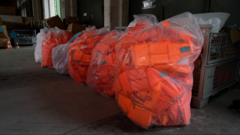
- The raids in western Germany yielded over 9,000 life jackets and equipment capable of transporting more than 2,000 people across the English Channel.
- Investigators attribute the supply chain disruptions to increased pressure on Kurdish criminal networks operating from German hubs near French launch sites.
German authorities have executed their first enforcement actions under a new legal framework designed to dismantle smuggling operations that use the country as a staging ground for small boat crossings into the United Kingdom. The raids, which took place in the North Rhine-Westphalia region during the spring, were part of a coordinated effort involving law enforcement agencies from Germany, France, and the UK. This operation marks a significant shift in Berlin’s approach to cross-border migration crime, moving beyond reliance on foreign warrants to direct domestic prosecution.
The seizures included more than 9,000 life jackets, dozens of inflatable dinghies, engines, and 360 pumps. These items are currently held at an undisclosed police warehouse in western Germany, where they remain largely as found by officers. The deflated boats, measuring approximately nine meters in length, were packed in cardboard boxes, while the life jackets were tightly bundled in plastic wrapping. Officials noted that the orange vests contained minimal poly-foam padding, rendering them inadequate for the unpredictable conditions of the English Channel.
Prior to the legislation passed last December, German anti-smuggling laws primarily applied to movements within the European Union’s zone of free movement. This legal gap meant that facilitating crossings to third countries, such as post-Brexit Britain, was not explicitly criminalized under domestic statutes. The new law closes this loophole, allowing police to investigate and prosecute individuals who assist in ferrying migrants to the UK. While the Interior Ministry confirmed these were the first raids under the statute, it did not specify whether additional operations have occurred since.
British investigators estimate that the seized equipment could have facilitated the illegal transport of more than 2,000 migrants across the Channel. This figure aligns with recent averages for passenger numbers per vessel, though it falls short of the capacity seen in larger 'mega dinghies' observed later in the summer. Experts from Oxford’s Migration Observatory suggest that the trend toward larger vessels is a direct response to heightened enforcement, as smugglers seek to maximize profit by fitting more people into each available boat.
The supply chain for these operations appears deeply rooted in international trade routes. Tags on the seized life jackets featured Chinese lettering, consistent with reports that much of the equipment is manufactured in China before being shipped to Europe, often via Turkey. Customs officials recently intercepted undeclared dinghies hidden within mattress pads at a Turkish-Bulgarian border crossing, with the driver heading toward Germany. This highlights the complexity of tracking materials from production sites in Asia through multiple European borders.
Criminal networks, particularly those identified as Kurdish, are believed to exert significant control over the small boat business in western Germany. The region has become a logistical hub due to its proximity to northern France, where boats typically launch. It is close enough to allow efficient transport of equipment but distant enough from heavily patrolled French beaches to avoid immediate detection. Many gang members reside in Germany, making it a convenient base for organizing these illicit activities.
Legal experts note that the amended provisions remain largely untested in court. Bernhard Schmeilzl, a lawyer specializing in UK-German law, observed that while the legal landscape resembles pre-Brexit conditions, the new statute provides clearer mandates for police action. He argued that authorities are now obligated to investigate suspicious activity related to smuggling, even if stretched resources might prioritize domestic issues. This change aims to ensure consistent enforcement rather than ad hoc responses.
The broader context of these raids includes a reported decline in Channel crossings this year. The UK Home Office stated that cooperation with partner nations like Germany is yielding results, citing a roughly 43% drop in crossings between January and early August compared to the same period last year. However, enforcement agencies warn that criminal groups tend to adapt rather than abandon their operations when supply lines are disrupted, suggesting that future challenges will require sustained international coordination.
As Germany continues to refine its legal tools against smuggling, the focus remains on disrupting the logistical networks that enable these dangerous journeys. The seizure of equipment in North Rhine-Westphalia serves as a test case for the effectiveness of the new law. Whether this approach will significantly reduce the flow of migrants or simply displace operations to other regions remains uncertain, but it represents a decisive step in aligning German enforcement capabilities with current migration dynamics.
Sources behind this briefing
Go to the original reporting
- BBC News↗Inside secret police warehouse as Germany targets small boats gangs

