The short version
- Police disarmed a drone loaded with Semtex near Ukrainian cargo planes at Leipzig/Halle airport after it evaded detection systems.
- The incident forced the closure of a major European logistics hub and caused a DHL flight to divert after colliding with an unidentified object midair.
- German officials have launched a counterterrorism investigation, describing the event as a hybrid threat while denying the targeted aircraft carried munitions.
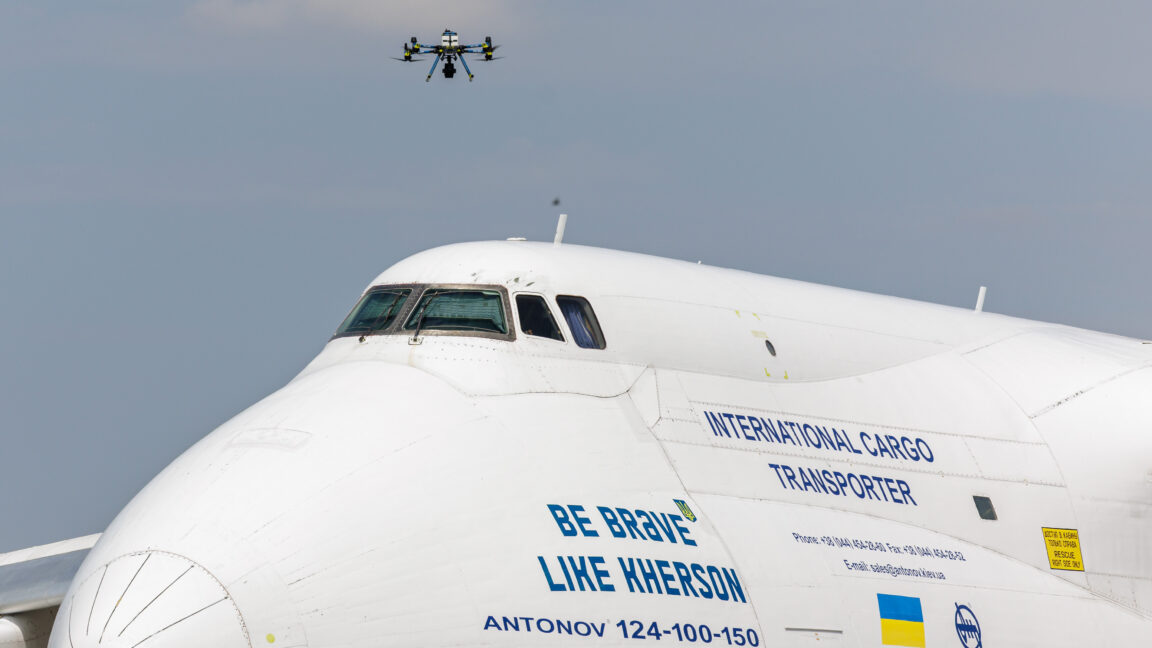
Authorities in Germany have disarmed a drone equipped with explosives that was discovered hovering near parked Ukrainian cargo aircraft at the Leipzig/Halle airport. The incident occurred shortly before midnight on August 4, when an airport employee spotted the device flying close to the ground between two Antonov An-124 jets owned by Ukraine’s Antonov Airlines. Federal Interior Minister Alexander Dobrindt stated that the drone had been specifically modified to evade the airport’s existing defense sensors, highlighting a sophisticated attempt to bypass security measures at one of Europe’s largest air cargo hubs.
The device carried a fist-sized package of what officials believe was Semtex plastic explosive. According to Dobrindt, the attack failed only because the detonator malfunctioned, preventing the payload from exploding near the aircraft. German police utilized a bomb disposal robot to secure the drone before conducting a controlled explosion to neutralize the threat. The Interior Ministry emphasized that the targeted aircraft were empty at the time of the incident, directly contradicting earlier media reports suggesting they were transporting weapons or munitions for delivery to Ukraine.
The security breach forced the immediate closure of Leipzig/Halle airport to all air traffic for several hours. This disruption caused nineteen flights to divert to other locations, including a Boeing 757 operated by DHL that aborted its landing approach. As the DHL aircraft began climbing again to leave the airspace, it collided with another flying object midair. The plane sustained minor damage and diverted to Hanover airport. German police are currently investigating whether this second object was another drone, suggesting the possibility of a coordinated multi-drone operation.
While no specific suspect has been officially named, German authorities have opened a counterterrorism investigation into the event. Dobrindt characterized the incident as a hybrid threat scenario involving potential foreign powers. Roderich Kiesewetter, a lawmaker on the German parliament’s intelligence committee, went further in his assessment, directly attributing responsibility for the attempted act of terrorism to Russia. This attribution aligns with broader concerns about Russian interference in European airspace, though official government statements have stopped short of formally accusing Moscow.
Indirect evidence has fueled speculation regarding the origin of the attack. Alexander Sosnowski, a pro-Kremlin propagandist who frequently appears on Russian state television, posted a video on Telegram expressing disappointment that the operation failed. In the clip, Sosnowski clearly assumed the attempt was a Russian effort targeting Ukrainian aircraft. While this does not constitute official confirmation, it adds to the narrative of state-sponsored or state-tolerated aggression against Ukrainian assets located in Germany.
Leipzig/Halle airport serves as a critical node for international logistics, frequently handling shipments for NATO and the German military. It is also the current home base for Antonov Airlines, which operates the world’s largest operational cargo aircraft fleet. The strategic importance of this location makes it a high-value target in the context of the ongoing war in Ukraine. Germany has provided approximately $118 billion in support to Ukraine since 2022, including weapons, humanitarian aid, and training for more than 24,000 soldiers.
This incident is part of a growing trend of drone incursions across Europe. Since 2024, dozens of drones have been sighted over airports, military bases, ports, and industrial facilities in Northern and Eastern Europe. These areas are particularly vulnerable due to their proximity to Russia. Previous incidents have included repeated scrambles of fighter jets and a crash in Romania that caused injuries and a building fire. In May, Munich airport closed twice within twenty-four hours due to possible drone sightings, illustrating the persistent nature of these threats.
Despite the increasing frequency of such events, the European Drone Defence Initiative has yet to deliver a comprehensive counter-drone surveillance system. Ulrike Franke, a senior policy fellow at the European Council on Foreign Relations, noted that the promised drone wall has not materialized in any meaningful way. Instead, individual nations like Poland are developing their own national defense systems. Germany continues to deepen its military cooperation with Ukraine, including recent joint ventures to produce new military drones capable of AI target tracking.
The failure of the detonator at Leipzig/Halle airport prevented a potentially catastrophic outcome, but it underscores significant vulnerabilities in European airspace security. The collision involving the DHL flight suggests that attackers may be employing multiple devices to overwhelm defenses or create secondary hazards. As investigations continue, the incident serves as a stark reminder of the evolving nature of hybrid warfare and the challenges facing European infrastructure protection.
German officials remain focused on determining the full scope of the attack and identifying those responsible. The counterterrorism probe will likely examine digital footprints, flight paths, and potential links to known hostile actors. With no unified European defense framework in place, individual airports and nations must rely on ad hoc measures to mitigate these risks. The incident at Leipzig/Halle highlights the urgent need for improved detection capabilities and coordinated response strategies across the continent.
Sources behind this briefing
Go to the original reporting
- Ars Technica↗Explosive drone found hovering near Ukrainian cargo aircraft at German airport

