The short version
- Approximately 320,000 people protested nationwide in France on Saturday, marking the third consecutive weekend of demonstrations focused on economic and educational grievances.
- Authorities deployed 70,000 security personnel and rerouted Paris marches to the city outskirts to prevent violence following severe rioting during earlier protests.
- Youth-led movements have expanded beyond France, with significant rallies reported in Germany and Italy demanding better social services, climate action, and affordable living.
France experienced another wave of mass demonstrations on Saturday, as hundreds of thousands of citizens took to the streets for a third consecutive weekend. The protests, largely driven by young people, focused on rising living costs, inadequate education infrastructure, and broader economic anxieties. Government estimates placed the nationwide turnout at approximately 320,000 participants, a figure that represents a decline from previous weekends but still indicates substantial public mobilization. Earlier demonstrations in mid-October drew significantly larger crowds, with official counts reaching over 500,000 on October 17 and 410,000 on October 24, though organizers consistently claim higher numbers.
The security response was extensive, with roughly 70,000 police officers and gendarmes deployed across the country to maintain order. French Interior Minister Laurent Nuñez characterized the situation as carrying a "very high risk" of disorder, particularly after dark on Halloween night. To mitigate potential unrest near government buildings and tourist attractions, authorities rerouted the main march in Paris to the city’s eastern edge. This decision followed a last-minute legal challenge and aimed to protect commercial areas from the looting and rioting that had marred earlier protests.
The atmosphere in Paris varied significantly depending on the location and group involved. At Porte de Bagnolet, thousands gathered behind lines of students holding hands, with security agents from the CGT labor union monitoring the front. Protesters carried banners representing diverse causes, including high school students, climate activists, and those frustrated by inflation. Some participants embraced the Halloween theme, wearing costumes such as zombies and superheroes, while chanting through megaphones in a calm manner. This festive approach was intentional for some attendees, who sought to counter the violent imagery associated with recent unrest.
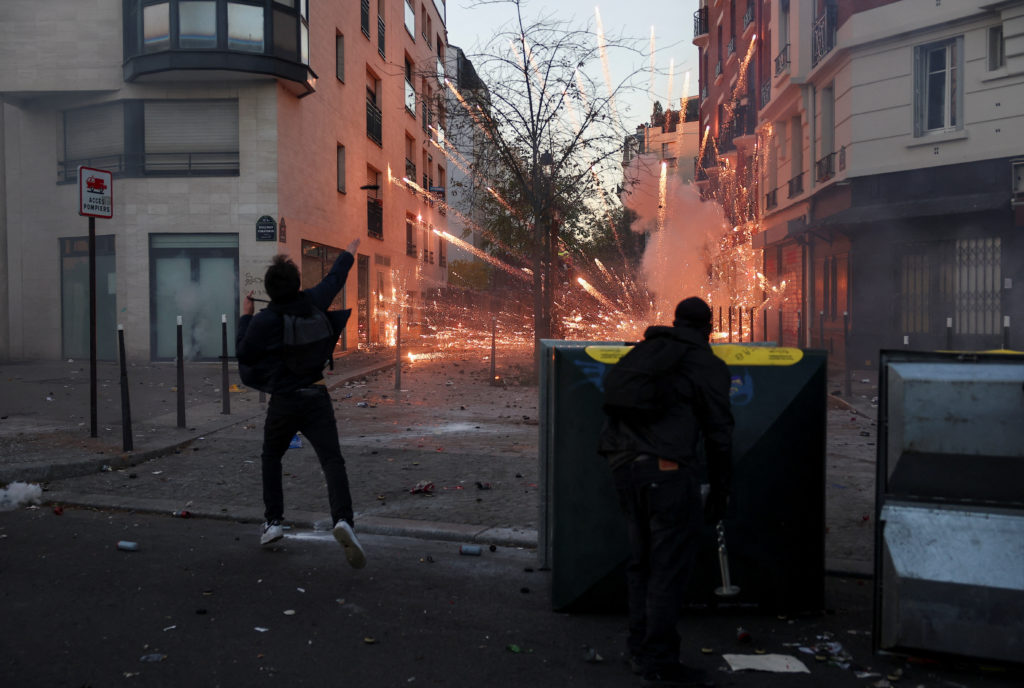
Despite the largely peaceful nature of the majority of demonstrators, isolated groups have engaged in serious violence. Previous protests deteriorated into some of the worst rioting seen in France in years, involving looting and attacks on police with fireworks and projectiles. Authorities responded with tear gas, water cannons, and dispersion grenades, leading to severe injuries among both protesters and officers. Thousands of arrests were made following the riots on October 17, which caught the government off guard. The current strategy involves strict containment and preemptive curfews to prevent a recurrence of such chaos.
Curfew measures have been implemented with varying degrees of legal scrutiny. Police barred entry to central Paris areas like Place de la Republique and Les Halles during late-night hours on Saturday and Sunday. Unaccompanied minors faced an earlier curfew near the Champs-Elysees, although a Paris court had previously suspended a similar restriction, ruling it an illegal infringement on freedom of movement. These restrictions highlight the tension between maintaining public safety and preserving civil liberties during periods of intense social unrest.
The roots of the current unrest lie in longstanding grievances within the French education system. The rallies began last month with high school students protesting neglected school buildings, teacher shortages, and a university admissions process perceived as unfair to disadvantaged youth. Corentin Cabreux, a 21-year-old student, described living conditions in state-run residences that included damp walls, peeling paint, and infestations of cockroaches and rats. These personal accounts underscore the tangible impact of systemic neglect on young people’s daily lives.
The movement has since broadened to include labor unions and critics of President Emmanuel Macron’s policies. While the initial focus was on education, demands have expanded to cover fuel prices, social services, and general affordability. Labor unions joined forces with student groups, creating a coalition that spans multiple sectors of society. This convergence of interests has amplified the protests’ reach and intensity, making them more difficult for authorities to dismiss as isolated incidents.
Similar youth-led demonstrations have emerged in other European countries, suggesting a broader continental trend. In Germany, an initiative called "Gen Z regelt" organized rallies in multiple cities, advocating for education, health, climate protection, and affordable living. Organizers reported over 180,000 online sign-ups, though actual turnout on Saturday numbered only in the thousands. Participants at Berlin’s Brandenburg Gate demanded increased investment in social services and housing, echoing concerns raised by French protesters.
German students emphasized the long-term consequences of current policy decisions. Lara Breitenbach, a high school student, argued that young people will bear the brunt of inadequate investments in climate protection and social infrastructure for decades to come. Janelle Schulz, another Berlin student, stressed the need for authorities to prioritize funding for education and housing. These parallel movements indicate a shared frustration among European youth regarding economic stability and future prospects.
Looking ahead, the situation remains volatile. The French government has pledged new university admissions reforms to address student anger, but these measures are set to take effect only after President Macron leaves office. This delay may fail to quell immediate frustrations, potentially sustaining protest momentum. With Halloween night posing a heightened risk for disorder, authorities remain on high alert. The coming days will reveal whether the current security strategies can contain unrest or if further escalation is likely across France and potentially other European nations.
Sources behind this briefing
Go to the original reporting
- NPR↗France seethes again as youth-led protests sweep Europe
- PBS NewsHour↗A third weekend of protests in France as youth-led rallies sweep Europe