The short version
- Researchers have identified a fossilized amphibian that appears to have lived its entire life in marine waters, defying the typical dual-life cycle of the class.
- The creature possessed bony armor and specialized gills that likely prevented dehydration, allowing it to bypass the osmotic challenges that prevent modern amphibians from entering the sea.
- This discovery forces a reevaluation of evolutionary history regarding how early vertebrates adapted to saline environments and may inform current conservation strategies.
The biological definition of an amphibian has long been anchored in its Greek etymology, which translates to 'double life.' This classification reflects the typical lifecycle of creatures that transition between aquatic and terrestrial habitats, relying on permeable skin for respiration and hydration. However, recent findings from southwestern China suggest that this rule was not absolute during the Triassic period. Paleontologists have uncovered evidence of a species that appears to have abandoned land entirely, residing exclusively in marine environments approximately 237 million years ago.
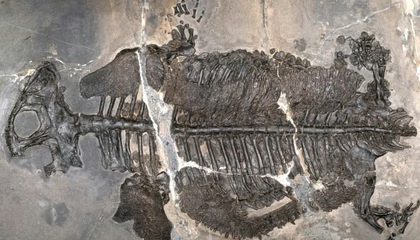
The discovery centers on two nearly complete fossilized skeletons unearthed in Guizhou Province. These specimens belong to a newly named species, Gerrothorax maritimus, which translates to 'armored chest of the sea.' The fossils were found within deep-sea sediment layers, indicating that the animals died and were preserved close to their natural habitat. The completeness of the remains is significant because marine carcasses typically degrade rapidly or lose limbs before sinking, making well-preserved specimens rare. Their presence alongside ancient marine reptiles, such as ichthyosaurs, further supports the conclusion that these creatures inhabited salty waters rather than freshwater systems.
For modern science, this finding presents a paradox. Today, there are more than 8,000 known amphibian species, yet none live exclusively in the ocean. Only a tiny fraction exhibit any tolerance for salt, and even those with some resistance struggle in brackish conditions. The primary obstacle is physiological: amphibian skin is thin and permeable, designed to absorb water and oxygen directly from the environment. When exposed to seawater, osmotic pressure causes the animal to lose body fluids rapidly, leading to dehydration and eventual death. This biological constraint has historically prevented amphibians from colonizing marine ecosystems.
Gerrothorax maritimus appears to have evolved a workaround for this fatal vulnerability. The creature was roughly 30 inches long and possessed a flattened body covered in bony armor. Researchers suspect that this external plating acted as a barrier, preventing the skin from absorbing water directly. Instead of relying on cutaneous respiration, the animal likely drank water through its mouth and utilized gills to filter out excess salt. This adaptation would have allowed it to maintain fluid balance in a high-salinity environment, a feat that remains impossible for contemporary amphibians.
The identification of G. maritimus as a fully marine species relies on multiple lines of evidence beyond anatomy. Scientists analyzed the strontium isotopes within the fossilized bones, a technique used to determine the chemical signature of the water in which an organism lived. The ratios matched those of Late Triassic oceans rather than freshwater sources. Additionally, the animal’s morphology suggests it was a bottom-dwelling predator that likely sucked in prey passing by, a feeding strategy consistent with life on the ocean floor.
Evolutionary analysis indicates that G. maritimus is closely related to Gerrothorax pulcherrimus, an extinct freshwater amphibian from the same era. The two species shared similar armored bodies and flattened shapes, suggesting a common ancestor. Researchers propose that the marine lifestyle of G. maritimus was not a deliberate evolutionary drive but rather an accidental colonization. The freshwater ancestor already possessed the necessary physical traits—specifically the body armor—that inadvertently allowed it to survive in saltwater, opening a new ecological niche.
Experts outside the study team have described the discovery as potentially revolutionary. If confirmed, this finding reshapes the understanding of vertebrate evolution and the historical relationship between amphibians and saline environments. It demonstrates that the barriers preventing modern amphibians from entering the sea are not insurmountable given the right anatomical adaptations. This insight is particularly relevant today as rising sea levels and freshwater salinization threaten current amphibian populations.
Understanding how ancient species adapted to changing water chemistry may offer valuable lessons for modern conservation efforts. As saltwater intrusion becomes a growing concern for freshwater ecosystems, studying the physiological mechanisms that allowed G. maritimus to thrive could inform strategies for protecting vulnerable species. The research underscores the complexity of evolutionary history and highlights that biological constraints observed today may not have always applied throughout Earth’s deep past.
Sources behind this briefing
Go to the original reporting
- Smithsonian Magazine↗Paleontologists Discover the First Known Amphibian That Lived Entirely at Sea: a Flat, Armored Creature From 237 Million Years Ago