The short version
- Artisans criticize the film’s use of plaiting rather than traditional willow weaving for its central character.
- Special effects experts prioritized actor mobility and facial expression recognition over botanical accuracy in costume construction.
- The controversy has increased public interest in basketry, though definitions of wicker remain contested among practitioners.
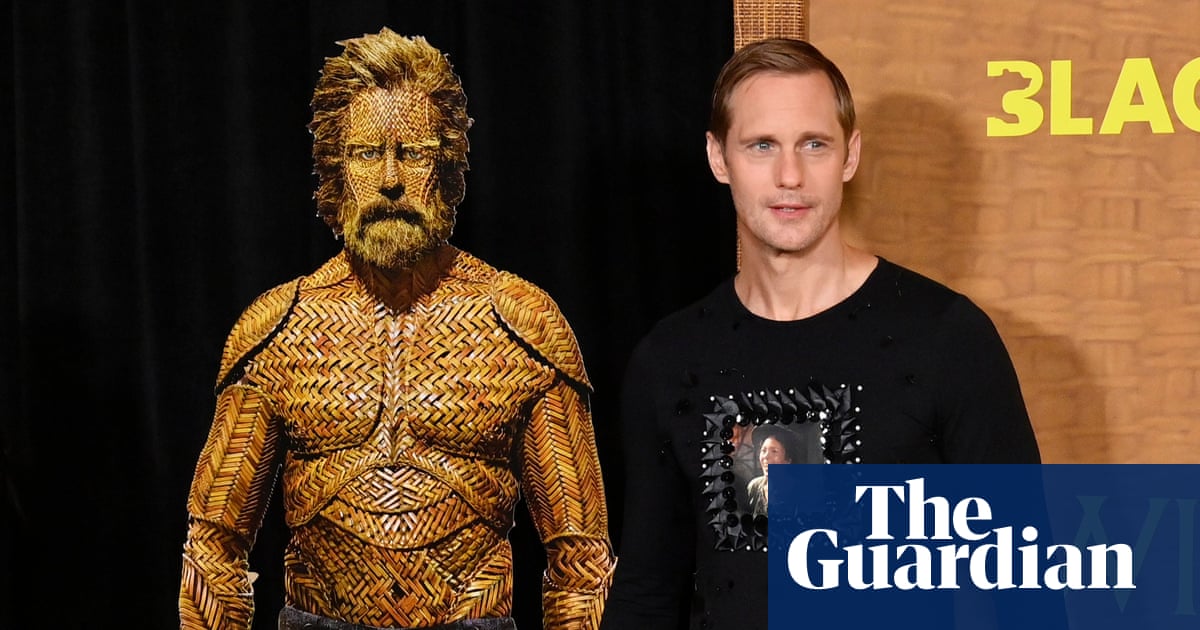
A romantic comedy featuring a sentient character constructed from woven materials has ignited a technical dispute within the global basketmaking community. The film, which stars Alexander Skarsgård as a figure referred to as the Wicker Husband, has drawn intense scrutiny from artisans who argue that the character’s construction violates traditional definitions of wickerwork. While general audiences have embraced the novelty of the role, with social media users joking about furniture and relationships, specialists in fiber arts are focused on material accuracy and structural integrity.
The core of the disagreement centers on the distinction between weaving and plaiting, as well as the choice of materials. Deborah Needleman, a former magazine editor turned basket maker, questioned why a character set in an English fishing village was not constructed from willow or rush, plants historically associated with British wickerwork. She noted that while she appreciates the visibility for her craft, the technical execution raises questions about authenticity. More than one hundred other makers have joined the conversation, highlighting a divide between cinematic fantasy and artisanal tradition.
Definitions of wicker vary among experts, complicating the debate. The Oxford English Dictionary describes wicker as thin sticks of wood twisted together to create baskets or furniture. Eleanor Morgan, a trade adviser for the Worshipful Company of Basketmakers in London, notes that while willow is commonly used today, historical usage included any pliant twig or osier. This suggests that the term may refer more to the flexibility of the material than to a specific plant species, though many purists maintain that true wickerwork requires specific botanical inputs.
Lewis Prosser, a basket maker from Cardiff, argues that wicker refers to an object that is woven but distinct from textile work. He identifies three primary methods for creating baskets: coiling, braiding, and stake-and-stand basketry. According to Prosser, traditional wicker items typically utilize the latter method, where vertical rods are interwoven with horizontal strands. The character in the film appears to be plaited rather than woven in this traditional sense, leading some artisans to view the costume as a misrepresentation of their craft.
The special effects team at Wētā Workshop in New Zealand faced significant challenges in creating a costume that allowed Skarsgård to move naturally while appearing sentient and non-human. Joe Dunckley, a prosthetic designer on the project, explained that standard prosthetic materials are designed to mimic soft skin, which was unsuitable for this role. Instead, the team developed fifty interlocking body pieces using a rubber-like thermoplastic elastomer. These pieces were 3D printed with a bespoke weave pattern and attached to a spandex suit, allowing for flexibility and durability during filming.
Dunckley emphasized that practical constraints dictated the material choices. Using actual willow would have been unviable for a costume requiring extensive movement and facial expression. He compared the situation to film armor, which is rarely made of real steel due to weight and safety concerns. The goal was to create a fantasy representation that remained recognizable as Skarsgård, particularly capturing his characteristic facial expressions. To achieve this, the team ensured the weave could furrow at the brow, maintaining the actor’s expressive range.
The production also incorporated traditional materials in specific areas. Skarsgård’s hair, beard, and eyelashes were crafted from muka, fibers derived from New Zealand flax. This choice reflects a blend of practical necessity and aesthetic consideration, aiming to ground the fantastical element in tangible, natural textures. The eighteen-month development process involved eighty specialists who created ten facial appliances alongside the body suit, ensuring that the character remained visually coherent throughout various scenes.
Despite the criticism, some artisans acknowledge the film’s potential to raise awareness for endangered traditional skills. Prosser noted that while he would not have approached the construction in the same way, the attention brought to basket making is valuable. Social media platforms have seen a surge in tutorials related to wicker costumes, indicating a broader public interest in the craft. Dunckley expressed respect for the artisans’ dedication, noting that it is natural for experts to critique a fantasy interpretation of their specialized field.
The setting of the film adds another layer to the authenticity debate. Although the characters speak in British dialects, the story is not explicitly set in England. Dunckley suggested that the character played by Peter Dinklage may have traveled globally, acquiring skills from various makers. This narrative device allows for a broader interpretation of weaving techniques, though Prosser argued that if the film were set in a specific location, the costume should reflect local plant availability. In the UK, willow would be appropriate, whereas Esparto grass might fit a Spanish setting.
As the discussion continues, the divide between artistic license and technical precision remains unresolved. For purists, the lack of osier-related accuracy is a significant oversight, while others view the costume as a creative adaptation necessary for cinematic storytelling. The film has succeeded in drawing attention to basketry, even if the methods depicted do not align with traditional practices. Whether this increased visibility will lead to greater appreciation for authentic techniques or merely reinforce misconceptions remains to be seen.
Sources behind this briefing
Go to the original reporting
- The Guardian US↗Basketweavers get in a twist over Alexander Skarsgård’s Wicker Husband