The short version
- FIFA has mandated that Spain play its next international friendly with fifteen percent of stadium seating closed due to discriminatory chants directed at Egypt.
- The disciplinary committee rejected the Spanish federation's argument that the behavior was harmless, citing inconsistencies in their initial response to the incident.
- The penalty will likely be enforced in June unless Spain qualifies for the Nations League finals, which would defer the sanction until next autumn.
FIFA has issued a disciplinary sanction against the Spanish Football Association requiring a partial stadium closure for an upcoming international friendly. The decision follows an incident during a match between Spain and Egypt in March, where supporters were recorded singing chants deemed discriminatory toward Muslims. The governing body determined that the behavior violated standards regarding xenophobia and Islamophobia, prompting formal proceedings against the national federation.
The specific penalty mandates that fifteen percent of the seating capacity at the venue for Spain’s next friendly must remain empty. This restriction is primarily targeted at the stands located behind the goals, areas often associated with organized supporter groups. However, FIFA has provided a mechanism for mitigation: the Spanish federation may apply to fill these vacant seats with representatives from community organizations, student groups, families, or anti-discrimination advocates, subject to final approval by the disciplinary committee.
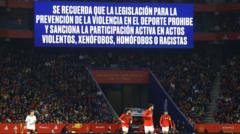
The incident in question occurred during a friendly match played at the RCDE Stadium in Barcelona. Witnesses and broadcast footage indicated that a group of home fans began chanting around the tenth minute of the first half and resumed the behavior at the start of the second half. In response to the initial outburst, stadium screens displayed messages warning against discrimination. When the chanting recurred early in the second half, the warnings were repeated, which reportedly provoked whistles from sections of the crowd.
Following the match, which ended in a goalless draw, reactions from Spanish officials were mixed in their framing but consistent in condemnation. Luis de la Fuente, the head coach for Spain, described the chants as intolerable and criticized individuals who use football to create space for violent ideologies. The Spanish Football Association also issued statements condemning the anti-Muslim rhetoric. Despite these public rebukes, the federation later argued in written submissions to FIFA that the chants did not rise to the level of discriminatory conduct.
The FIFA disciplinary committee explicitly rejected this defense. In its published reasoning, the panel noted a logical contradiction in the Spanish federation’s position. The committee observed that it was not persuasive for the RFEF to simultaneously claim the behavior was entirely harmless while also justifying the activation of anti-discrimination measures during the match. This inconsistency undermined the federation’s attempt to minimize the severity of the incident.
The Egyptian Football Association responded to the events by condemning the chants as a repugnant act of racism. However, they emphasized that the actions of a small group of fans should not overshadow the broader relationship between the two nations’ football bodies. They stated that these isolated incidents would not affect the close ties maintained between the Spanish and Egyptian federations.
The timing of the penalty’s implementation depends on Spain’s future competitive schedule. If the team does not qualify for the finals of the Nations League, the stadium closure is expected to be enforced during a friendly scheduled for June. Should Spain advance to the Nations League finals, the punishment will be postponed. In that scenario, it would apply to one of the available dates during the Euro 2028 qualifying window in the following autumn.
This case highlights the ongoing challenges football authorities face in policing fan behavior and enforcing anti-discrimination policies. While national federations often issue immediate condemnations, the subsequent legal or disciplinary arguments can complicate accountability. FIFA’s decision underscores a strict interpretation of conduct standards, prioritizing consistency in how discriminatory acts are classified regardless of post-incident justifications by member associations.
The requirement to close sections of the stadium serves as both a punitive measure and a symbolic gesture. By mandating that specific areas remain empty or be filled by designated community groups, FIFA aims to disrupt the environment that facilitated the chanting. This approach seeks to address the root cause of the behavior rather than merely penalizing the organization financially, marking a distinct strategy in handling crowd-related disciplinary issues.
As Spain prepares for its next international fixtures, the federation must navigate the logistical and reputational implications of this ruling. The potential involvement of anti-discrimination organizations in filling the closed seats could reshape the atmosphere at future matches. Meanwhile, the incident remains a point of reference for how international bodies handle allegations of bias in sports, balancing the need for swift justice with procedural fairness.
Sources behind this briefing
Go to the original reporting
- BBC Sport↗Spain handed partial stadium closure after discriminatory chants v Egypt

