The short version
- Five people died and three were critically injured when an Amazon cargo jet overran the runway at Miami International Airport on Sunday afternoon.
- Federal investigators are focusing on whether the aircraft touched down too far down the runway to stop safely, potentially exacerbated by strong winds.
- The crash halted operations at the busy hub for much of the day and raised questions about safety buffers and arresting systems at major airports.
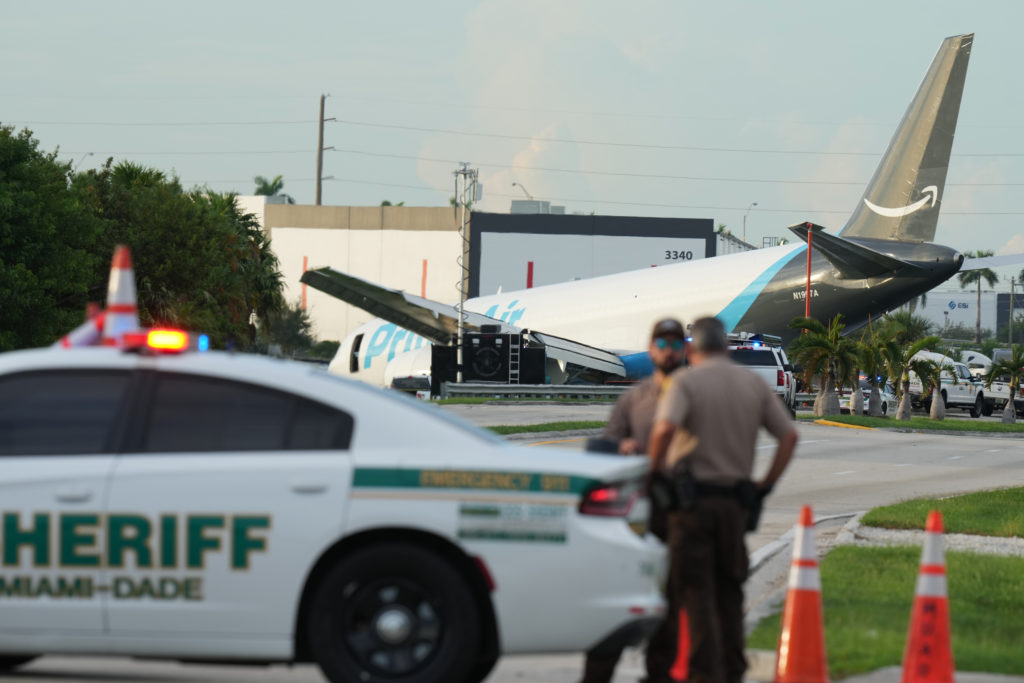
Federal investigators have launched a probe into a deadly aviation incident at Miami International Airport after an Amazon cargo jet overran the runway and crashed into vehicles on Sunday. The crash resulted in five deaths, three critical injuries, and two additional hospitalizations. The National Transportation Safety Board sent a team led by Chairwoman Jennifer Homendy to the scene, with an initial briefing scheduled for Monday afternoon to outline early findings.
The aircraft, a Boeing 767-300 operated by North Carolina-based carrier 21 Air under contract for Amazon Prime Air, was arriving from San Juan, Puerto Rico. Video footage of the landing shows the plane remaining airborne well beyond the typical touchdown zone before making contact with the tarmac. Aviation experts note that standard procedure dictates pilots should abort a landing and circle back if they determine they have passed the optimal landing area without touching down.
Investigators are expected to scrutinize several key factors, including the precise location of the initial touchdown, the aircraft's speed upon landing, and the effectiveness of braking systems. Weather conditions at the time included dark storm clouds and strong winds, though it was not raining. Experts suggest that a tailwind could have significantly reduced the plane's ability to decelerate, particularly if the aircraft had already consumed a large portion of the runway while floating above the surface.
Mary Schiavo, a former Inspector General of the Transportation Department and current pilot, observed that the video appears to show the jet failing to flare its nose upward to force the main landing gear onto the ground. This technique is typically used to ensure a firm touchdown within the designated zone. If the plane landed beyond the first 3,000 feet of the runway, safety protocols generally require an aborted landing attempt.
The Boeing 767 involved in the crash has a complex history. Originally built for passenger service more than three decades ago, it flew for several airlines before being converted to a cargo aircraft in 2015. The plane also has a history of foreign ownership, including by a Russian company. Investigators will likely examine the maintenance records closely to determine if mechanical issues played a role in the overrun.
The crash sent thick black smoke billowing into the sky and trapped the pilot and copilot in the cockpit, along with occupants of nearby vehicles. Miami-Dade Fire Rescue crews deployed over 60 units to the scene, where they had to extricate individuals from burning wreckage and vehicles. It remains unclear whether the pilots were among those who perished in the incident.
Miami International Airport lacks arresting systems, which are beds of crushable material designed to safely stop aircraft that overrun runways. The Federal Aviation Administration has installed such systems at more than 120 airports nationwide, crediting them with saving nearly 500 lives. However, Miami is in compliance with federal requirements because it maintains a 1,000-foot safety buffer at the end of its runways, a standard established after a fatal crash in Little Rock, Arkansas, in 1999.
The incident caused significant disruptions to air travel, grounding flights for much of Sunday and continuing to affect operations into Monday. Two of the airport's four runways remained closed on Monday morning as crews worked to clear debris and investigate the scene. Amazon stated it would cooperate fully with the investigation and expressed deep sympathy for those affected by the tragedy.
This event marks another high-profile aviation safety concern following a UPS plane crash in Louisville last year, which occurred after an engine failure during takeoff. While the causes of these incidents differ, both highlight the ongoing challenges in ensuring safety at major transportation hubs. The NTSB's investigation will likely take months to complete as experts analyze flight data, maintenance logs, and witness testimonies.
As the investigation proceeds, attention is turning to whether existing safety measures at Miami International Airport are sufficient given the volume of traffic and the types of aircraft operating there. The absence of arresting systems, while compliant with current regulations, has drawn scrutiny in light of the severity of this crash. Officials emphasize that the focus remains on determining the exact sequence of events to prevent similar incidents in the future.
Sources behind this briefing
Go to the original reporting
- PBS NewsHour↗WATCH LIVE: NTSB holds initial briefing on Amazon Air crash at Miami International Airport
- The Verge↗An Amazon cargo plane crashed at Miami International Airport

