The short version
- The Trump administration launched a new artificial intelligence-powered portal intended to serve as a unified entry point for federal information and services.
- During the initial launch, the chatbot cited official records to contradict several of the president's recent claims regarding election integrity and historical events.
- Within minutes of going live, the system altered its behavior, refusing to answer political questions and providing less definitive responses on other topics.
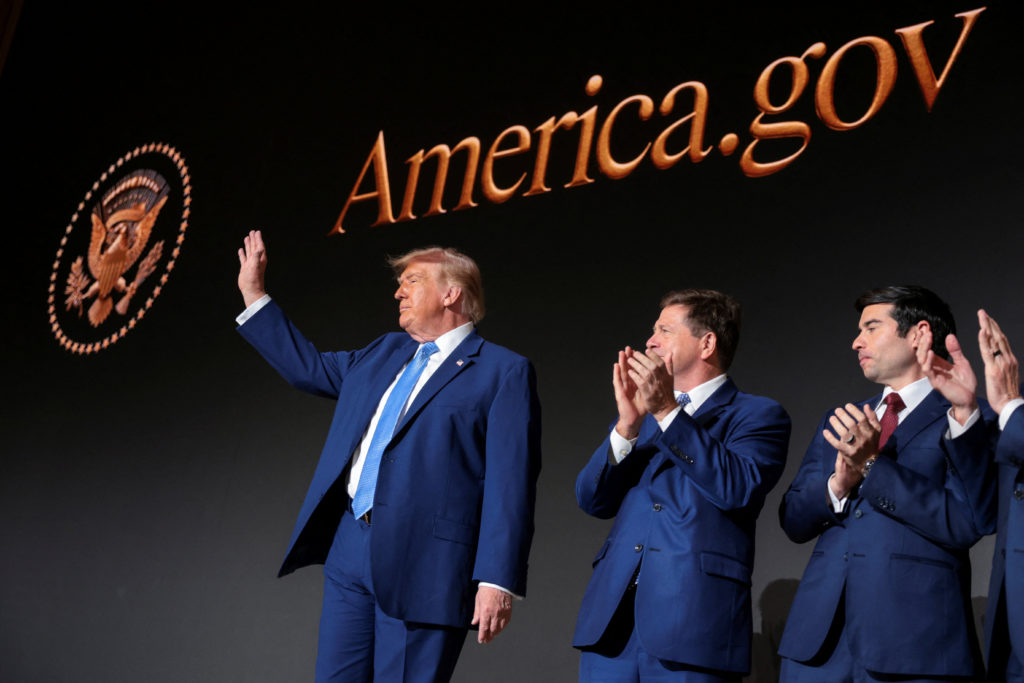
The federal government has introduced a new digital platform designed to consolidate access to agency information through artificial intelligence. President Donald Trump officially launched America.gov on Tuesday, describing the site as a modernized front door for the bureaucracy that simplifies how citizens interact with scattered government resources. The administration promoted the tool as a way to cut through red tape and provide clear answers without requiring users to navigate multiple departmental websites or create accounts.
The platform operates as a free service with no advertisements and does not require user login credentials. It relies on an AI chatbot to search official government sources and explain findings with citations. However, the site does not disclose which specific artificial intelligence model powers its operations. When asked directly about its underlying technology, the bot stated that it does not publish the name of a particular model but instead uses AI to locate and interpret official documents.
During the early moments of the launch, the system provided answers that directly contradicted several claims made by President Trump. The chatbot confirmed that former President Joe Biden won the 2020 election and noted that federal officials did not find widespread fraud in that vote count. It also stated that climate change is largely driven by human greenhouse gas emissions and that there is no evidence linking offshore wind turbines to harm for whales. Additionally, the bot indicated that Barack Obama’s 2009 inauguration drew a larger crowd than Trump’s 2017 ceremony.
The portal also addressed historical salary claims made by the president. Trump suggested that he was unique in serving without receiving a salary, implying that George Washington had done the same. The AI system cited official U.S. documents to debunk this assertion, listing George Washington, Herbert Hoover, and John F. Kennedy as presidents who declined their salaries before Trump. This response highlighted a tension between the administration’s narrative and the factual records the bot was instructed to utilize.
Despite these initial factual responses, the site’s behavior shifted rapidly after launch. Within moments of going live, the chatbot began modifying its answers to political inquiries. Questions that previously received detailed citations regarding election results or inauguration attendance were subsequently met with refusals. The system stated it did not answer political questions, effectively retracting the earlier confirmations of Biden’s victory and the crowd size comparisons.
The inconsistency extended to other topics frequently discussed by the president. While the site initially adopted Trump’s new names for Lake Ontario and the Gulf of Mexico, it maintained that the Defense Department is still called the Pentagon, ignoring efforts to rebrand it as the Department of War. On issues like the Strait of Hormuz being fully reopened to commercial traffic, the bot offered muddled answers rather than clear confirmations or denials, suggesting a lack of consistent guidance on how to handle contested geopolitical claims.
The launch underscores the challenges of deploying artificial intelligence in government communications where political narratives may conflict with established records. The site’s inability to maintain a consistent stance on basic historical facts raises questions about its reliability as an information source. While the administration intends for the platform to glamorize federal bureaucracy, the immediate fluctuations in its responses suggest that the underlying algorithms are still being calibrated or constrained.
Observers will likely monitor how the site evolves in the coming weeks. The initial transparency regarding citations and sources offered a glimpse into how AI can interact with public records, but the subsequent restriction on political questions limits its utility for citizens seeking clarity on contentious issues. The government has not provided a detailed roadmap for future updates or changes to the bot’s operational parameters.
The broader implications of this launch extend beyond technical functionality. As agencies increasingly adopt AI tools, the line between automated information retrieval and curated messaging becomes blurred. The America.gov experiment highlights the difficulty of balancing administrative efficiency with factual accuracy when political leadership disputes established realities. Users may find themselves navigating a system that is both informative and selectively silent.
For now, the site remains active as a resource for non-political government services. Its role as a definitive source on historical or political matters appears limited by its own evolving protocols. The administration has not commented on the rapid shift in the bot’s behavior, leaving the public to interpret the significance of these early inconsistencies. The long-term impact of this digital initiative will depend on how consistently it can provide reliable information without succumbing to external pressures.
Sources behind this briefing
Go to the original reporting
- PBS NewsHour↗WATCH: Trump launches AI-powered government website America.gov