The short version
- Authorities confirmed the unearthing of two large statue fragments depicting Pharaoh Ramses II in Behbeit El-Hagar, following a tip from a local resident.
- The artifacts include a five-foot head and an eight-foot torso fragment, suggesting the original monuments were among the largest ever constructed for the ruler.
- Experts view the find as evidence of major construction projects undertaken by Ramses II at this specific site, which had previously been associated primarily with later dynasties.
A routine agricultural activity in Egypt’s Nile Delta has yielded a significant archaeological breakthrough, revealing substantial remains of monumental statues dedicated to Pharaoh Ramses II. The discovery began when Khaled al-Shahat, a farmer working his land in the village of Behbeit El-Hagar, encountered an unusual pink stone embedded in the soil. Recognizing that the object appeared to bear ancient inscriptions, he contacted local officials rather than removing it himself. This decision prompted the Egyptian Ministry of Tourism and Antiquities to deploy a team of specialists to investigate the site, leading to the unearthing of artifacts that may reshape understanding of the area’s historical timeline.
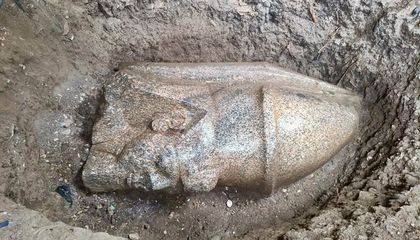
The excavation has revealed two distinct sets of remains belonging to colossal statues of Ramses II, who ruled from 1279 B.C.E. to 1213 B.C.E. The first find includes a head measuring approximately five feet in height. This fragment depicts the pharaoh wearing the double crown, a royal headdress symbolizing sovereignty over both Upper and Lower Egypt. Alongside the head, archaeologists recovered the upper section of a back pillar inscribed with the king’s formal title, Hor Ka Nakht Mery Maat. Based on the scale of these components, officials estimate that the complete statue, including its base, would have stood nearly 28 feet tall, marking it as one of the largest representations of the ruler.
A second set of fragments was also recovered from the same property. These remains include a portion of a statue measuring nearly eight feet in height, though the legs and base are missing. The head of this second figure is adorned with a nemes, the striped headcloth commonly associated with pharaonic iconography. Officials note that the facial features of this second statue closely resemble those of the first, suggesting they were part of a coordinated monumental program at the site. The proximity of these finds indicates a deliberate placement of royal imagery within the village boundaries.
The initial object that triggered the investigation was a block of pink granite more than four feet long. Located roughly three feet from the second statue fragment, this stone bears hieroglyphic inscriptions referencing two specific titles of Ramses II: Nesw-Bity, meaning king of Upper and Lower Egypt, and Sa-Ra, identifying him as the son of Ra, the sun god. The presence of these royal identifiers on a standalone block suggests it may have served as a dedicatory marker or part of a larger architectural ensemble that has since been dismantled or buried over millennia.
The location of these finds carries considerable historical weight. Behbeit El-Hagar, situated about 80 miles north of Cairo, is best known for the ruins of an ancient temple dedicated to the goddess Isis. This deity was worshipped as a protector of the dead and a symbol of motherhood and healing. Historical records indicate that the temple structure visible today was primarily constructed under Nectanebo II, who reigned from 360 B.C.E. to 343 B.C.E., with completion occurring under Ptolemy II and Ptolemy III. The complex eventually collapsed before the early third century C.E., likely due to seismic activity.
However, the discovery of Ramses II artifacts challenges the prevailing narrative that the site’s significance began only in later periods. Mahmoud Emam, an Egyptologist at Cairo University who was not involved in the current excavation, noted that the new finds were located on the western side of the temple complex. He pointed out that this is not the first time evidence of Ramses II has been found in Behbeit El-Hagar. In 2017, Emam and his colleagues uncovered two architectural fragments bearing the king’s name, leading them to conclude that the pharaoh had undertaken major building works at the location long before the Isis temple was constructed.
Ramses II is widely regarded as one of ancient Egypt’s most prolific builders, responsible for constructing more monuments and statues than any other pharaoh. His reign saw the erection of famous sites such as the temples at Karnak and Abu Simbel. The presence of colossal statues in Behbeit El-Hagar suggests that his building program extended further into the Nile Delta than previously documented. This expansion implies a strategic effort to assert royal authority and religious devotion across a broader geographic area, integrating older cultic sites into his imperial narrative.
Archaeologists are continuing to excavate the site to determine the full extent of the buried structures. The primary goal is to understand the spatial relationship between the two statues and their connection to the surrounding temple complex. By studying the artifacts already unearthed, researchers hope to shed light on the early history of Behbeit El-Hagar and clarify how Ramses II’s construction projects influenced the development of the site over subsequent centuries. The farmer who made the initial discovery expressed satisfaction with the outcome, noting that authorities indicated the find could change the historical understanding of the region.
The ongoing investigation highlights the importance of community engagement in archaeological preservation. Without the farmer’s decision to report the inscribed stone, these significant remains might have remained buried or been damaged by agricultural activity. As work continues, the site serves as a reminder that ancient history is often layered beneath modern landscapes, waiting for careful observation and professional intervention to reveal its secrets. The findings underscore the dynamic nature of historical research, where new evidence can rapidly alter established timelines and interpretations.
Future studies will likely focus on dating the specific layers of soil in which the statues were found to pinpoint when they were buried or dismantled. This information could provide insights into political or religious shifts that led to the concealment of royal imagery. Additionally, researchers may examine the stylistic details of the statues to compare them with other known works from Ramses II’s reign, potentially offering new perspectives on artistic evolution during his long rule. The site remains active, with experts working to preserve the artifacts while expanding the excavation area.
Sources behind this briefing
Go to the original reporting
- Smithsonian Magazine↗A Farmer in Egypt Stumbled Upon a Pink Stone and Called the Authorities. They Found the Remains of Two Colossal Statues of Ramses II Beneath the Property