The short version
- The European Commission urges strengthened external borders and cooperation with partner nations after tens of thousands crossed into Ceuta.
- Italy suspended Schengen checks with Spain, a move supported by Finland and Denmark but criticized by Madrid as politically motivated.
- Spain reports that most migrants have returned to Morocco, though the incident has resulted in dozens of deaths on both sides of the border.
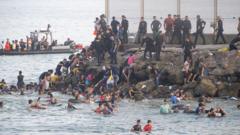
European Union officials are pushing for a coordinated approach to border security following a massive and chaotic influx of migrants from Morocco into the Spanish enclave of Ceuta last week. European Commission President Ursula von der Leyen has called for united action, emphasizing that protecting external borders is a shared responsibility across member states. She highlighted the need for vigilant monitoring and the potential use of physical barriers at critical points to manage future irregular migration flows.
The incident has already strained diplomatic relations within the bloc. Italy temporarily suspended its participation in the Schengen agreement with Spain, a decision backed by Finland and Denmark. Czech Prime Minister Andrej Babiš went further, urging a temporary suspension of Spain’s membership entirely. These moves reflect growing pressure on member states to control entry points, even as the Schengen area encompasses nearly 450 million people across 29 countries.
Spanish Prime Minister Pedro Sánchez has pushed back against what he describes as attacks driven by prejudice and political interest. He noted that Ceuta is not part of the Schengen area and argued that while many European governments showed solidarity, others chose to criticize Spain unfairly. Von der Leyen praised Sánchez’s swift handling of the crisis in a letter but warned that the episode underscores the necessity for stronger collective measures.
Current estimates indicate that approximately 69,500 migrants have returned to Morocco, surpassing earlier projections of 50,000. The human cost remains significant, with an official death toll of 72 on the Spanish side and 11 on the Moroccan side. Emergency talks among EU interior ministers are scheduled for Tuesday via video conference to discuss lessons learned and potential policy adjustments.
Von der Leyen outlined five key areas for future focus: preventing irregular migration through cooperation with partner states, strengthening external borders, implementing early warning systems, dismantling smuggling networks, and reinforcing return procedures. Meanwhile, Spanish authorities are working on inflatable barriers to prevent sea crossings, citing a recent supreme court decision that constrained immediate deportations as a factor exploited by traffickers.
Sources behind this briefing
Go to the original reporting
- BBC World↗EU calls for stronger borders after Ceuta migrant crossings

