The short version
- The European Union has committed 200 million euros in immediate aid for infrastructure and climate initiatives in Greenland.
- EU leaders emphasized respect for Greenlandic sovereignty following repeated demands from the Trump administration for U.S. control of the territory.
- NATO allies are conducting military exercises in the region without American participation, signaling continued support for Danish-Greenlandic autonomy.
The European Union has moved to strengthen its ties with Greenland through a significant financial commitment and a renewed diplomatic partnership, aiming to stabilize relations in the Arctic amid ongoing geopolitical friction. During a visit to Nuuk, the capital of the semiautonomous territory, European Commission President Ursula von der Leyen announced an initial investment of 200 million euros, equivalent to approximately 232 million dollars. This funding is designated for a two-year period and targets critical infrastructure improvements, including enhancements to hydropower facilities, internet connectivity, fisheries management, and educational systems.
The strategic timing of this announcement reflects a direct response to the persistent pressure exerted by U.S. President Donald Trump, who has repeatedly asserted that the United States should assume control of Greenland for national security reasons. These claims have generated considerable anxiety among local leaders and raised broader concerns about territorial integrity within the North Atlantic Treaty Organization. Von der Leyen explicitly addressed these tensions, stating that the future of Greenland is a matter solely for its people and Denmark to determine. She underscored that border inviolability and sovereignty remain foundational principles of international law.
Beyond the immediate financial injection, the European Commission outlined plans to substantially increase long-term budgetary support. Von der Leyen indicated an intention to double the EU’s annual contribution to Greenland by 2028, raising the total to approximately half a billion euros. The expanded funding will also cover social and economic development goals, such as improving housing conditions, providing assistance to small enterprises, and fostering sustainable tourism. This comprehensive approach aims to demonstrate that European partners are reliable allies capable of supporting Greenland’s development without compromising its political autonomy.
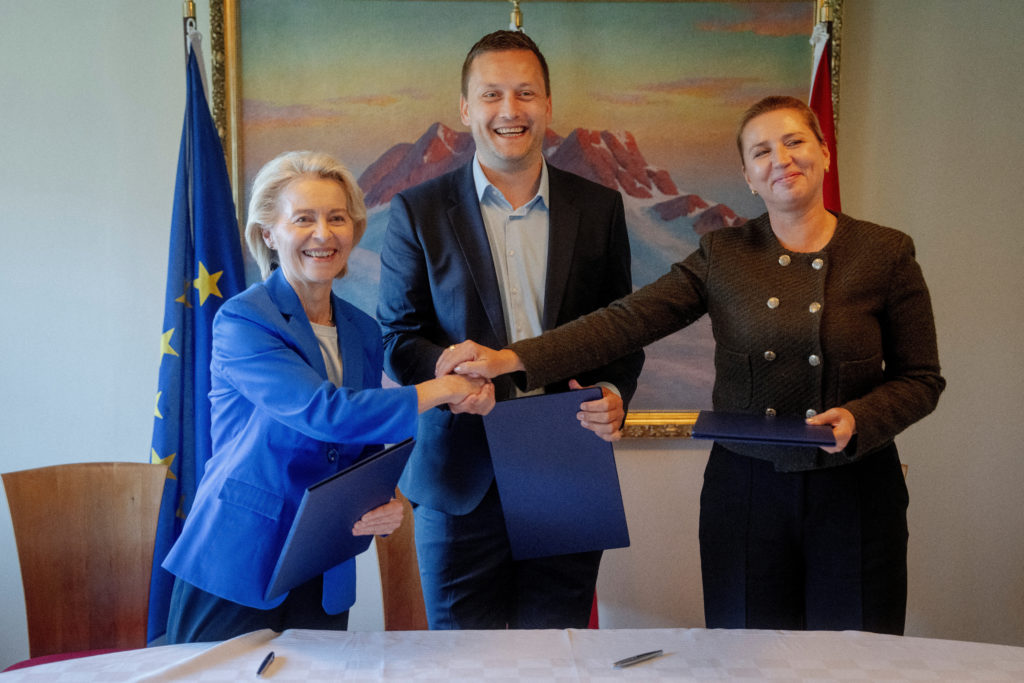
Greenlandic leadership has welcomed the EU’s gesture, framing it as a vital source of stability during a period of external uncertainty. Prime Minister Jens-Frederik Nielsen described the 27-nation bloc as a loyal and trusted friend, noting that the island faces complex challenges that require international cooperation. He expressed deep gratitude for the unwavering support received from European partners, emphasizing that such backing is crucial for navigating the current geopolitical landscape. The signing of an EU-Greenland declaration with Nielsen and Danish Prime Minister Mette Frederiksen formalized this renewed commitment.
The diplomatic maneuvering extends beyond Greenland to include Denmark, which has also felt the weight of American pressure. Frederiksen acknowledged that her government has been under significant strain due to Trump’s demands but expressed appreciation for the solidarity shown by European allies and other global partners. The situation highlights a broader rift within NATO, where traditional alliances are being tested by unilateral assertions from Washington. Denmark and several of its European neighbors have sought to reassure Greenland through both diplomatic channels and tangible displays of support.
Military dynamics in the region further illustrate the shifting allegiances and security concerns. In January, Denmark coordinated with seven European allies to deploy a small contingent of military personnel to Greenland. While officially framed as exercises aimed at enhancing Arctic security capabilities, the move was widely interpreted as a demonstration of commitment to Greenland’s sovereignty against American encroachment. Trump responded by threatening tariffs against all participating nations, including Denmark, Finland, France, Germany, the Netherlands, Norway, Sweden, and the United Kingdom. These countries condemned the tariff threats as detrimental to trans-Atlantic relations, and Trump eventually retreated from the stance after NATO agreed to increase its security presence in the Arctic.
Current military activities continue to reflect this complex balance of power. As von der Leyen visited Nuuk, eleven NATO member states initiated a series of drills involving approximately 400 personnel, including special forces units trained for Arctic operations. Participants included troops from Canada, Denmark, and Finland, among others. Notably, the United States is not participating in these specific exercises, known as Arctic Shield, which are scheduled to run through mid-September. This absence underscores the distinct path European allies are taking in managing security and diplomatic relations in the region.
The convergence of economic investment and military posturing signals a deliberate effort by European powers to counterbalance American influence in the Arctic. By combining financial aid with explicit statements on sovereignty, the EU aims to provide Greenland with alternatives that respect its self-determination. The situation remains fluid, with ongoing tensions between Washington and its allies likely to shape future negotiations regarding resource access, security cooperation, and political autonomy in one of the world’s most strategically significant regions.
Sources behind this briefing
Go to the original reporting
- PBS NewsHour↗EU seeks to reassure a Trump-rattled Greenland with promise of a new partnership and investment

