The short version
- A Greater Anglia service derailed in Essex on Friday afternoon, causing significant travel chaos but resulting in no injuries among the sixty-plus passengers on board.
- Investigators are examining whether extreme heat contributed to the incident, which occurred less than a day after a separate derailment in East Sussex that seriously injured two people.
- Network Rail has warned of major disruptions lasting into Saturday, while emergency services and local residents assisted with evacuations and support during the high temperatures.
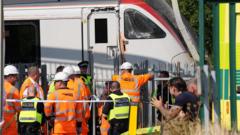
Railway operations across parts of eastern England were thrown into disarray on Friday afternoon after a commuter train derailed south of Wickford station in Essex. The incident occurred at approximately 14:12 BST, involving a Greater Anglia service traveling from Southend Victoria to London Liverpool Street. Although the event caused immediate cancellations and widespread confusion for travelers, authorities confirmed that no passengers were injured. The train remained upright after two of its rear carriages left the tracks, allowing emergency responders to manage the situation without major medical evacuations.
More than sixty individuals were aboard the affected train when it departed Rayleigh at 14:06 BST. According to the East of England Ambulance Service, crews assessed all patients on board and discharged them at the scene following evaluation. British Transport Police corroborated these findings, stating there were no reported casualties. In addition to the primary derailment, a second train unable to continue its journey due to the obstruction was also evacuated safely. The swift assessment by medical teams helped prevent further complications despite the sudden nature of the event.
Eyewitness accounts describe a jarring experience for those on board. One passenger, Jon Young, reported that the train swung violently for about ten seconds, creating a sensation that it might tip over. This was followed by several minutes of intense vibration and a loud noise that frightened many travelers. Smoke reportedly entered the rear carriage, leading to panic among some passengers who ran in fear. The physical impact was felt beyond the train itself; Danielle Belton, a local business owner and Conservative councillor, noted that the sound was so powerful it shook her office building nearby, startling employees inside.
The derailment comes at a time of heightened scrutiny regarding railway safety in the UK. It occurred less than twenty-four hours after two passengers were seriously injured in a separate derailment in East Sussex. This proximity in time has raised questions about systemic issues within the rail network. Martin Frobisher of Network Rail acknowledged that the summer’s hot weather had presented exceptional challenges to infrastructure maintenance and operations. He confirmed that speed restrictions were not in place at either Wickford or Lewes, the site of the earlier incident, suggesting that environmental factors may be under review.
Emergency services responded rapidly to the scene off Salcott Crescent, deploying police, firefighters, paramedics, and an air ambulance as a precautionary measure. The Rail Accident Investigation Branch (RAIB) also sent a team to gather evidence and assess how the train came off the tracks. Investigators are specifically looking into whether the extreme heat played a role in the failure of the track or train components. Mark Francois, the Conservative MP for Rayleigh and Wickford, emphasized that determining if the incident was weather-related is a key part of the ongoing inquiry.
Local residents contributed to the relief efforts by handing out bottled water and ice lollies to emergency crews working in temperatures reaching 33C (91.4F). The heat added an additional layer of difficulty for both responders and stranded passengers. Confusion spread to Southend Airport, which relies on the affected rail line for connectivity. Many travelers found themselves unable to reach onward destinations from the railway station, compounding the disruption. BBC reporter Matt Knight noted that even he faced difficulties after landing from a holiday, highlighting the broader impact on regional transport links.
Network Rail has warned that major disruptions will continue until at least Saturday, affecting services to Southminster and Braintree among other locations. The Department for Transport reiterated that Britain’s railways are among the safest in the world, describing derailments as incredibly rare events. However, the recent sequence of incidents has prompted a thorough technical review. Engineers from Network Rail and experts from the RAIB are on site conducting detailed examinations to understand the root causes of the failure.
While it is too early to speculate on the full findings of the investigation, officials have committed to acting on whatever lessons emerge from the data collected. The focus remains on ensuring passenger safety and restoring normal service levels as quickly as possible. For now, travelers are advised to check for updates before planning journeys, as the rail network works to recover from this unexpected setback. The incident serves as a reminder of the vulnerabilities inherent in complex transportation systems, particularly under extreme weather conditions.
Sources behind this briefing
Go to the original reporting
- BBC News↗Derailed Essex to London train leads to travel chaos

