The short version
- Epic Games has released a preview of its new launcher, claiming it is significantly faster than Steam due to a ground-up rewrite using AI-assisted coding techniques.
- Early benchmarks show the new Epic Launcher can start up faster in cold starts, though some tests indicate Steam may still outperform it in specific scenarios.
- The preview version lacks certain social and account management features, with Epic warning users to expect bugs during the testing phase.
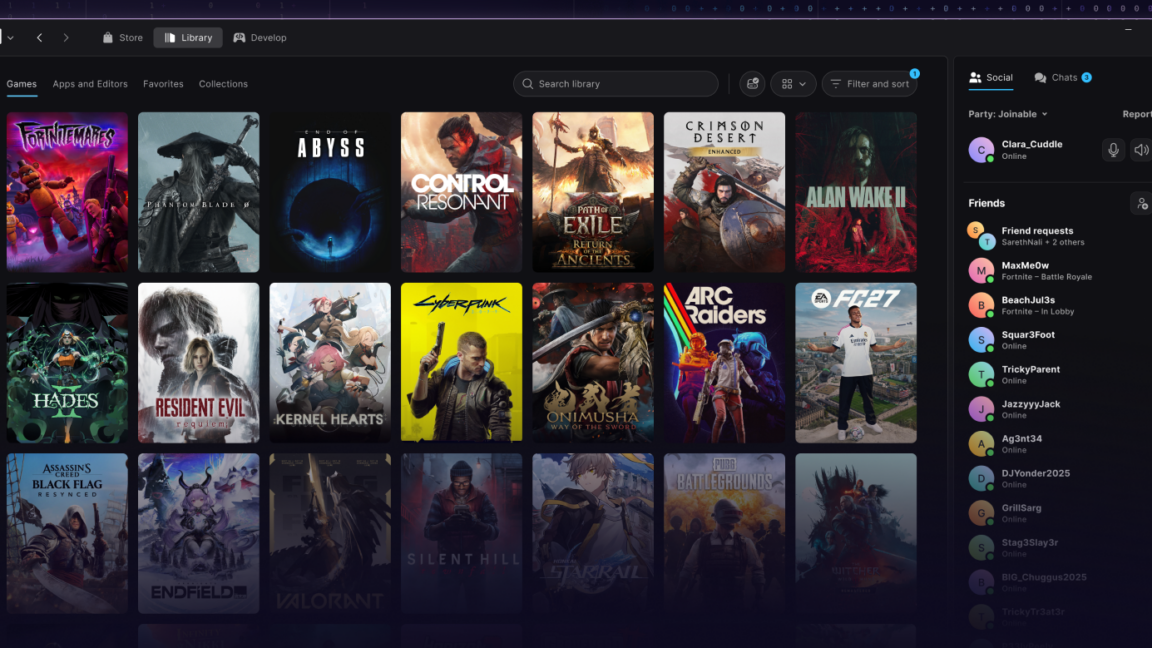
Epic Games has unveiled a new version of its launcher application, boldly claiming that it is faster than Valve's Steam client. The update, described by the company as 'vibe-coded,' represents a complete overhaul of the software architecture. Epic Games Store General Manager Martin Keely explained that the team started from scratch, using artificial intelligence to write and review code for new features. This approach allowed a small team to replicate existing functionality without carrying over legacy code, resulting in a more responsive interface.
The term 'vibe coding' has drawn attention for its informal nature, suggesting a rapid development process that prioritizes speed and feel over traditional rigorous testing. Epic acknowledges this by warning users that the preview build 'will have some bugs.' The company encourages early testers to report issues via a feedback form, indicating that stability is still a work in progress. Despite these warnings, the focus remains on performance improvements, particularly in startup times.
Initial benchmarks conducted by tech outlets reveal mixed results. Ars Technica reported that the new Epic Launcher achieves faster cold start times compared to Steam, reaching the store page several seconds quicker. However, other tests suggest that the difference may be negligible in real-world usage, with some measurements showing only a 0.06-second advantage when restoring from the system tray. VideoCardz.com noted that in certain scenarios, the Steam client still launches faster than Epic's new offering.
The new launcher introduces several long-requested features, including a Recent Games list and improved navigation tools. These additions aim to address user complaints about the previous version's clunkiness and lack of organization. By rebuilding the tech stack, Epic hopes to provide a smoother experience across Windows, Mac, and Linux platforms. The inclusion of Linux support is particularly notable, as it expands the launcher's accessibility for open-source users.
However, the preview version is currently 'light on features,' with several social functions and account management options missing from the legacy version. This limitation means that early adopters will not have access to all the tools they may rely on, such as friend lists or detailed purchase histories. Epic has promised to reintegrate these features in future updates, but their absence highlights the trade-off between speed and completeness in this initial release.
The competitive landscape between Epic and Steam remains intense. Nearly eight years after launching its own store, Epic continues to seek ways to differentiate itself from Valve's dominant platform. The emphasis on speed and modern design reflects a broader industry trend toward optimizing user experience. Yet, the reliance on AI-assisted coding raises questions about long-term maintainability and potential hidden errors that may not be immediately apparent.
User reception has been cautious, with many gamers skeptical of the 'vibe-coded' label. While some appreciate the improved responsiveness, others are concerned about the lack of thorough testing. The term itself carries connotations of hastily assembled software, which could undermine trust in the product's reliability. Epic's challenge will be to prove that this new approach delivers consistent performance without compromising stability.
As the preview phase continues, Epic will gather data on how users interact with the new launcher. This feedback will inform subsequent updates, potentially addressing the missing features and resolving bugs. The success of this initiative could influence future development strategies, not just for Epic but for other platforms considering similar AI-driven approaches to software creation.
Ultimately, the race between Epic and Steam is not just about speed but also about ecosystem loyalty. While technical improvements are important, users often remain tied to their existing libraries and social networks. The new launcher's ability to attract new users or convert existing ones will depend on whether it can offer a compelling enough advantage to justify switching platforms.
Sources behind this briefing
Go to the original reporting
- Ars Technica↗Epic says its new vibe-coded Epic Games Launcher is faster than Steam
- VideoCardz.com↗Steam Client now launches faster than Epic’s new launcher
- PC Gamer↗Epic said it's new vibecoded launcher is faster than Steam, so I put the two head to head
- GameGPU↗The new Epic Games Launcher is faster than Steam in early benchmarks.