The short version
- Elephant carcasses cause initial nutrient spikes that are toxic to most plants but boost specific microbial activity.
- After nutrients stabilize, fast-growing grasses emerge, attracting herbivores like zebras and buffalo for up to eight years.
- The study highlights how mega-carcasses shape landscape dynamics differently than whale falls in marine environments.
African savanna elephants function as critical architects of their environment throughout their lives, but new scientific evidence indicates they continue to reshape the landscape significantly after death. A study published recently in the Proceedings of the National Academy of Sciences details how elephant remains trigger a prolonged ecological sequence involving soil chemistry, microbial communities, and herbivore behavior. This process can persist for at least eight years, challenging previous assumptions about how quickly carcass nutrients dissipate or integrate into the broader food web.
The research team investigated forty elephant carcasses located within Kruger National Park in South Africa. These animals had died between eight days and nearly eight years prior to sample collection, allowing scientists to observe various stages of decomposition and ecological response. The study focused on measuring changes in soil nitrogen levels, microbial diversity, plant growth patterns, and the presence of scavenging or grazing animals near the remains.
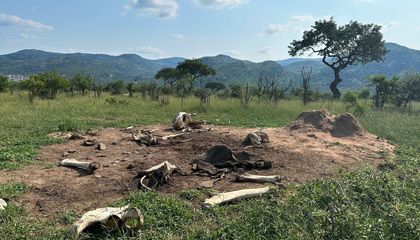
In the immediate aftermath of death, the impact on the local environment is severe and destructive. The massive weight of the body eliminates all biomass directly beneath it, while scavengers clear the surrounding area as they feed. Simultaneously, fluids from the carcass leak into the ground, causing a dramatic surge in soil nitrogen concentrations. At sites with very fresh remains, nitrogen levels can reach up to three thousand times higher than in areas without a carcass, creating conditions that are largely inhospitable to most plant life.
This initial flood of nutrients acts as a toxin rather than a fertilizer for vegetation. The sheer concentration inhibits plant growth and suppresses microbial diversity, allowing only a small number of hardy microbial species to thrive. This phase represents a biodiversity cold spot, contrasting sharply with the nutrient-rich but balanced environments typically found in healthy savanna soils. The toxicity prevents immediate regeneration of the diverse plant communities that usually characterize these regions.
As time passes and nutrient concentrations gradually decrease, the ecological dynamic shifts. Plants begin to respond similarly to microbes, with only a few fast-growing species capable of colonizing the hyperlocal environment. These specific grasses become particularly nutritious due to the residual nitrogen enrichment. Their emergence marks a transition from a sterile zone to a highly attractive feeding ground for large herbivores.
The presence of these nutrient-dense grasses draws in animals such as zebras, buffalo, and rhinos. These herbivores selectively graze on the vegetation, returning to the site repeatedly over several years. Their continued presence introduces additional organic matter through their waste, further fertilizing the land and sustaining the localized burst of biological activity. This cycle ensures that the ecological footprint of the elephant extends well beyond the physical decay of its body.
The phenomenon observed in savannas differs notably from whale falls in marine ecosystems. While a sinking whale provides essential nutrients to deep-ocean environments where they are scarce, thereby boosting biodiversity, an elephant carcass delivers such an intense concentration of nutrients in an already fertile area that it temporarily suppresses diversity. The high nutrient load creates a selective pressure that favors only specific fast-growing plants and microbes, rather than supporting a broad range of species immediately.
Researchers suggest that savanna ecosystems may be uniquely susceptible to these long-lasting ecological cascades compared to other biomes. In more dynamic environments like forests or wetlands with frequent rainfall, or in arid deserts where drought limits biological activity, the impact of a mega-carcass might be less pronounced or shorter-lived. The team plans to expand their investigation across sub-Saharan Africa to test these hypotheses and continue monitoring the Kruger sites to understand how these landscapes evolve over time.
This work underscores the importance of understanding underground processes that drive ecosystem structure. Experts note that large animals shape their environments in ways that are not always visible on the surface. By examining the legacy of elephant carcasses, scientists are gaining new insights into the complex interactions between death, decomposition, and renewal in African ecosystems.
The findings contribute to a growing body of research focused on how mega-fauna influence ecological balance both during their lives and after death. As conservation efforts continue to prioritize large mammals, understanding their full environmental impact—including post-mortem contributions—may inform more holistic strategies for preserving savanna health and biodiversity.
Sources behind this briefing
Go to the original reporting
- Smithsonian Magazine↗African Elephants Shape the Savanna Ecosystem—and Continue Doing So Long After They've Died, Study Suggests