The short version
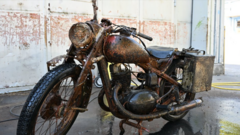
- Severe drought conditions in the Danube River have exposed World War II-era remains and artifacts in Budapest, including two soldiers and a Wehrmacht motorcycle.
- The German War Graves Commission has launched an investigation to identify the individuals, noting that one tag belonged to a Waffen-SS member, a unit designated as criminal at Nuremberg.
- Discovery of anti-tank mines near the site required bomb disposal intervention, while preservation conditions in the riverbed have kept items remarkably intact.
An intense drought that has driven water levels in the Danube River to record lows is exposing historical remnants from World War II along its banks. In Budapest, Hungary, the receding waters revealed the remains of two German soldiers alongside a largely intact military motorcycle and personal effects. The discovery, made on August 2 by a passerby who noticed part of the vehicle protruding from rocks near the downtown riverbank, has initiated a complex forensic and historical investigation led by the German War Graves Commission.
The artifacts recovered from the riverbed are in exceptional condition, attributed to the specific mixture of harbor sludge and oil present on the bottom of the river. Among the items found were identification tags for both soldiers, a wedding ring, and a Kuban shield, which served as a combat badge for the Wehrmacht. The motorcycle itself is identified as a DKW NZ 350-1 model, a vehicle produced specifically for wartime use starting in 1944. These well-preserved objects offer rare physical evidence from the final stages of the conflict in Central Europe.
The identification process presents significant challenges. One of the recovered tags belonged to a regular Wehrmacht soldier, while the other was issued to a member of the Waffen-SS. The latter organization was declared criminal by the Nuremberg Trials for its role in war crimes. Arne Schrader of the German War Graves Commission described the task as a puzzle, noting that while the names associated with the tags might be found quickly, confirming that the artifacts actually belong to the specific bodies recovered is uncertain. Bone analysis will be a critical component in linking the remains to their identities.
The discovery carries emotional weight for descendants of those who fought in the war. During the conflict, identification tags were split upon a soldier’s death; one half remained with the body while the other was sent to authorities to notify families. The commission noted that relatives of these two men likely waited in vain for official confirmation of their deaths. Now, more than eighty years later, there is hope that some families may finally learn the fate of their ancestors. Social media groups dedicated to World War II history have expressed relief that the fallen can receive a dignified burial and that bereaved families might find closure.
Safety concerns accompanied the archaeological discovery. The recovery team also located anti-tank mines in the vicinity of the remains, necessitating the temporary closure of the riverbank. A bomb disposal unit was deployed to secure the area before further excavation could proceed. This highlights the ongoing dangers associated with unexploded ordnance left behind from the fierce fighting that characterized the Battle of Budapest between Soviet and German forces late in the war.
The broader context of this discovery is a severe drought affecting Europe’s major waterways. The Danube’s low levels have not only revealed historical artifacts but also forced operational changes, including the shutdown of Hungary’s only nuclear plant due to insufficient cooling water. Similar phenomena have been observed elsewhere along the river, such as the emergence of a broken-up ship hull near Prahovo in Serbia. These events underscore how climate-induced environmental shifts are reshaping access to submerged history and infrastructure.
The German War Graves Commission, a non-profit organization acting on behalf of the German government, is responsible for searching for, recovering, and burying war dead. The two soldiers recovered in Budapest are scheduled to be interred at the German war cemetery in Budaörs, located just outside the Hungarian capital. The commission has urged anyone missing relatives from the war era to search its database, though it cautioned that the outcome of the identification process remains uncertain given the complexity of matching physical evidence to historical records.
This incident illustrates the intersection of environmental crisis and historical preservation. As water levels drop across Europe, including record lows in the Rhine, previously inaccessible sites are becoming visible. While the exposure of war graves offers a chance for resolution for some families, it also requires careful handling of hazardous materials and sensitive historical narratives. The commission’s work continues as they gather pieces of the puzzle to determine the identities of those who died during one of the most destructive conflicts in human history.
Sources behind this briefing
Go to the original reporting
- BBC News↗Danube river's low water levels reveal remains of WWII soldiers and motorcycle

