The short version
- The Curiosity rover has shifted focus to a new drilling location named Nazca, situated near the previously studied Chiu Chiu block.
- Scientists aim to determine if disc-shaped rock features are original crystals or pseudomorphs replaced by different minerals over time.
- Advanced imaging and concentrated laser shots will create 3D models and deep compositional profiles of the Martian geology.
NASA’s Curiosity rover has initiated a new scientific campaign on Mars, moving to a location designated as Nazca. This site is located just meters away from the Chiu Chiu block, which served as a reference point during recent operations. While the Chiu Chiu block itself was deemed unsuitable for drilling due to its physical characteristics, the adjacent rock formation presented more promising geological features. The rover team identified this neighbor block as a high-priority target after reviewing close-up images taken following a recent drive.
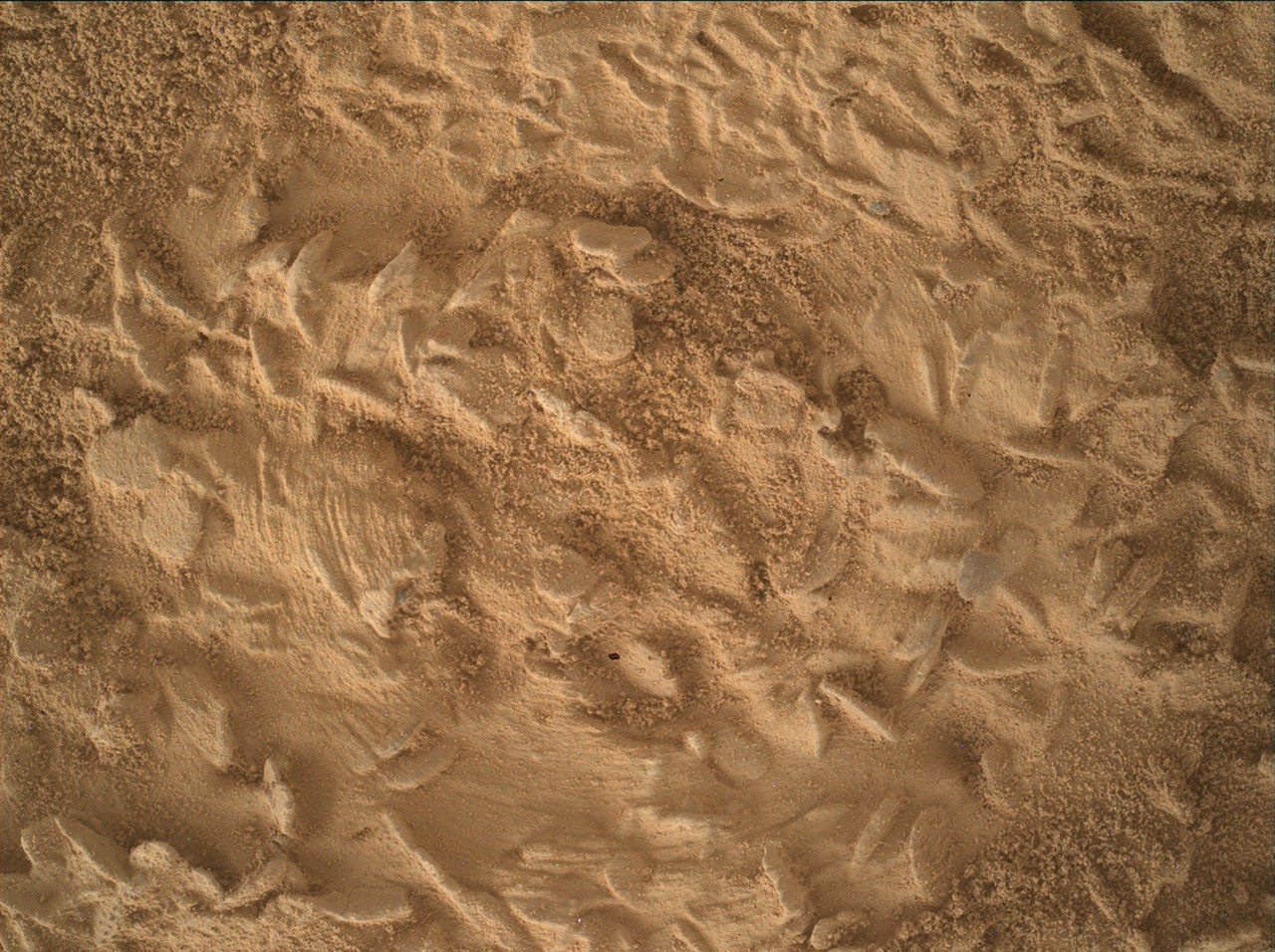
The primary scientific objective at Nazca involves analyzing distinctive rock textures described as disc- and needle-shaped lumps. These formations are central to a major hypothesis regarding their origin: they may be crystal forms that grew in specific shapes determined by microscopic mineral structures. Similar to salt crystals grown in laboratory settings, these Martian minerals likely developed their geometry based on the conditions present during their formation. The relatively large size of these features offers potential insights into the historical temperature and the availability of salts and fluids when the rocks were created.
However, determining the original composition of these rocks presents a significant challenge. Scientists cannot assume that the current mineral makeup reflects the initial crystallization process. Over time, original minerals can be replaced by different substances while retaining their external shape. These replacements are known as pseudomorphs, meaning they preserve the form of the first minerals but possess a different chemical composition and molecular structure. Distinguishing between original crystals and pseudomorphs is critical for accurately reconstructing the environmental history of the region.
To address these questions, the rover team has planned a series of detailed observations before commencing any drilling activities. The Mars Hand Lens Imager, or MAHLI, will perform a Quantitative Relief Model observation. This technique involves capturing five overlapping images from slightly different angles to construct a high-resolution three-dimensional model of the rock surface. Additionally, the camera system will increase its focus mechanism steps, effectively doubling the number of frames in its highest-resolution imaging mode. These enhancements aim to provide unprecedented detail regarding the topography and structure of the crystal forms.
Compositional analysis will also be intensified using the ChemCam instrument’s laser-induced breakdown spectroscopy capability. Instead of spreading laser shots across multiple points as is standard practice, the team plans to concentrate all 150 daily laser shots on a single spot within a nearby target called Toucan. This focused approach allows the lasers to vaporize rock material progressively deeper into the surface. By penetrating approximately five times deeper than a typical observation, scientists hope to reveal whether the internal composition differs from the outer layers.
Understanding variations between surface and subsurface compositions is essential for interpreting the geological record. Differences may arise from exposure to the modern Martian environment, which can alter surface materials over time. Alternatively, compositional changes could reflect the specific circumstances under which the crystal forms originally developed. By comparing deep-layer data with surface readings, researchers can better assess how environmental factors have influenced the rock’s chemistry since its formation.
In addition to geological studies, the rover continues to monitor the current Martian atmosphere as twilight cloud season begins. The team has scheduled nighttime imaging of Phobos, Mars’ larger moon, when it appears full in the sky. Observing sunlight reflecting off Phobos and scattering through the Martian atmosphere provides a method for estimating particle sizes in high-altitude clouds. While solar observations can offer similar data, lunar reflections allow for measurements later in the night, contributing to a more comprehensive understanding of atmospheric conditions.
The upcoming drill preload test at Nazca will serve as a final check before full-scale sampling begins. Prior to this test, instruments including the Dynamic Albedo of Neutrons and Alpha Particle X-ray Spectrometer will characterize the surface composition thoroughly. This multi-instrument approach ensures that scientists have a robust baseline of data regarding the rock’s chemistry and structure. The findings from Nazca could significantly advance understanding of Mars’ ancient hydrological history and the potential for past habitability.
Sources behind this briefing
Go to the original reporting
- NASA↗Curiosity Blog, Sols 5043-5049: Preparing to Drill at ‘Nazca’

