The short version
- Engineers have commenced assembling four massive liquid argon detectors in a mile-deep cavern within South Dakota's former Homestake mine.
- The Deep Underground Neutrino Experiment aims to analyze particles traveling from Chicago and cosmic sources to understand why the universe consists of matter rather than antimatter.
- The project represents a significant transition for Lead, South Dakota, shifting from its historical gold mining economy to becoming a hub for advanced subterranean scientific research.
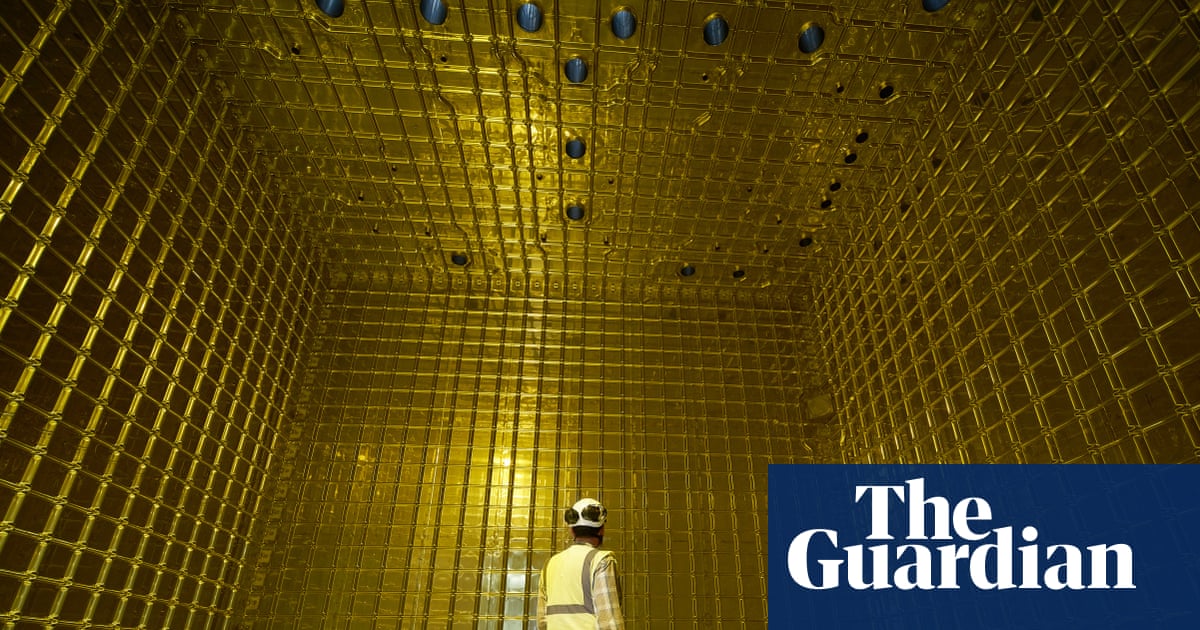
Construction has officially begun on one of the most ambitious particle physics projects in history, marking a pivotal shift for the Black Hills region of South Dakota. Engineers are now assembling four enormous detectors inside caverns located approximately one mile beneath the surface at the former Homestake mine site. This facility, known as the Sanford Underground Research Facility, has transitioned from its century-long role in gold extraction to becoming a premier destination for exploring the fundamental secrets of the universe.
The Deep Underground Neutrino Experiment, commonly referred to as Dune, involves a complex engineering undertaking that will span several years. The detectors, constructed from more than 4,000 tonnes of steel, will reach heights comparable to five-story buildings. Once assembled, these structures will contain a combined total of 70,000 tonnes of liquid argon, which must be maintained at extremely low temperatures of minus 200 degrees Celsius. The assembly phase is expected to take nearly three years, followed by an additional year required to fill the vessels with the necessary cryogenic fluid.
The primary scientific objective of this massive infrastructure is to study neutrinos, subatomic particles that are abundant yet notoriously difficult to detect. These chargeless particles interact so weakly with ordinary matter that trillions pass through the human body every second without leaving a trace. Despite their elusiveness, neutrinos play a critical role in understanding cosmic events, including the mechanisms behind supernovae and the formation of black holes. Scientists hope that by observing these particles, they can uncover new physics that current theories cannot explain.
A central focus of the research is the enduring mystery of why the observable universe is composed almost entirely of matter rather than antimatter. According to standard models of particle physics, equal amounts of both should have been created during the Big Bang, yet they appear to have annihilated each other, leaving behind a small surplus of matter that forms everything we see today. Dune will investigate subtle differences between neutrinos and their antimatter counterparts, antineutrinos, in an effort to identify the asymmetry that allowed our existence.
The experiment relies on an intense beam of neutrinos generated at Fermilab, a government laboratory near Chicago, Illinois. These particles will travel through 800 miles of Earth's crust and mantle before reaching the detectors in South Dakota. While most neutrinos will pass through the rock and detectors unnoticed, occasional interactions with argon atoms will produce flashes of light and electric charges. Analyzing these rare events will provide detailed data on neutrino masses and oscillation patterns, a phenomenon where particles change varieties as they travel.
The choice of location is scientifically strategic, leveraging the deep underground environment to shield sensitive equipment from cosmic rays and other background radiation that could interfere with measurements. This site has a long history in neutrino research; in the 1960s, physicist Ray Davis used a tank of dry-cleaning fluid in the same mine to detect solar neutrinos for the first time. Today, the facility also hosts other major experiments, such as Lux-Zeplin, which recently reported potential detections of dark matter, further cementing its status as a global hub for subterranean science.
International collaboration is a key component of the project, with the United Kingdom serving as the largest partner outside the United States. British institutions are contributing core detector components, critical computing resources for reconstructing particle events, and graphite targets used to generate the neutrino beam at Fermilab. This global effort underscores the scale and complexity of modern physics research, requiring coordinated engineering and scientific expertise across continents.
For the local community in Lead, South Dakota, the project represents a significant economic and cultural transformation. City officials note that the presence of world-class science facilities brings new opportunities for local businesses and educational prospects for young residents. The shift from resource extraction to high-tech research reflects a broader trend in repurposing industrial sites for advanced scientific inquiry, offering a sustainable future for towns historically dependent on mining.
As construction progresses, the scientific community anticipates that Dune will operate for decades, providing long-term data collection capabilities. The insights gained could redefine our understanding of fundamental forces and the origins of the cosmos. While the answers to why matter dominates antimatter remain elusive, the infrastructure now being built underground offers one of the best tools available to probe these deep questions.
The next phase involves the meticulous assembly of detector components and the eventual filling of the vessels with liquid argon. Once operational, the experiment will begin its long-term observation campaign, capturing data from both the directed beam from Chicago and natural neutrino sources such as the sun and distant supernovae. This sustained effort aims to resolve some of the most persistent puzzles in particle physics.
Sources behind this briefing
Go to the original reporting
- The Guardian US↗From gold rush to cosmic questions: a South Dakota mine and the search for the secrets of the universe