The short version
- Federal and state courts have issued contradictory rulings regarding which congressional map Missouri must use for the upcoming November midterms.
- The legal dispute centers on a new districting plan that shifts Kansas City voters to favor Republicans, overturning decades of Democratic control in one seat.
- Election officials face significant uncertainty as early voting approaches, with no clear directive on whether to proceed with old or new boundaries.
The United States Supreme Court is now the final arbiter in a chaotic legal battle over Missouri’s congressional districts, following a series of conflicting rulings that have left election officials and voters uncertain about the upcoming midterm elections. With less than two months remaining until Election Day, the state remains without a definitive map to guide ballot preparation and voter registration. The latest development occurred when a federal appeals court panel declined to block a lower court’s order mandating the use of newly drawn lines that favor Republican candidates. Opponents of these maps immediately filed an appeal to the nation’s highest court, escalating a dispute that has already spanned four different judicial bodies.
The core of the controversy involves a redistricting plan passed by state lawmakers last September, which was designed to give Republicans an advantage in the House of Representatives. This effort followed a broader push by President Donald Trump urging Republican-led states to redraw their congressional boundaries ahead of the midterms. Missouri’s revised map specifically targeted the fifth congressional district, a seat held by Democrat Emanuel Cleaver for decades. The new lines reassigned portions of Kansas City to neighboring districts represented by Republicans and extended the remainder of Cleaver’s district into rural areas with strong Republican leanings. This change effectively dismantled a Democratic stronghold that had existed for over seventy years.
Legal challenges to the new map began almost immediately, leading to a complex judicial tug-of-war. Voters in Missouri circulated petitions to reverse the redistricting through a referendum, meeting the necessary requirements to trigger a review. The Missouri Supreme Court recently issued a unanimous ruling blocking the newer maps, arguing that they should not stand and that the state should revert to its previous congressional lines. This decision was initially supported by Justice Brett Kavanaugh of the US Supreme Court, who denied a request from Missouri officials to enforce the Republican-favored map. His refusal kept the state supreme court’s ruling in place, suggesting that the old maps would govern the November election.
However, this stability was short-lived. Shortly after Justice Kavanaugh’s denial, federal district judge Stephen Clark issued a temporary restraining order that contradicted the state high court’s decision. Judge Clark ordered Missouri to use the newly drawn districts, citing the fact that primary elections had already been conducted under these new boundaries. He argued that switching maps for the general election would create widespread voter confusion and undermine the fairness of the electoral process. His ruling emphasized that using a different map would call into question the validity of primary nominations and votes, weighing heavily in favor of maintaining the status quo established during the primaries.
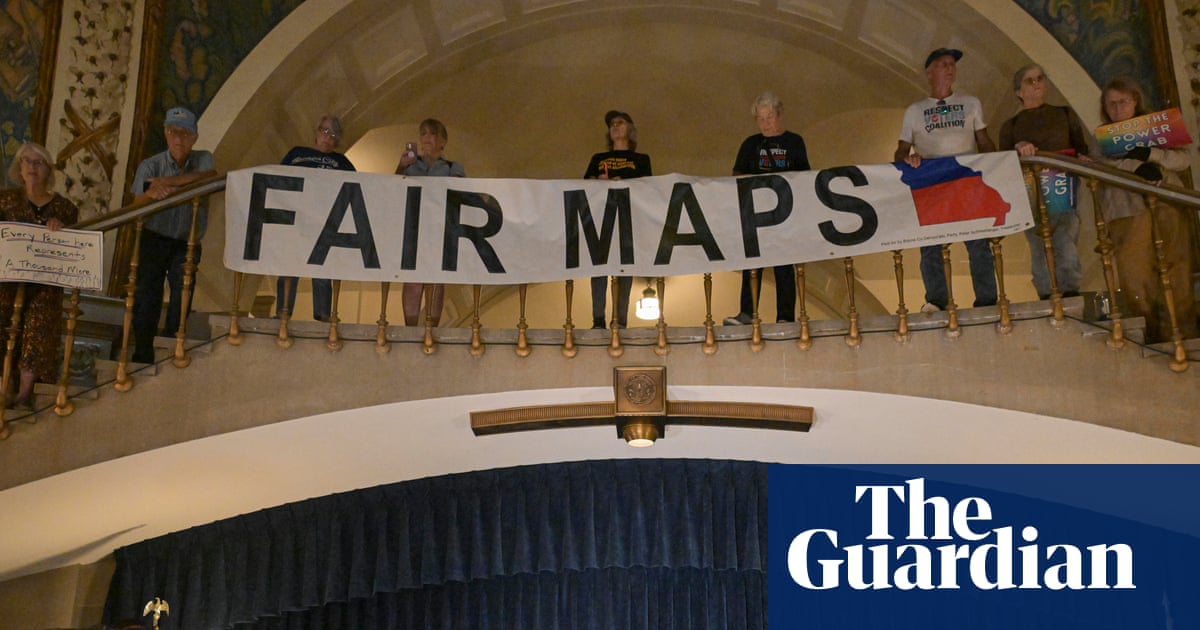
The opposing side, led by the group People Not Politicians, contends that the current legal landscape leaves state election officials with no valid map to use. They argued that the eighth US Circuit Court of Appeals’ decision to deny their request for a stay created an untenable situation. The group maintains that the new maps were drawn with partisan intent rather than neutral criteria, violating principles of fair representation. Their challenge highlights the tension between judicial interpretations of election integrity and political strategies aimed at securing legislative advantages. As the case moves to the Supreme Court, the stakes remain high for both parties involved in the national battle for congressional control.
This dispute in Missouri is part of a larger national trend involving mid-decade redistricting efforts across several states. Republicans had hoped these changes would yield significant gains in the House of Representatives, potentially flipping multiple seats. However, early analysis suggests that the actual electoral impact may be less pronounced than initially anticipated. While Republicans targeted numerous districts for pickup, political analysts indicate that Democrats are favored in several of the remapped races. The complexity of voter demographics and shifting political allegiances has made it difficult to predict outcomes with certainty, even in districts where boundaries have been altered to favor one party.
The timing of these legal maneuvers adds pressure to an already tight election cycle. Missouri is scheduled to begin early voting next month, requiring officials to finalize ballot designs and voter information well before the Supreme Court issues a decision. The lack of clarity poses logistical challenges for local administrators who must ensure compliance with federal and state laws while avoiding disenfranchisement or confusion among the electorate. Candidates running in affected districts also face uncertainty regarding their eligibility and campaign strategies, as they navigate a landscape where the rules of engagement are still being defined by the judiciary.
As the Supreme Court considers the appeal, the broader implications for American democracy come into focus. The case tests the limits of executive influence on electoral processes and the role of courts in mediating partisan disputes. It also raises questions about the stability of democratic institutions when legal battles intersect with imminent elections. Regardless of the final outcome, the Missouri saga serves as a cautionary tale about the fragility of electoral norms in an era of intense political competition. The resolution will likely set precedents for how similar conflicts are handled in future election cycles, impacting not just Missouri but the national political landscape.
Observers note that while Republicans have made strategic gains through redistricting, the overall advantage may be narrower than expected. In states like Texas, which pioneered these efforts, some targeted districts remain competitive due to diverse voter populations and changing political dynamics. Hispanic voters, in particular, have shown varying levels of support for Republican candidates, complicating predictions based solely on geographic shifts. This unpredictability underscores the limitations of map-drawing as a tool for securing long-term political dominance. As the November elections approach, all eyes remain on the Supreme Court to provide clarity and restore order to Missouri’s electoral process.
Sources behind this briefing
Go to the original reporting
- The Guardian World↗Missouri’s voting maps saga reaches supreme court after conflicting rulings
- PBS NewsHour↗Missouri's election maps in chaos after conflicting rulings

