The short version
- Only eight teams since 1992 have won both the Community Shield and the Premier League title in the same season.
- League runners-up who lose the Shield have historically secured more championships than the winners of the match.
- Individual goal performances in the opening fixture do not reliably predict a player's overall seasonal output or transfer success.
The upcoming Community Shield match between Arsenal and Manchester City at Cardiff’s Principality Stadium serves as the ceremonial start to the English football season, yet historical records suggest the result carries minimal weight regarding long-term league success. While the fixture pits the reigning champions against the FA Cup holders or league runners-up, statistical analysis indicates that winning this curtain-raiser is not a strong predictor of securing the Premier League title later in the campaign.
Since the inception of the Premier League in the 1992-93 season, only eight of the thirty-four Community Shield winners have gone on to win the league championship. This trend highlights a significant disconnect between early-season form and final standings. The majority of these dual victories occurred during a concentrated six-year period from 2005 to 2010, suggesting that such outcomes are exceptions rather than the rule in modern English football.
Manchester City’s victory in 2019 remains the most recent instance where the Shield winner also claimed the league title. Prior to that, Manchester United achieved the same feat in 2011 under manager Alex Ferguson. In the fifteen seasons preceding the current one, only a single Shield winner managed to finish as league champions, reinforcing the notion that early-season triumphs often lack correlation with sustained dominance over thirty-eight matchdays.
Conversely, teams that lose the Community Shield have demonstrated a stronger propensity for winning the league. Ten different clubs that lost the opening fixture went on to secure the Premier League title during this period. Manchester City exemplifies this pattern, having won the league in three consecutive seasons between 2021 and 2023 despite not retaining the Shield. This data suggests that losing the ceremonial opener may even be a more common trait among eventual champions than winning it.
Furthermore, nearly half of all Premier League winners since 1992 were not involved in the Community Shield at all. In the 2025-26 season, Arsenal qualified as league runners-up rather than cup winners, meaning their participation does not align with the historical cohort of teams that bypassed the fixture entirely. This statistic underscores that the path to the title often lies outside the immediate participants of the season’s first match.
When both participating teams do finish in the top two positions, which has occurred ten times, the Shield winner finished as league champions in only four instances. In the remaining six cases, the loser of the Community Shield secured the higher league position. This imbalance further diminishes the predictive value of the match result for fans and analysts attempting to forecast the season’s outcome based on early performances.
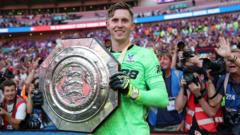
The competitive landscape has also shifted regarding which teams typically win the fixture. Historically, the previous season’s league winner held a distinct advantage, but this trend has weakened in recent years. Including Crystal Palace’s victory in 2025, FA Cup winners have claimed eight of the last twelve Shields. This represents a notable increase from the five times it occurred in the preceding twenty-two seasons, indicating a changing dynamic in how these teams approach the season opener.
Individual player performances in the Community Shield also fail to serve as reliable indicators of future success. While some players, such as Cole Palmer and Raheem Sterling, experienced breakthrough seasons after scoring in the fixture, others saw their form diverge significantly from their opening-day displays. Erling Haaland failed to score on his debut in the match but went on to net fifty-two goals that season, whereas Darwin Nunez scored for Liverpool yet managed only fifteen goals overall. These contrasting outcomes illustrate that early-season moments are often anomalies rather than precursors.
Ultimately, while the Community Shield provides a high-profile spectacle and marks the official start of the campaign, its results should be viewed with skepticism when assessing title prospects. The historical record clearly shows that league success is determined by consistency over many months, not by a single match in August. Fans and analysts would be better served by monitoring squad depth, managerial stability, and mid-season form rather than placing undue significance on the winner of the season’s first game.
Sources behind this briefing
Go to the original reporting
- BBC News↗How important is Community Shield to a team's season?

