The short version
- Daniela Largo survived three and a half days under rubble after firefighters dug tunnels to bypass heavy concrete slabs blocking access.
- Official figures indicate at least two hundred forty-one fatalities nationwide, with significant structural damage concentrated in Pereira and Cali.
- Authorities have implemented curfews in hard-hit zones to facilitate rescue operations while managing the risk of further collapses and looting.
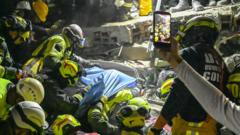
Emergency responders in western Colombia successfully extracted a thirty-two-year-old woman from beneath the ruins of a collapsed building on Tuesday, marking a significant moment in the ongoing relief effort following a powerful earthquake. Daniela Largo had been trapped for thirty-six hours under four heavy concrete slabs in the city of Pereira before firefighters completed a ten-hour operation to free her. The rescue required specialized techniques, as standard access was blocked by the weight and positioning of the debris.
The operation involved coordination between local fire departments, colleagues deployed from the capital Bogotá, and the national police disaster response team. Rescuers initially located Largo using a small camera after a local resident reported hearing cries for help emanating from the rubble. Because the concrete slabs prevented direct entry, teams dug two separate tunnels to reach her. One tunnel allowed them to supply oxygen from above, while a second tunnel excavated from below provided the necessary clearance to pull her out safely.
Largo was carried to an ambulance wrapped in a blue sheet, appearing stable after her ordeal. Her mother confirmed that their twelve-year-old son had been waiting at home for her return. The Colombian president took to social media to highlight the rescue, framing it as a source of hope for the nation during a period of widespread devastation and loss.
The broader context of the disaster remains grim. Official statistics place the death toll at two hundred forty-one people, with three thousand seven hundred others injured. Hundreds remain missing across the affected regions. The earthquake, which measured 7.4 on the Richter scale, struck early Monday morning near the village of San José del Palmar in Chocó province. Seismometers recorded intense shaking lasting between ninety seconds and two minutes at the epicenter, with tremors felt across a vast area of the country.
Pereira, located in Colombia’s coffee-growing region, has suffered extensive structural damage. At least ninety-two buildings have collapsed in the city, resulting in seventy-nine confirmed deaths. This makes Pereira the second hardest-hit location after Cali, where ninety-five fatalities have been recorded. In Pereira alone, fifteen people are known to be trapped under debris, and thirty-seven others are listed as missing according to data from the Association of Colombian Capital Cities.
Cali, the country’s third most populous city, continues to face significant challenges. As of Tuesday afternoon, more than two hundred individuals remained trapped in the ruins there. Rescue teams have managed to save eighty-seven people in the city so far. The scale of the destruction has prompted local authorities to declare a nighttime curfew in the worst-affected areas. Soldiers have been deployed to patrol these zones to ensure the safety of rescue workers and prevent potential looting or unrest.
The mayor of Cali emphasized that the curfew is necessary to allow rescue operations to proceed without interference. He noted that despite the high number of casualties, there remains hope of finding more survivors alive. The commitment to continue searching reflects the difficult balance between urgency and caution in unstable environments where aftershocks pose a constant threat.
More than one hundred aftershocks have occurred since the initial quake, complicating efforts to stabilize structures and search for survivors. The seismic activity has kept emergency services on high alert as they navigate the hazardous conditions. The focus now shifts from immediate extraction to sustained support for the injured and the families of those who have not yet been found.
The international community is watching closely as Colombia manages this large-scale disaster. The successful rescue of Largo demonstrates the effectiveness of coordinated, technical approaches in urban search and rescue scenarios. However, the high casualty count and the number of missing persons underscore the severity of the event and the long road to recovery ahead for the affected communities.
As night falls over the region, the work continues under artificial light and strict security measures. The coming days will likely reveal more about the full extent of the damage and the resilience of the local population. For now, the priority remains locating those still trapped and providing medical care to the thousands who have been injured in the quake.
Sources behind this briefing
Go to the original reporting
- BBC World↗Woman pulled alive from rubble 36 hours after Colombia quake

