The short version
- A magnitude 7.4 earthquake has struck southwestern Colombia, causing significant structural damage and loss of life in Cali and surrounding regions.
- Rescue operations at the collapsed Torres del Limonar building continue under challenging conditions, with volunteers and emergency personnel working to locate trapped individuals.
- Official death tolls remain uncertain due to ongoing rescue efforts and communication difficulties, though local authorities report dozens of fatalities and numerous missing persons.
A powerful magnitude 7.4 earthquake struck southwestern Colombia on Monday, marking the most severe seismic event in the country this century according to the National Geological Service. The tremor caused widespread destruction, particularly in Cali, the nation’s third-largest city, where multiple buildings collapsed and infrastructure was severely damaged. Emergency responders have been working around the clock to locate survivors trapped beneath debris, while local officials attempt to assess the full scale of the disaster.
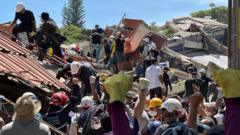
In Cali, the collapse of the Torres del Limonar building has become a focal point for rescue efforts. The four-story structure, located in the Capri neighborhood, housed dozens of apartments and was reduced to a pile of concrete, furniture, and personal belongings. Rescuers, including firefighters, military personnel, and volunteers, have been digging through the rubble using hand tools such as saws and hammers to create tunnels and clear escape routes. The operation has been marked by moments of intense silence, during which teams hold their hands up to signal quiet so that any sounds from survivors can be heard.
Efraín Gallego, whose 80-year-old brother and sister-in-law were buried in the collapse, has remained at the scene despite the emotional toll. He expressed hope each time rescuers announced potential signs of life, though no definitive news of his brother’s survival has emerged. Gallego acknowledged the efforts of ordinary citizens who have joined the rescue effort, bringing water, supplies, and tools to support the operation. Many residents in the area have chosen not to speak, visibly affected by the tragedy, while others gather under shade or sleep exhausted on the ground.
The death toll remains uncertain due to the ongoing nature of the rescue operations and challenges in verifying information. Mayor Alejandro Éder reported at least 95 deaths in Cali as of Monday night, though other reports suggest higher numbers, with some estimates reaching 180 fatalities nationwide. Local media outlets have provided varying accounts of survivors pulled from the rubble, including an infant only a few months old. Rescuer James Velasco confirmed that at least two people had been detected alive under the Torres del Limonar building, with tunnels being constructed to free them, one of whom required leg extraction.
The earthquake’s impact extended beyond Cali, affecting regions such as Chocó in the northwest. More than 50 buildings have collapsed in Cali alone, though many surrounding structures sustained only minor damage, such as cracks. The city’s population of over two million faces significant challenges as rescue teams work to locate missing persons and provide aid to displaced residents. A nighttime curfew was declared to facilitate faster rescue operations, allowing emergency personnel greater access to affected areas.
Volunteers have played a crucial role in the response effort, with young people like 19-year-old Alejandro Mahecha joining friends to clear debris, distribute water, and assist rescuers. Mahecha described his decision to help as driven by a desire to support his community after the initial shock of the earthquake subsided. The collaborative spirit among residents has been evident, with many contributing resources and labor to aid those affected by the disaster.
As rescue operations continue, the focus remains on locating survivors trapped under the rubble while managing the logistical challenges posed by the scorching heat and limited equipment. Rescuers have noted that survival is possible even after extended periods underground, citing past experiences where individuals were found alive after seven days. However, the uncertainty surrounding casualty figures and the condition of those still missing underscores the complexity of the situation.
The coming days will likely bring further clarity on the extent of the damage and the number of lives lost. Authorities are expected to provide updated assessments as rescue efforts progress and communication channels improve. For now, the priority remains saving lives and supporting those displaced by the earthquake, with communities rallying together in the face of adversity.
The disaster has highlighted both the vulnerability of urban infrastructure in seismic zones and the resilience of local populations in responding to crises. As Colombia works to recover from this devastating event, the lessons learned may inform future preparedness strategies and building codes to mitigate the impact of similar disasters.
Sources behind this briefing
Go to the original reporting
- BBC World↗Anguish of Colombian brother at rubble of building being searched for earthquake survivors

