The short version
- Mark Carney requested provinces end the boycott of US whiskey and other alcohol to facilitate a trade agreement.
- Negotiators report a deal is 'very close,' with potential reductions in tariffs on Canadian steel, aluminum, and vehicles.
- Provincial leaders express mixed feelings about restoring sales, citing consumer sentiment against US brands.
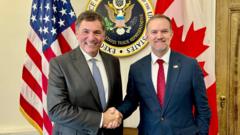
Prime Minister Mark Carney has asked Canadian provinces to restore US alcohol to the shelves of liquor stores and supermarkets as a trade deal with the United States edges closer. The request comes amid intense negotiations aimed at resolving trade irritants between the two nations. Trade negotiators met on Thursday in Washington for the fourth time in as many days, with Canada-US trade minister Dominic LeBlanc telling reporters afterwards that a deal is 'very close.' Details on what the proposed agreement includes have not yet been announced, but premiers of Canada's provinces confirmed Carney had asked them to end the boycott of US whiskey and other alcohol.
Reports suggest the deal may cover Canadian steel, aluminum, and cars, in addition to US booze. Speaking to reporters on Wednesday after meeting his Canadian counterpart, US trade representative Jamieson Greer said the US was 'very happy' and that the deal eliminated 'some of the irritants' with Canada. US President Donald Trump paused a new wave of tariffs he had threatened to impose overnight on Wednesday on a range of Canadian goods to allow the deal's details to be hammered out. Trump said on Wednesday that Canada has agreed to eliminate tariffs on US farmers, though he did not specify which specific agricultural sectors would benefit.
Asked whether the US will also reduce some tariffs it has placed on Canada, Trump said by 'a little bit.' In a post on X on Wednesday, Carney said 'significant progress' had been made and that they were moving towards an agreement that addressed 'Canada's most important strategic sectors.' Canada has been in pursuit of a deal that would have the US drop or reduce tariffs on its steel, aluminum, automobiles, and lumber. Under a deal that could be completed by Friday evening, US tariffs on Canadian steel and aluminum would reportedly be cut to 25% from 50%. The US may also lower its headline tariff rate on Canadian-made vehicles from 25% to 15%, according to reports from US and Canadian media.
The prime minister met his cabinet and leaders of Canadian provinces on Wednesday afternoon to brief them. Following Carney's meeting, Nova Scotia Premier Tim Houston said the prime minister asked provinces to return US alcohol to Canadian markets. 'It's been something that has kind of really bothered the United States for so many reasons,' Houston said. 'Now, whether Canadians will really buy it when it's back on the shelf, that's a whole other discussion.' Most Canadian provinces banned US alcohol sales last year in retaliation to Trump's tariffs. The US wine and spirits industry says they have seen exports to Canada drop by more than 70% since the boycott went into effect early last year.
Speaking to reporters on Thursday, Manitoba Premier Wab Kinew said his government is not keen to restore US alcohol sales but would in order to present a united Canadian front. The decision to end the boycott reflects the broader strategy of leveraging consumer sentiment to achieve favorable trade terms. However, provincial leaders acknowledge that public opinion may remain resistant to US brands, regardless of political directives. The tension between diplomatic goals and consumer preferences adds complexity to the implementation of any agreement.
The potential deal represents a significant shift in US-Canada trade relations, addressing long-standing disputes over tariffs and market access. The reduction in tariffs on steel, aluminum, and vehicles would provide relief to Canadian industries that have been impacted by previous measures. The inclusion of alcohol sales in the negotiations highlights the symbolic importance of the boycott and its role as a bargaining chip. The success of the deal will depend on the ability of both sides to finalize details quickly and address remaining concerns.
As the deadline for the agreement approaches, attention remains on whether the proposed terms will be accepted by all parties. The pause in new tariffs provides a window for final negotiations, but uncertainties remain regarding the specific provisions and their impact on various sectors. The request to end the alcohol boycott underscores the interconnectedness of trade issues and the need for comprehensive solutions. The outcome of these talks will have lasting implications for US-Canada economic relations.
Sources behind this briefing
Go to the original reporting
- BBC Business↗Carney asks Canada's provinces to end US alcohol ban as trade deal nears
- CBC↗'A bad taste left in my mouth': Will Canadians buy U.S. booze again?
- Yahoo! Finance Canada↗Carney asks provinces to return U.S. alcohol to stores
- Global News↗Even if U.S. alcohol returns to provincial shelves, will Canadians buy it?