The short version
- Canadian and European leaders launched the Alliance for the Future in Montreal, focusing on digital trade, critical minerals, and security cooperation.
- Prime Minister Mark Carney expects to conclude talks on associate membership by June, despite the term being absent from the initial joint declaration.
- The partnership aims to reduce economic dependence on the United States while strengthening sovereignty through shared values and strategic alignment.
Canadian Prime Minister Mark Carney has signaled a decisive shift in North American foreign policy, announcing plans to conclude negotiations with the European Union by June that would establish Canada as the bloc’s first associate member. This unprecedented arrangement seeks to create the closest relationship the EU has ever forged with a non-member nation, bridging the Atlantic through deepened economic and security ties. While the designation of associate membership was notably omitted from the joint declaration issued at the conclusion of a two-day summit in Montreal, Carney affirmed that this status remains the ultimate objective of the ongoing diplomatic efforts.
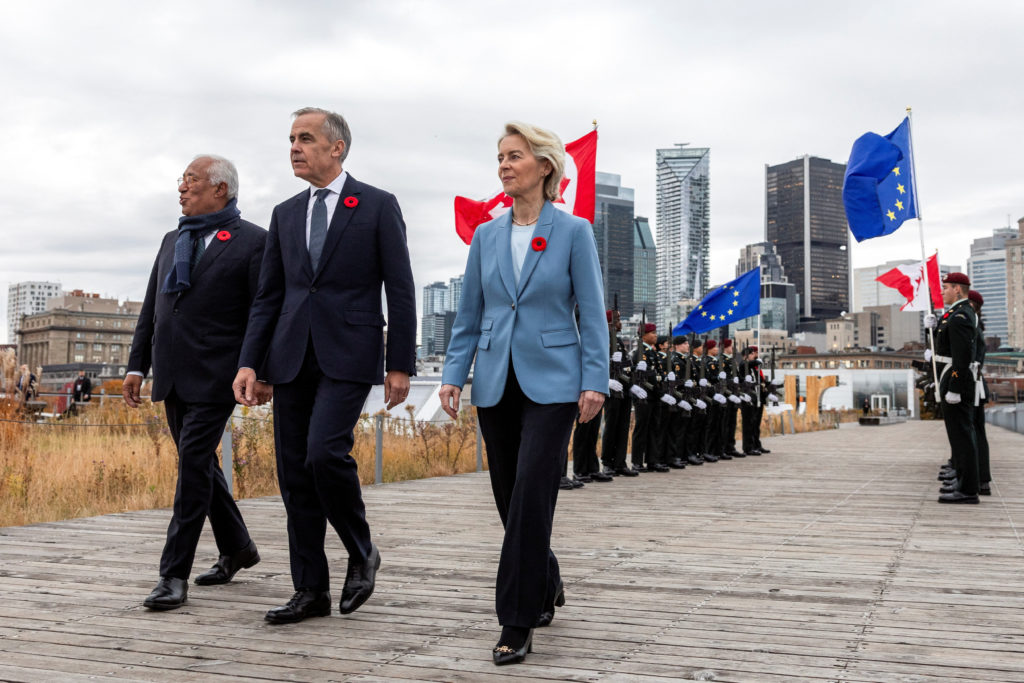
The summit marked the launch of the Alliance for the Future, a comprehensive framework designed to enhance cooperation across multiple sectors. European Commission President Ursula von der Leyen and European Council President António Costa joined Carney in Montreal to announce significant progress on digital trade agreements and investments in critical minerals. These developments reflect a strategic pivot toward greater economic independence for both Canada and Europe, driven by shared concerns over global supply chain vulnerabilities and the need for resilient infrastructure.
A central component of the new alliance involves a concluded digital trade agreement intended to streamline cross-border operations for businesses. This pact facilitates the movement of data between Canada and Europe, reducing regulatory friction for companies operating on both sides of the Atlantic. Additionally, negotiations have been finalized on a competition agreement aimed at curbing anti-competitive practices, which officials hope will result in lower prices for consumers. The two sides are also exploring the linkage of their instant-payment systems to make international money transfers faster and more cost-effective.
Strategic resource security plays a pivotal role in the partnership, particularly regarding critical minerals essential for electric vehicles and defense industries. Canada and the European Investment Bank have concluded an agreement to encourage European investment in Canadian mineral projects. This collaboration underscores the mutual interest in securing supply chains for materials that are increasingly vital to green technology and national defense. Furthermore, leaders agreed to study the feasibility of exporting Canadian liquefied natural gas to Europe, potentially diversifying energy sources amid global geopolitical tensions.
Technological cooperation is another cornerstone of the alliance, with Canada set to participate in a European supercomputing initiative. Carney highlighted the potential for this collaboration to dramatically accelerate research capabilities, noting that Europe’s JUPITER supercomputer could perform calculations in one day that would take Canada’s most powerful research machine six months. This access to advanced computational resources is expected to bolster scientific innovation and data analysis capacities within Canadian institutions.
Despite the enthusiasm surrounding these developments, the path to associate membership faces internal challenges within the EU. Von der Leyen has been a strong advocate for bringing Canada as close as possible to the bloc, emphasizing that shared values matter more than geographic proximity in determining international partnerships. However, some European governments have expressed resistance to the specific designation of associate member. Consequently, the joint declaration focused on defining an ever-closer association by the next summit in 2027, leaving the precise nature of the relationship to be determined through further negotiations.
The geopolitical context of this alliance is heavily influenced by strained relations between the United States and its traditional allies. European Council President António Costa described Canada as the most European of non-European countries, highlighting cultural and political affinities that transcend borders. Carney framed the partnership as a means to strengthen sovereignty and withstand economic shocks, particularly in light of trade tensions initiated by U.S. President Donald Trump. The United States accounts for nearly 72% of Canada’s merchandise exports, making diversification a critical priority for Canadian economic security.
Looking ahead, Canadian cabinet ministers and European commissioners are scheduled to meet in March to advance negotiations before Carney attends European Council meetings in June. The broader Alliance for the Future may eventually expand to include other like-minded countries, with Canada and the EU at its core. Additional areas of cooperation include border security, defense, cybersecurity, Arctic security, and countering foreign interference. Educational exchanges are also on the agenda, with plans to explore expanding Canadian participation in the Erasmus+ student exchange program.
The potential for this alliance to reshape transatlantic dynamics is significant, but it also carries risks. Trump has suggested that Canada’s proposed arrangement could be viewed as a hostile act and has threatened tariffs against Europe if he considers the partnership unfriendly. As Canada moves forward with these negotiations, it must balance its desire for greater autonomy and diversified partnerships with the economic realities of its deep integration with the U.S. market. The outcome of these talks will likely set a precedent for how non-EU nations engage with the bloc in an increasingly fragmented global order.
Sources behind this briefing
Go to the original reporting
- PBS NewsHour↗Canada is taking steps toward becoming European Union's first associate member


