The short version
- California voters rejected a proposed one-time tax on the net worth of billionaires, ending a contentious ballot measure that aimed to replace lost federal healthcare funding.
- Opposition groups raised roughly ten times more money than supporters, with Google co-founder Sergey Brin contributing over $100 million to defeat the initiative.
- The measure faced broad resistance from traditional Democratic allies and moderate voters who feared economic instability and a potential exodus of wealthy residents.
California voters have decisively rejected Proposition 40, a pioneering ballot measure that sought to impose a one-time five percent tax on the net worth of individuals exceeding $1 billion. The Associated Press confirmed the defeat on Monday, marking a significant victory for Democratic state leaders who opposed the initiative and for wealthy taxpayers eager to avoid new financial burdens. This outcome concludes a highly polarized campaign that highlighted deep divisions within the state’s political landscape regarding how to address wealth inequality and fund public services.
The measure was designed to generate revenue primarily to offset anticipated cuts in federal healthcare funding, with an estimated $100 billion in losses projected over five years. Supporters, including Service Employees International Union United Healthcare Workers West, argued that the tax was essential for protecting patient care and maintaining social safety nets. Additionally, ten percent of the collected funds were earmarked for education and food assistance programs. Proponents framed the initiative as a necessary response to shifting federal priorities, aiming to ensure that the state’s most affluent residents contributed proportionally to public infrastructure.
However, the opposition campaign was overwhelmingly well-funded, raising approximately ten times more money than the supporters of the tax. Google co-founder Sergey Brin alone contributed more than $100 million to a political action committee dedicated to defeating the measure. This committee, known as Building a Better California, raised over $333 million in total, with nearly a third coming from Brin. The sheer scale of this financial mobilization allowed opponents to dominate advertising and outreach efforts, effectively framing the tax as an economic threat rather than a fiscal solution.
Critics of Proposition 40, including Governor Gavin Newsom, argued that the tax would destabilize California’s economy by prompting ultra-wealthy residents to leave the state. Traditional Democratic allies such as Planned Parenthood and the California Medical Association joined the opposition coalition, expressing concerns about how the revenue would be allocated and the potential budgetary fallout if wealthy taxpayers departed in large numbers. They characterized the initiative as a reckless experiment that ignored the structural reliance of the state’s budget on income taxes from its richest residents.
Voting patterns revealed distinct demographic splits along age and income lines. Polling data indicated that young voters under the age of 30 largely supported the measure, while older voters were significantly more resistant, with roughly seventy percent of those aged 65 and older voting against it. Income also played a crucial role; about half of voters with household incomes below $100,000 backed the tax, whereas nearly sixty percent of those earning $100,000 or more opposed it. These trends suggest that while progressive ideals resonate with younger and lower-income demographics, fiscal caution remains prevalent among older and higher-income groups.
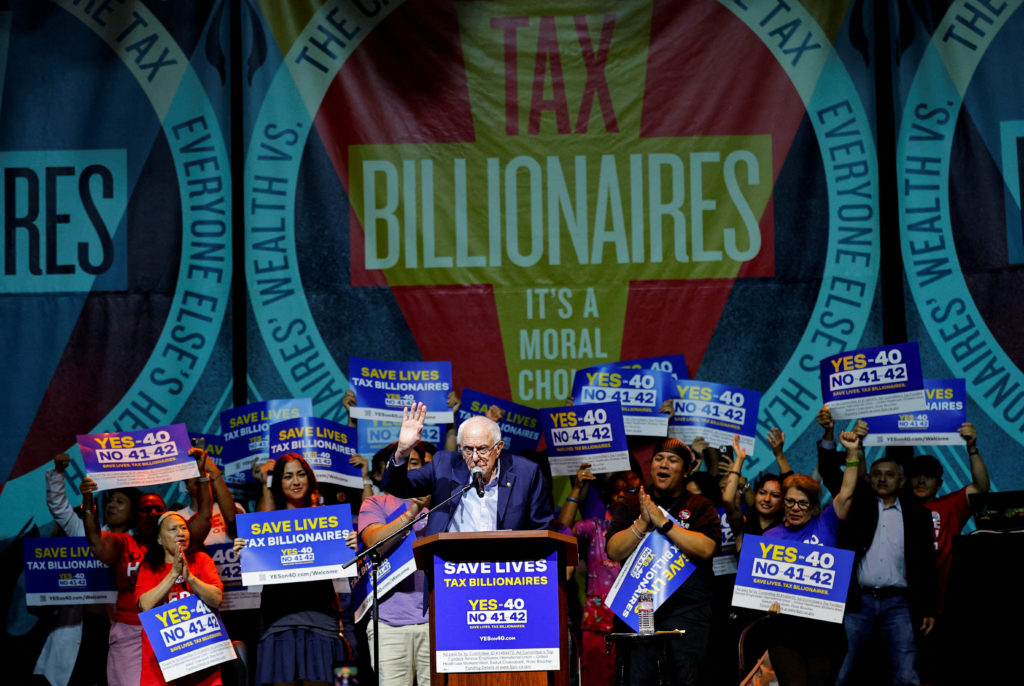
The campaign also highlighted tensions between national progressive leaders and state officials. Vermont Senator Bernie Sanders rallied across California in the final weeks of the race, urging voters to pass the measure as part of a broader push for wealth taxation. However, Governor Newsom, who may seek the presidency in 2028, publicly disagreed with the state-level approach while supporting a national minimum tax on high-net-worth individuals. This divergence underscored the complex political calculus involved in addressing inequality without jeopardizing local economic stability.
Some billionaires had already begun severing ties with California in anticipation of the tax’s potential passage. Google co-founders Sergey Brin and Larry Page were among those reducing their connections to the state, while Meta CEO Mark Zuckerberg negotiated a deal to remain for eight years, allowing him to pay any applicable taxes without losing ownership stakes. These actions reinforced opponents’ arguments that the tax could trigger a mass exodus of capital and talent, further complicating the debate over its feasibility.
Despite the defeat, proponents of the wealth tax have vowed to continue their efforts. The 'Yes on 40' campaign stated that they would reintroduce a similar measure in 2028 if patient protections are not secured, framing the current loss as a temporary setback rather than a final resolution. They argued that financial spending did not equate to winning the broader debate on economic justice. As California moves forward, the question of how to fund public services amidst federal funding cuts remains unresolved, leaving room for future legislative and ballot battles.
The rejection of Proposition 40 serves as a cautionary tale for progressive advocates seeking to implement wealth taxes at the state level. It demonstrates the formidable power of concentrated financial opposition and the challenges of building broad coalitions across diverse voter demographics. While the idea of taxing extreme wealth continues to gain traction nationally, California’s experience suggests that local implementation faces significant hurdles rooted in economic anxiety and political polarization.
Looking ahead, the outcome may influence how other states approach similar initiatives. The failure in California could deter lawmakers elsewhere from pursuing aggressive wealth-tax measures without stronger bipartisan support or clearer mechanisms for revenue distribution. Conversely, it may also galvanize progressive movements to refine their strategies, focusing on national legislation rather than state-level experiments. The debate over economic inequality is far from over, but the path forward will likely require more nuanced approaches than those tested in this election.
Sources behind this briefing
Go to the original reporting
- PBS NewsHour↗California voters reject tax on net worth of billionaires


