The short version
- Prime Minister Andy Burnham intends to travel to New York in September to meet with President Trump and European allies regarding Ukraine's military needs.
- The UK has agreed to share blueprints for Storm Shadow missile components, enabling Ukraine to manufacture these long-range weapons domestically.
- Urgent negotiations are underway to address dwindling Patriot missile stocks, which are critical for defending against anticipated Russian winter attacks on energy infrastructure.
UK Prime Minister Andy Burnham has announced plans to travel to the United States next month to engage directly with President Donald Trump and other European leaders regarding the defense of Ukraine. The proposed visit, scheduled for September during the UN General Assembly meetings in New York, would mark Burnham’s first trip to the US since assuming office in July. While the prime minister noted that logistical details remain unconfirmed, he expressed strong likelihood of attending, emphasizing the necessity of coordinating international support as Russian aggression intensifies.
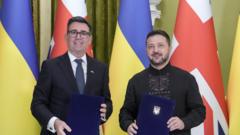
The diplomatic push comes against a backdrop of escalating violence in Ukraine, including recent deadly strikes on civilian infrastructure such as a shopping center that killed at least sixteen people. Burnham recently completed his first official international visit to Kyiv, where he met with President Volodymyr Zelensky and chaired the inaugural session of the 'coalition of the willing,' an initiative established by the UK and France under the previous administration. During this meeting, leaders reaffirmed their commitment to strengthening Kyiv’s air defenses as an urgent priority.
A central focus of the upcoming negotiations will be the severe shortage of Patriot interceptor missiles, which Ukraine relies on to counter Russian ballistic missile attacks. Stockpiles have diminished significantly due to concurrent military demands in Iran, leaving Ukrainian cities increasingly vulnerable. President Zelensky has indicated a need for approximately three hundred additional Patriot systems before winter, a period historically marked by intensified Russian assaults on energy infrastructure. Burnham acknowledged the complexity of resolving this supply gap but expressed confidence that a solution is achievable through multilateral efforts.
The UK is taking concrete steps to bolster Ukraine’s long-range strike capabilities by agreeing to transfer blueprints for British-made components used in the Scalp missile system. This French variant of the UK’s Storm Shadow cruise missile will allow Ukrainian manufacturers to produce the weapons domestically, reducing reliance on external shipments. This move represents a significant shift in military aid strategy, aiming to sustain Ukraine’s offensive and defensive operations despite potential disruptions in Western supply chains.
However, securing similar technology for air defense systems remains contentious. In July, President Trump reversed earlier indications that Ukraine might be permitted to manufacture Patriot missiles locally, citing concerns over the transfer of advanced technology. He described the weapons as 'incredible' and emphasized the need for caution regarding who is allowed to build them. This hesitation has created uncertainty around whether the US will support domestic production or alternative supply mechanisms for these critical defense assets.
Burnham stressed that the United States is not the sole provider of military aid, noting that other nations with whom the UK holds influence can contribute to filling the gap. He described the path forward as requiring multiple layers of negotiation and cooperation among allied countries. The joint statement issued by Burnham, French President Emmanuel Macron, and German Chancellor Friedrich Merz highlighted a shared goal of constraining Russia’s war chest through targeted sanctions and actions against its shadow fleet.
The coalition leaders also condemned Moscow’s systematic targeting of Ukrainian cities and critical infrastructure, pledging continued pressure until a just and lasting peace is achieved. Burnham used the occasion of Ukraine’s thirty-fifth independence anniversary to reassure Kyiv of unwavering British support, stating that Ukraine’s security is intrinsically linked to UK national interests. He emphasized that the friendship between the two nations would endure beyond the current conflict.
As preparations for the September visit continue, the outcome of these diplomatic efforts could significantly influence the trajectory of military aid to Ukraine. The interplay between US policy shifts under Trump and European commitments will determine whether Kyiv can secure the necessary defenses for the coming winter. Burnham’s proactive engagement signals a determination to maintain momentum in international support despite evolving political landscapes in Washington.
The situation remains fluid, with key decisions pending on both sides of the Atlantic. While the UK moves forward with missile blueprint transfers, the broader question of air defense sustainability hangs in the balance. The upcoming meetings in New York will serve as a critical test of allied cohesion and the ability to adapt military assistance strategies in response to changing geopolitical realities.
Observers will be watching closely to see if Burnham can bridge the gap between European urgency and American caution. The success of these negotiations may not only affect Ukraine’s immediate survival but also set precedents for future international military cooperation. As the conflict enters another phase, the stakes for diplomatic engagement have never been higher.
Sources behind this briefing
Go to the original reporting
- BBC News↗Burnham planning to visit US in September to lobby Trump on Ukraine

