The short version
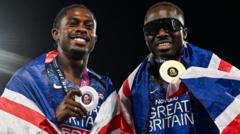
- Romell Glave won the men's 100m title with a time of 10.09 seconds, marking his first international gold medal.
- Jeremiah Azu secured silver with a time of 10.16, completing a British one-two finish for the host nation.
- Defending champion Lamont Marcell Jacobs withdrew from the race due to injury, allowing German Owen Ansah to take bronze.
Great Britain achieved a significant milestone in track and field at the European Athletics Championships in Birmingham, securing both the top two spots in the men's 100-meter final. Romell Glave claimed the gold medal with a winning time of 10.09 seconds, while his teammate Jeremiah Azu finished second with a time of 10.16 seconds. This result marked the first time a British duo had occupied the top two positions in this event at the continental championships, adding to the nation's growing reputation for sprint excellence on home soil.
The victory represented a major career upgrade for Glave, who previously won bronze at these same championships in Rome two years prior. At 26 years old, Glave has shown marked improvement throughout the current season, becoming the first athlete to break the ten-second barrier under legal conditions during his campaign. He recorded sub-ten-second times on six separate occasions this year, demonstrating a level of consistency that had eluded him in previous seasons due to various physical setbacks.
Glave's path to the podium was not without challenges. He has dealt with injury issues in the past, including a fractured back that disrupted his progress after a promising junior career where he was ranked as the fastest 17-year-old globally in 2017. Despite reporting that his physical condition had been inconsistent in the week leading up to the final, Glave stated he was prepared for the occasion. His strategy focused on sharpening his start, allowing him to take the lead by the 30-meter mark and maintain control through the finish line.
Jeremiah Azu's silver medal performance provided a strong conclusion to what he described as an irregular season. The 25-year-old Welsh sprinter had experienced inconsistency in recent competitions, finishing fourth at the World Indoor Championships and fifth at the Commonwealth Games earlier this year. Although he had run a personal best of 10.00 seconds at the Commonwealth Games, his championship form had been less predictable. Azu emphasized that times are often irrelevant during major championships, noting that his focus remained on racing for medals rather than specific clock times.
The race dynamics shifted significantly when Italy's Lamont Marcell Jacobs, the two-time defending European champion and surprise Olympic winner from five years ago, withdrew from the competition. Jacobs pulled up with an injury halfway through the race, removing a primary contender from the field. This development allowed German sprinter Owen Ansah to complete the podium in third place. The absence of Jacobs altered the competitive landscape, though Glave and Azu appeared unaffected by the change in field composition.
The British success in the men's 100 meters followed closely on the heels of Amy Hunt's victory in the women's 100-meter final just 24 hours earlier. Hunt's triumph had already signaled a strong showing for the host nation, and the men's one-two finish extended that momentum. Glave described the collective performance as total domination, noting that while the team had aimed for a one-two-three sweep, securing the top two positions was still an exceptional outcome. Three British athletes had qualified for the final, but Louie Hinchliffe did not contest the medal race.
Glave's confidence appeared bolstered by earlier successes against top-tier competition, including a victory over Jacobs on Italian soil earlier in the season. His semi-final performance demonstrated his readiness, as he dominated the field before executing to perfection in the final. The celebration was evident as Glave raised a finger to the sky after crossing the line, becoming only the sixth man to win the European 100-meter title and the third British winner in the past six editions of the championship.
The event took place at Alexander Stadium, where the home crowd reacted enthusiastically to the double podium finish. While some criticism has emerged regarding ticket prices and empty seats at certain events during the championships, the men's 100-meter final drew significant attention due to the high caliber of British participation. The results underscored a shift in European sprinting power, with Great Britain asserting its dominance through consistent performances from multiple athletes rather than relying on a single star performer.
Looking ahead, the implications of this victory extend beyond the immediate podium finish. For Glave, the gold medal validates his recent training adjustments and recovery from past injuries. For Azu, the silver medal offers reassurance that he can perform under pressure despite a season marked by inconsistency. The British athletics federation will likely view this one-two finish as evidence of a robust sprint program capable of sustaining success at both European and global levels in future competitions.
Sources behind this briefing
Go to the original reporting
- BBC News↗GB's Glave and Azu claim European 100m one-two
- BBC Sport↗Glave wins 100m gold ahead of Azu in stunning GB one-two

