The short version
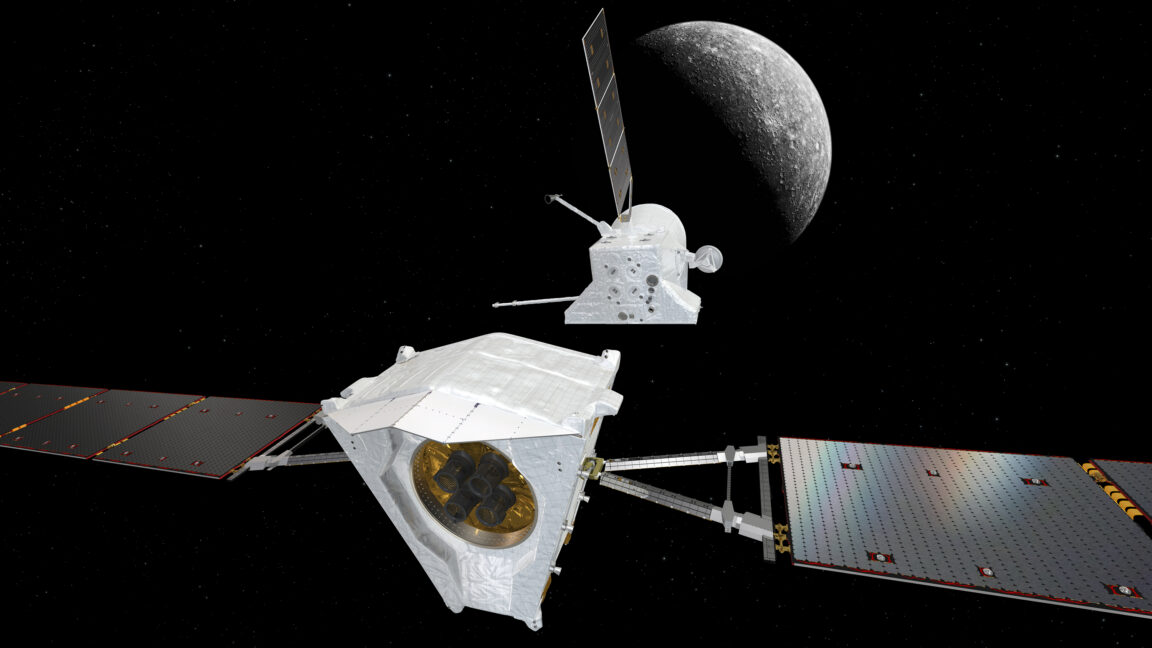
- BepiColombo successfully separated from its Mercury Transfer Module, a necessary step before entering orbit around the innermost planet.
- The separation exposed previously shielded scientific instruments to solar radiation and allowed the orbiters to begin generating power independently.
- Mission managers describe the maneuver as high-risk due to the extreme thermal environment and the complexity of transferring control systems.
The BepiColombo mission has reached a pivotal juncture in its eight-year voyage to Mercury, successfully discarding the propulsion module that carried it through most of its interplanetary journey. This separation marks the end of the cruise phase and the beginning of the final approach to the Sun’s closest planet. The maneuver was executed on Thursday, with telemetry confirming that the remaining spacecraft components are functioning as expected. Early data indicates that the Mercury Planetary Orbiter’s solar arrays are generating sufficient power to recharge batteries depleted during the separation process.
The decision to jettison the Mercury Transfer Module was driven by necessity rather than choice. The module, which housed four powerful ion thrusters and provided power for the duration of the transit, had served its purpose. As the spacecraft neared Mercury, the propulsion system became dead weight that needed to be removed before the final orbital insertion scheduled for November. The transfer module’s departure leaves two scientific orbiters—the European-built Mercury Planetary Orbiter and the Japanese-built Mercury Magnetospheric Orbiter, known as Mio—still attached to one another but ready for independent operation.
This separation is technically unprecedented in such a hostile environment. Occurring approximately 39 million miles from the Sun, the maneuver took place in a region characterized by intense solar radiation and extreme temperatures. Mission officials have likened the complexity of this event to launching an entirely new spacecraft. The remaining orbiters had to assume full responsibility for power generation, thermal control, propulsion, and attitude pointing immediately after the split. Any failure in these systems could jeopardize the entire mission given the proximity to the Sun.
The success of the separation also unlocks the scientific potential of the mission’s primary instruments. During the long transit, several key sensors, including high-resolution cameras, were shielded by the bulky transfer module to protect them from heat and radiation. With the module now gone, these instruments are exposed to sunlight for the first time. This exposure allows scientists to begin calibrating equipment and preparing for detailed observations of Mercury’s surface, magnetic field, and exosphere once the orbiters settle into their final positions.
The path to this moment has not been without significant challenges. In 2024, the spacecraft experienced a partial loss of power in its ion thrusters, forcing engineers to extend the mission timeline by one year to compensate for reduced thrust capability. Despite this setback, BepiColombo has traveled more than 6 billion miles since its launch in 2018. The journey required an unprecedented nine planetary flybys involving Earth, Venus, and Mercury to gradually adjust the spacecraft’s velocity and trajectory. These gravity assists were essential for slowing the probe down enough to be captured by Mercury’s gravity.
Reaching Mercury is energetically more demanding than missions to the outer planets. While NASA’s New Horizons probe took nearly a decade to reach Pluto, entering orbit around Mercury requires significantly more delta-v due to the Sun’s strong gravitational pull. BepiColombo utilized the most powerful electric propulsion system ever deployed in deep space to navigate this challenge. The four gridded ion thrusters reshaped the spacecraft’s orbit around the Sun between flybys, allowing it to spiral inward toward its target.
The mission is a collaborative effort led by the European Space Agency with substantial contributions from Japan and the United States. With a budget nearing $2 billion, BepiColombo aims to uncover the origins of Mercury and understand how the iron-rich planet evolved into its current state. The two orbiters will separate in December, shortly after arriving in their initial parking orbit around Mercury. Each orbiter carries distinct scientific payloads designed to study different aspects of the planet’s geology, magnetosphere, and interaction with the solar wind.
Mission managers remain cautious but optimistic as they monitor the spacecraft’s performance following the separation. Ignacio Tanco, head of inner Solar System mission operations at ESA, noted that the team would only know for certain if the new sensors and mechanisms were working correctly after the event. The confirmation of positive power margins is a strong indicator that the transition was successful. As BepiColombo continues its final approach, the focus shifts to ensuring the orbiters can withstand the harsh conditions near Mercury while preparing for the complex orbital insertion maneuvers later this year.
The upcoming months will test the resilience of the spacecraft and the precision of the mission planning. The November 21 orbital insertion will be the next major milestone, requiring precise timing and velocity adjustments to capture the probe into a stable orbit. Until then, the team must ensure that the newly exposed instruments remain functional and that the thermal control systems can manage the intense heat. The success of BepiColombo could provide unprecedented insights into the formation of terrestrial planets and the dynamics of the inner Solar System.
As the spacecraft moves closer to its destination, the scientific community anticipates a wealth of new data. The ability to observe Mercury from multiple vantage points using both European and Japanese instruments will allow for a comprehensive analysis of the planet’s environment. This mission represents a significant achievement in interplanetary exploration, demonstrating the capability to operate complex robotic systems in one of the most challenging regions of the Solar System. The final stages of the journey will determine whether BepiColombo can deliver on its ambitious scientific goals.
Sources behind this briefing
Go to the original reporting
- Ars Technica↗After 8 years, Europe's BepiColombo mission is on final approach to Mercury
