The short version
- Harland and Wolff is spending £3 million to overhaul its historic Samson and Goliath cranes as part of a larger £100 million investment package.
- The shipyard preparations are critical for the final assembly of three Royal Navy support ships under the Fleet Solid Support programme.
- Airbus has commenced construction on a significant extension to its Belfast wing factory to meet rising demand for A220 aircraft components.
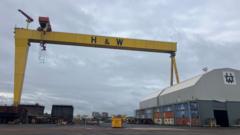
Significant industrial activity is accelerating in Belfast as two major manufacturing entities prepare for substantial operational expansions. Harland and Wolff, the historic shipyard owned by Spanish state-owned builder Navantia since January 2025, has announced a £3 million refurbishment of its iconic yellow cranes, Samson and Goliath. This expenditure is part of a broader nearly £100 million investment strategy designed to ready the facility for a pivotal defence contract involving the Royal Navy.
The cranes, which remain a defining feature of the east Belfast skyline, require comprehensive mechanical, electrical, hydraulic, and fabric maintenance. The overhaul involves replacing key components and updating technology to ensure the structures can operate at full lifting capacity. Carlos Lopez Carregado, General Manager at Harland & Wolff, emphasized that the project aims to restore the cranes to their best condition while treating them with respect for their cultural significance to the city.
This infrastructure upgrade is directly linked to the Fleet Solid Support programme, for which the Belfast yard serves as the integration and final assembly site. Three Royal Navy support ships are being constructed in blocks at Navantia sites in Spain and Devon. These large sections will be transported by barge to Belfast, where they will be assembled into complete vessels. The first ship, RFA Resurgent, is scheduled to have its blocks arrive in early 2027.
Navantia’s commitment to the Belfast site extends beyond crane maintenance. Previous investments have included expanding the fabrication hall and installing advanced plasma cutting equipment. These upgrades are essential for handling the complex assembly tasks required by the defence contract. The timeline suggests that while work is already underway in Spain and Devon, Belfast is currently undergoing critical preparatory phases to ensure it can receive and integrate the incoming ship sections efficiently.
Simultaneously, the aerospace sector in the region is experiencing growth. Airbus has begun construction on a major extension to its wing factory in east Belfast. The new facility will cover 6,221 square meters and is designed to increase production capacity for wings used in the A220 passenger jet. This expansion reflects a strategic response to growing global demand for this specific aircraft model.
The Airbus project includes the installation of a new autoclave, an industrial pressure vessel crucial for manufacturing composite wings. Additional infrastructure improvements involve high-voltage electrical substations, a new office block, and an expanded car park. These enhancements are intended to support increased operational throughput and improve working conditions for employees at the site.
Anthony Rouse, Head of Airbus Belfast Plant and Site, noted that the investment is directly tied to future production needs. The company is also focusing on workforce development, with plans to onboard 40 new apprentices starting in September. This recruitment drive underscores the long-term nature of the expansion and the need for skilled labor to operate advanced manufacturing equipment.
The concurrent investments at Harland and Wolff and Airbus highlight a broader trend of industrial revitalization in Belfast. Both companies are leveraging significant capital to upgrade facilities and secure future contracts. While the shipyard focuses on heavy defence infrastructure, the aerospace manufacturer is scaling up commercial aviation component production. These developments suggest a robust outlook for the local manufacturing sector.
The timeline for these projects indicates that tangible results will emerge over the next few years. The arrival of ship blocks in 2027 marks a key milestone for Harland and Wolff, while Airbus’s expansion will gradually increase output capacity. Both initiatives depend on successful execution of current construction and refurbishment phases, as well as continued investment from their respective parent companies.
Observers note that these projects represent a shift toward high-value manufacturing in the region. The integration of advanced technologies, such as plasma cutting and composite wing fabrication, positions Belfast as a competitive hub for complex industrial tasks. The success of these ventures could have lasting implications for local employment and economic stability, provided that operational targets are met without significant delays.
Sources behind this briefing
Go to the original reporting
- BBC Business↗Overhaul for Belfast cranes ahead of major contract