The short version
- Robots broke human world records in sprinting and high jump events during the Beijing competition, signaling major advances in whole-body control systems.
- Despite speed achievements, machines frequently crashed or caught fire due to an inability to stop safely, highlighting significant stability issues.
- Practical household tasks such as laundry and cleaning proved more challenging for the robots than athletic feats, suggesting commercial readiness remains distant.
The second edition of the World Humanoid Robot Games in Beijing showcased a stark contrast between rapid athletic performance and limited practical utility. Held from August 22 to 26, the event featured humanoid machines that successfully surpassed human world records in the 100-meter sprint and standing high jump. These achievements mark a significant departure from the inaugural 2025 games, where robots lagged behind elite human athletes. The improvement suggests substantial progress in engineering whole-body control systems capable of coordinating complex joint movements for specific physical tasks.
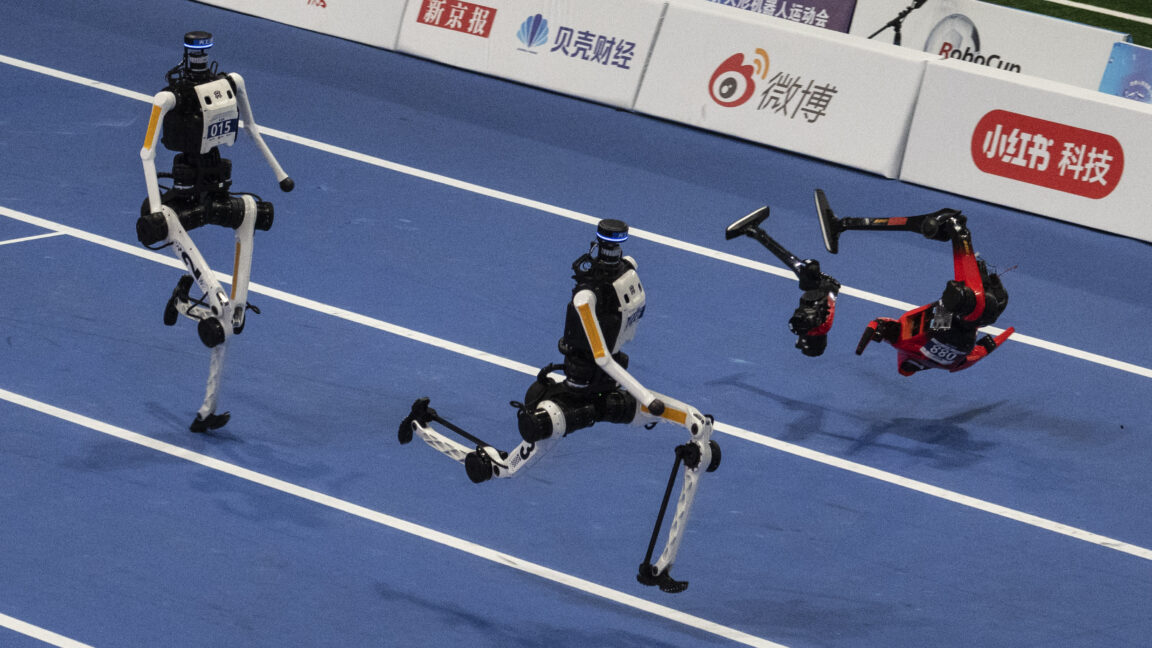
However, the spectacle of speed was frequently undermined by severe stability issues. Viral footage captured sprinting robots crashing into barriers or collapsing after crossing the finish line because they lacked the ability to decelerate safely. Some units suffered structural damage, breaking at the waist in showers of sparks, while others caught fire. These incidents underscore that current models are often engineered for single-task optimization rather than general-purpose autonomy. The machines prioritize completing a specific objective, such as reaching a finish line, over maintaining operational integrity or safety.
Experts note that these specialized designs limit the broader applicability of the technology. Dipam Patel, a computer science PhD candidate at Purdue University and research assistant at the US Army DevCom Army Research Lab, observed that the robots displayed impressive coordination for their designated tasks but remain far from versatile. He emphasized that the engineering push has focused on maximizing performance in isolated scenarios, resulting in machines that excel at one activity but fail to adapt when conditions change or when required to perform secondary actions like stopping.
One notable example of this specialized engineering involved a robot developed by Beijing-based X-Humanoid. The machine won a 400-meter race using an unconventional posture described as resembling a shy person hiding behind their hands. Developers explained that the robot learned through reinforcement learning simulations to shift from a traditional arm-swinging running style to holding its arms near its face and rotating its hips. This unusual gait allowed it to maintain balance and speed in a straight line but would likely be ineffective or unsafe in unstructured environments requiring dynamic interaction with obstacles or people.
In contrast to the high-speed races, the games introduced more mundane challenges designed to test commercial viability. Robots were tasked with household chores such as washing and hanging laundry, folding clothes, and cleaning living rooms. In these scenarios, the machines appeared to operate at speeds significantly slower than typical human workers. The inclusion of these practical tests by organizers, including Chinese state media and the Beijing city government, reflects an effort to demonstrate the potential for humanoid robots in everyday labor markets amid rapid industry development.
Additional practical assessments included hotel service tasks and library management. At the Beijing Continental Grand Hotel, robots attempted to move wheeled luggage to assigned rooms, clean beds, and restock supplies. A separate challenge required machines to collect book returns and shelve them correctly, testing visual recognition and reasoning capabilities. An unscheduled interruption during household chores forced robots to switch tasks to handle a delivery package, further probing their ability to adapt to changing priorities. These events aim to provide more meaningful benchmarks for robotic progress than purely athletic competitions.
A particularly demanding scenario involved an outdoor firefighting and rescue exercise. Teams had thirty minutes to identify hazardous substances, locate and shut off three different types of open valves, spot a fire, and extinguish it using a fire extinguisher. Only three out of twelve competing teams completed the task successfully. This low success rate highlights the difficulties robots face in integrating perception, decision-making, and physical manipulation in complex, high-stakes environments where precision and reliability are critical.
The competition serves as both a technical showcase and a marketing platform for robotics companies seeking investor attention. While viral videos of record-breaking sprints generate public interest, experts suggest that repeated trials would offer better insights into system reliability. Running the same race multiple times would test whether robots possess the software and hardware durability to perform consistently without sustaining damage. As the industry evolves, the focus may shift from flashy athletic feats to robust, safe, and adaptable machines capable of handling the unpredictable nature of real-world tasks.
The disparity between athletic prowess and practical competence indicates that while engineering capabilities have advanced rapidly, significant hurdles remain for widespread adoption. The inability of sprinting robots to stop safely or handle unexpected interruptions suggests that current models are not yet ready for unsupervised deployment in dynamic settings. Future developments will likely need to prioritize safety mechanisms and adaptive control systems alongside speed and strength to bridge the gap between specialized prototypes and general-purpose assistants.
Organizers and researchers alike recognize that meaningful progress requires more than breaking records in controlled environments. The integration of household chores, emergency response simulations, and adaptive task-switching challenges provides a more comprehensive view of robotic capabilities. As China’s robotics industry continues to expand, the emphasis on practical scenarios may drive innovation toward machines that are not only fast but also reliable, safe, and versatile enough to contribute effectively to both industrial and domestic sectors.
Sources behind this briefing
Go to the original reporting
- Ars Technica↗World humanoid robot games show runners breaking records, bursting into flames

