The short version
- Russian ballistic missiles and drones hit Kyiv, killing one person and injuring at least twelve others across multiple districts.
- The assault follows a pattern of intensified exchanges, including Ukrainian strikes on Russian logistics hubs and a deadly drone attack in southern Russia.
- Ukrainian officials are urging international partners to supply additional Patriot missile systems to counter the growing threat from long-range weaponry.
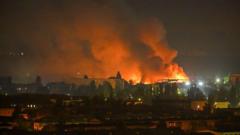
A significant escalation in aerial warfare has unfolded over Kyiv, with Russian forces launching a coordinated barrage of ballistic missiles and unmanned drones against the Ukrainian capital. Authorities report that the assault resulted in one fatality and left at least twelve individuals wounded. The strikes targeted residential structures and industrial warehouses, prompting fears among local officials that civilians may remain trapped beneath debris in the city center. Air raid warnings persisted for more than an hour as waves of projectiles descended upon the metropolis and its surrounding suburbs.
Timur Tkachenko, the head of Kyiv’s military administration, described the operation as a massive enemy offensive aimed at the region. He confirmed that damage was recorded in several key districts, including Bucha, Brovary, and Fastiv. Tkachenko issued urgent appeals to residents to heed air raid sirens and prioritize their safety, emphasizing the immediate danger posed by the ongoing bombardment. The intensity of the attack underscores a shift in Russian strategy, focusing heavily on urban centers rather than solely peripheral military installations.
Vitali Klitschko, the mayor of Kyiv, highlighted the severe humanitarian concerns arising from the destruction. He noted that rescue teams are working to assess the extent of the damage and locate any survivors potentially buried under collapsed buildings. The strikes have disrupted daily life in the capital, reinforcing the vulnerability of civilian populations even as the conflict enters its third year. Local emergency services are overwhelmed by the volume of casualties and structural failures reported across the affected zones.
This latest assault on Kyiv occurs against a backdrop of intensifying reciprocal violence. Ukraine has recently escalated its own operations, targeting critical infrastructure within Russian territory. Notably, Ukrainian forces have struck depots belonging to Wildberries, a major e-commerce company, causing significant disruptions to logistics networks. In the most recent incident involving these targets, five people were killed and ten others injured in the Moscow region. These actions represent a strategic effort by Kyiv to degrade Russia’s economic and military supply chains.
Tensions have further risen following a separate incident in southern Russia, where officials reported that a drone attack on a crowded beach in the Krasnodar region resulted in seven deaths and dozens of injuries. The timing of this event, occurring just before the Kyiv strikes, suggests a coordinated period of heightened aggression from both sides. While Russian authorities attribute the beach attack to Ukrainian drones, the incident has drawn international condemnation and raised concerns about the safety of civilians in non-combat zones.
Conversely, Ukraine has expressed deep outrage over footage circulating online that appears to show a man being pursued by a drone in Kherson. Kyiv officials characterized the video as evidence of a deliberate hunt targeting civilians, describing it as a safari-like operation designed to terrorize the local population. Both Moscow and Kyiv have consistently denied intentionally aiming weapons at non-combatants, maintaining that their operations focus exclusively on military objectives. However, the frequency of civilian casualties continues to fuel accusations of war crimes from both sides.
The strategic implications of these events are profound, particularly regarding air defense capabilities. Ukrainian leadership has urgently requested additional US-made Patriot missile interceptors from allied nations. These systems are critical for countering the high-speed ballistic missiles that have proven difficult to stop with existing defensive measures. The shortage of advanced anti-aircraft technology leaves Kyiv exposed to repeated strikes, limiting its ability to protect infrastructure and save lives during large-scale attacks.
As the conflict evolves, the line between military necessity and civilian protection continues to blur. The destruction in Kyiv serves as a stark reminder of the human cost of prolonged warfare. With both sides engaging in increasingly bold operations, the risk of further escalation remains high. International observers are closely monitoring the situation, hoping for diplomatic breakthroughs while acknowledging the grim reality on the ground. The coming days will likely see continued volatility as each side seeks to gain tactical advantages.
Sources behind this briefing
Go to the original reporting
- BBC World↗Russian ballistic missile strike on Kyiv kills one and injures others