The short version
- Researchers analyzed Tomb 209 in Thebes to understand how burial customs changed from the 25th Dynasty through the Ptolemaic period.
- The study found a shift from individual, coffin-based burials to dense reusing of spaces with superposed bodies and fewer artifacts.
- Despite increased density, the arrangement of remains suggests deliberate spatial logic rather than chaotic accumulation or ritual loss.
A recent archaeological study provides new insight into how funerary practices in ancient Egypt evolved over several centuries. Researchers focused on Tomb 209, located in the western necropolis of Thebes, a region containing more than four hundred known tombs. The site offers a unique window into changing burial trends because it was used repeatedly across different historical periods, allowing scientists to observe shifts in how bodies were treated and arranged.
The tomb originally belonged to Nisemro, likely a high-ranking official of Nubian descent, during the early 25th Dynasty, which spanned from 754 to 656 BCE. The site remained in use until it was abandoned during the Ptolemaic period, roughly between 305 and 30 BCE. Its location within an active drainage channel of the Wadi Hatasun made it susceptible to repeated flash flooding, creating a complex stratigraphic record that preserved evidence of multiple phases of occupation and reuse.
The research team employed what they describe as an integrated archaeothanatological approach. This method combines data on body positioning, coffin usage, and the layering of remains with osteological analysis to reconstruct the chronological sequence of burials. The team concentrated their efforts on Side Chamber 3, a secondary area of the tomb that had remained largely undisturbed by later intrusions or natural disturbances.
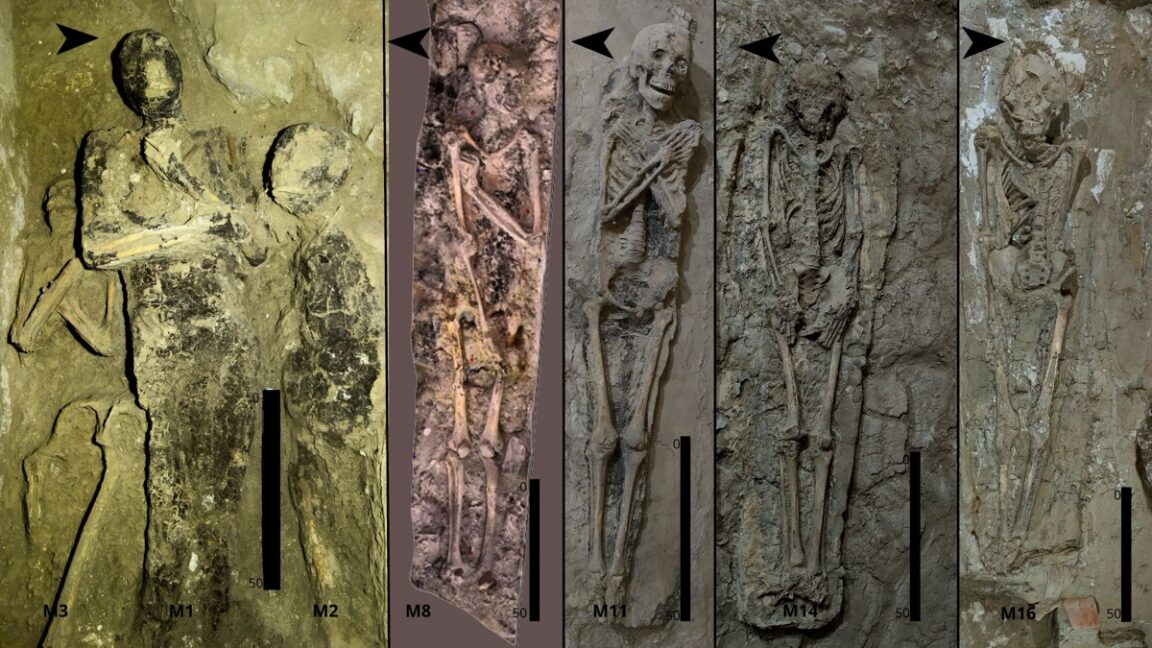
Excavations in this chamber revealed sixteen mummified individuals, comprising 1,444 bones, along with one mummified dog. Additionally, another chamber contained disarticulated remains consisting of 1,775 bone fragments from at least four other people. The detailed examination of these bodies challenged assumptions that later reuse of tombs resulted in chaotic accumulation or a decline in ritual significance.
Instead, the researchers identified a clear spatial logic in how new depositions were adapted to existing bodies. This suggests a form of funerary memory, where each new burial was carefully placed with respect to previous occupants. The earliest burials from the 25th Dynasty involved individual interments, often separating men and women, though the authors caution against overinterpreting this gender separation. These early individuals were buried in elaborate coffins and accompanied by costly items such as Phoenician amphorae, incense cups, amulets, and beads.
As time progressed into the late 25th Dynasty and through the Persian phase, burial practices shifted significantly. New bodies were placed in areas already occupied by earlier mummies, leading to increased density and vertical superposition of remains. There was a notable decline in the use of coffins during these later stages. Some coffins were dismantled or had degraded, while others were simply not used at all. This change reflects a broader reconfiguration of the Egyptian funerary system.
The authors suggest that as burial spaces became denser and older structures were reused, coffins could no longer serve as the sole organizing framework for burial space. The focus appears to have shifted toward the integrity of the body itself and the symbolic efficacy of the ritual, rather than the container. Later burials featured bodies with arms folded in, contrasting with the outstretched arms seen in earlier phases. Artifacts also became more dispersed in later stages.
The site also showed evidence of substantial reworking, including accumulated silts, sands, gravels, limestone blocks, plaster, and ceramics. Some of this displacement was likely due to human intervention, while other changes may have resulted from flooding. One chamber containing fragmented remains showed signs of exposure to extreme heat, reaching temperatures as high as 550 degrees Celsius, which damaged the crania and lower limbs. This finding adds another layer of complexity to the tomb's history.
The study highlights that approximately eighty percent of Theban tombs from the first millennium BCE contain remains from different time periods in shared spaces. This widespread practice of reuse underscores the dynamic nature of ancient Egyptian burial customs. By examining Tomb 209, researchers have been able to trace these changes in detail, offering a clearer picture of how societal and religious priorities evolved over centuries.
Future research may expand on these findings by analyzing other tombs in the region with similar histories of reuse. The integrated approach used in this study provides a model for understanding the chronological sequence of burials in complex archaeological sites. As more data becomes available, scholars hope to further refine their understanding of how ancient Egyptians navigated the practical and spiritual challenges of death and remembrance.
Sources behind this briefing
Go to the original reporting
- Ars Technica↗Theban tomb reveals how Egyptian burial trends evolved in time
